Invasion Go-ahead - The build-up to invasion started
when Britain protested about the landing on South Georgia.
With talks on the
future of the Falklands stalled, Argentina reacted
strongly and by the 26th March,
two frigates were on their way south, and more ships had
put to sea ostensibly for exercises with the Uruguayan
Navy. But it seemed that only now was the final decision
taken to invade and they headed for Stanley although bad weather delayed their
arrival. By Wednesday 31st March, British intelligence had to assume
landings were imminent, Governor Hunt
was warned, and next evening he announced
over the radio that invasion was expected early on Friday 2nd April.
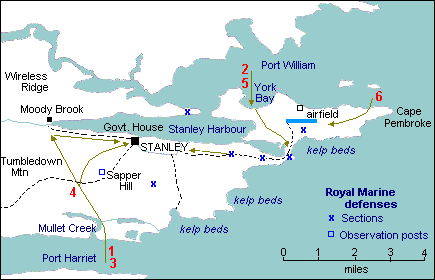
Defences - Before the broadcast took place, the
defence of Stanley was already being put in hand by the small Falklands
garrison of Naval Party 8901. Usually consisting of just
40 Royal Marines, the remaining members of the 1981/82
Detachment (others had left with "Endurance"),
had only been relieved that day by
Major M J Norman
(MID)
RM and his 1982/83 Detachment. Assuming
the main landing would
be near the airfield followed by an
advance on Stanley, he deployed his 70 men accordingly,
and positioned four delaying sections on the Stanley road
ready to fall back on the main HQ at Government House. By
the early hours of Friday, they were mostly in position
and the small coaster "Forrest" was out in Port
William on radar watch.
Landings
around Stanley, Friday 2nd April - The plan was for the Buzo
Tactico to attack both the Royal Marine barracks at Moody Brook and
Government House to force a surrender, supported if
necessary by men of the 2nd Marine Infantry Battalion
landed from ships of Task Group 40.1. Once the airfield
was in Argentine
hands, the Army garrison would then fly in. The first
landings were before midnight with a Buzo Tactico party going ashore from
destroyer "Santisima Trinidad" to secure
Mullet Creek, followed early on Friday morning by a smaller group from submarine
"Santa Fe" to check out the main landing beach north of Stanley.
Reports now started
reaching the defenders about the presence of Argentine
ships, and at 4.30am, more
Buzo Tactico landed at
Mullet Creek apparently from Sea
King helicopters embarked on icebreaker "Almirante
Irizar". Most of them headed for the by now empty
barracks at Moody Brook while the rest passed quietly
below Sapper Hill on their way to Government House. As
they approached their objectives the destroyers and
frigates of TF 40 took up support and escort positions
and the LST headed in for the unguarded beach at York
Bay.
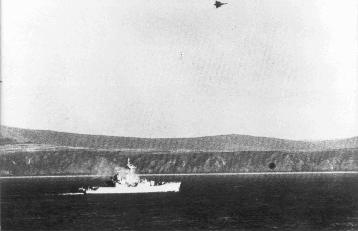
Less
than eight weeks after the invasion,
an Argentine Mirage was attacking a
British frigate in San Carlos Water
Attacks - From 6.00am the main attacks and supporting landings
got underway. The larger body of Buzo Tactico hit Moody Brook and
then headed east for Government House which by then was under fire from the
smaller group. Around 6.30am, the first of some 20 LVTP-7 Amtraks with
20 Marines each inside were landing from "Cabo San
Antonio" and by 6.45am more troops were coming
into the airfield
by helicopter. As the off-balanced Royal Marine defenders
fell back on Government House, one of the sections on the
Stanley road stopped an Amtrak with anti-armour weapons.
British
Surrender -
With daybreak and Government House surrounded, under sniper fire and the
Amtraks approaching, Governor Hunt attempted to negotiate. Faced with the
overwhelming forces
at Adm Busser's
disposal, he ordered the Marines to lay down
their arms, which they did at 9.30am without having suffered any
casualties. The Argentines only admitted to one dead and
others wounded. That evening, Governor and Mrs Hunt
and most of the Royal Marines and
the few men from "Endurance" were flown out.
Major Norman and
his men were back in Stanley 76 days later with J Coy, 42 Cdo RM.
Argentine
Reinforcements -
Before the surrender, the Army garrison, mainly from the
25th Infantry Regt was flying in. Another early arrival
by Hercules was an AN/TPS-43F surveillance radar which
became the centre of Argentina's command, control and
communications structure at Stanley right through until the
end of the war. Now Lieutenant General Osvaldo Garcia
took over as Commander, Malvinas Operational Theatre, but as Britain's military
response became clearer, the command was relocated to
Argentina to cover the South Atlantic as a whole. Then on
Wednesday
7th April,
Major General Mario
Menendez was appointed
commander-in-chief as well as military governor, the same
day Britain announced a 200 nautical mile maritime exclusion
zone (MEZ) around the
Falklands to take effect from the 12th April.
By Monday 5th April following the landings, the
invading warships were returning to port, although some
of the naval transports were used in the build-up, and
after the MEZ came
into force the blockade was run by fleet transport
"Bahia Buen Suceso" and merchantmen
"Formosa" (12,800 grt) and "Rio
Carcarana" (8,500 grt). Most of the aircraft
destined to be lost on the islands flew over although
some of the helicopters were air-lifted, and Coast Guard
patrol craft "Islas Malvinas" and "Rio
Iguaza" reached Stanley for local duties.
Occupation - The
occupying forces were soon imposing their rules and
regulations on the Islanders, many of whom got out of
Stanley to the "Camp". Coasters
"Forrest" (144 grt) and "Monsunen"
(230 grt) were requisitioned
together with a number of civil aircraft, some of which
were lost in the subsequent bombardments. By the end of the month, as the British Task Force drew
near, air raid precautions were introduced and a curfew
and black-out was in force. A number of people were
rounded up, some deported, and others confined, sometimes
as at
Goose Green in poor conditions.