Sea
Harriers - Lacking
fleet carriers and with the Falklands less than 500 miles
from Argentine, the Navy had to provide the only possible
air cover with its few Sea Harrier FRS.1 jump-jets
armed with
30mm Aden cannon, the
lethal AIM-9L Sidewinder AAM for combat air patrol,
and
cluster bombs for ground attack.
Including those
transferred from No.899 HQ Training Squadron, 12 were scraped together for
"Hermes'" No.800 and 8 for "Invincible's"
No.801 NAS. Thus 20 aircraft, some piloted by the RAF,
had to defend the Fleet against 100 plus Argentine
attackers. Only in mid-May were they reinforced by
Harriers eight more Sea of No.809 NAS (plus six
RAF GR.3's). Just six Navy Harriers were lost by accident or ground
fire, and not one in air-to-air fighting.
 Sea Harriers of, from top, Nos
899, 801,
800 NAS (Courtesy - RNAS Yeovilton)
|
|
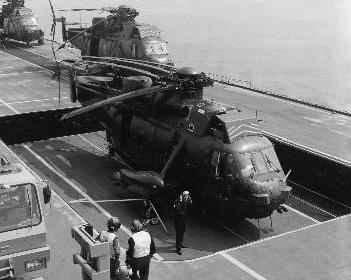 Sea King Mk 5 of 820 NAS on
"Invincible"
class carrier HMS Illustrious (Courtesy - MOD,
Navy)
|
| |
|
|
Helicopters
- The rest of
the Navy's airpower came from its numerous helicopters,
although three more squadrons had to be reformed to
support the land forces in their later drive on Stanley. Flying mainly from the warships and
RFA's, they carried out transport and vertical
replenishment (vertrep) duties, special forces landings
and naval gunfire support, and anti-submarine and
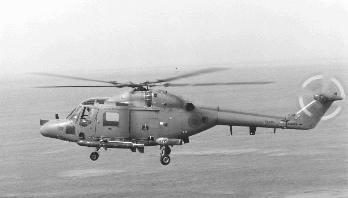
anti-ship missions, the latter by Sea Skua-equipped Lynx.
But not airborne early warning which was sadly lacking.
Some transferred from ship to ship, including the
merchantmen, and many later went ashore on the Falklands.
In all, 17 helicopters were lost - five Sea Kings by accident, two Wessex on South Georgia, six Wessex and a Lynx went down with "Atlantic
Conveyor", one Lynx each with "Ardent" and
"Coventry" and last of all a Wessex destroyed on Exocet-hit
"Glamorgan". Helicopter types, Naval Air
Squadron and Main Roles were:
SEA KINGS
No.820 - 11 HAS.5's on "Invincible"
for ASW,
No.824 - 5 HAS.2A's on RFA's, 2 at
Gibraltar,
No.825 - Reformed Squadron of 10 HAS.2A's
reached Falklands late May in support role,
No.826 - 9 HAS.5 's on "Hermes" for
ASW,
No.846 - 15 HC.4 Assault, including 9
initially on "Hermes", 3 on
"Fearless" and 1 on
"Intrepid"
WESSEX
No.737 - 2 HAS.3's on County class
destroyers,
No.845 & No.848 (reformed NAS) - 30
HU.5's before end of war on RFA's,
"Intrepid", carried on
"Atlantic Conveyor" (6) and at
Ascension (1),
No.847 - Reformed Squadron of 24 HU.5's
reached Falklands early June in support role
LYNX
No.815 HAS.2's on destroyers and frigates
WASP
No.829 HAS.1's on Rothesay frigates and small
ships
|
|