 |
|
Battle Atlas of the Falklands War 1982
EARLY BRITISH TASK FORCE
MOVEMENTS
(Parts 17-19)
Part 19. ASCENSION
ISLAND -
Stepping Stone to Victory |
|
|
|
|
|
|
|
see also
Passing
Through Ascension
a Photographic record of People, Places, Ships and Planes
at Ascension Island during the Falklands War |
|
|
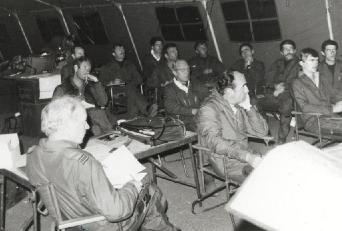
British
Forces Support Unit Ascension Island
Summary of Main
Roles
ROYAL AIR
FORCE DEFENCES
Surrounding area - Nimrod maritime reconnaisance aircraft
from early April.
Local air defence
-
three Harrier GR.3's of 1(F) Sqdn from
early May until relieved later in the
month by three Phantom FGR.2's of 29(F)
Sqdn. RAF-manned mobile early warning
radar on Green Mountain.
Ground defence - HQ Unit, No.3
Wing and No.15 Field Sqdn, RAF
Regiment.
Other RAF Units - one 202 Sqdn Sea
King and one 18 Sqdn Chinook helicopters
for vertrep duties from early May. Also
air movements, mobile servicing, tactical
communications and meteorological units.
ARMY
included:
Royal Corps of Signals - established rear
link Communications Centres for the Task
Force.
Royal Engineers - constructed 3½
mile fuel pipeline system to the airfield
along with 180,000 gallon bulk fuel
storage, and a desalination plant.
Royal Army Ordnance
Corps - operated the pipeline
system capable of delivering up to
300,000 gallons each day.
Royal Corps of
Transport - 47 Air Despatch Squadron
prepared stores for air dropping.
ROYAL NAVY
Naval Party 1222 - arrived in early
April to receive men, stores, equipment,
and helicopters flown out from Britain
and to arrange for transhipment south.
Fleet Air Arm - maintenance
personnel prepared the arriving
helicopters
No.845 NAS - one Wessex HU.5
of D Flt, provided vertrep and crossdeck
delivery services together with the two
RAF
helicopters which arrived
later.
|
| |
|
| |
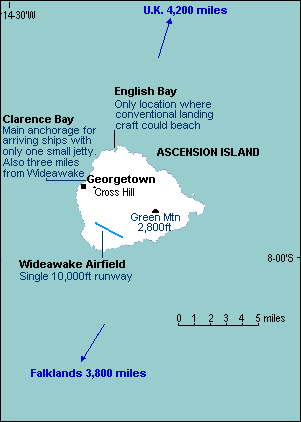
Geography
- Located at position
07.56' South, 14.22' West, 4,200 miles (3,700 nautical)
from Britain and 3,800 (3,300 nautical) from the
Falklands, Ascension
was vital to the success of the Task Force. Close to the
equator, but not unbearably hot, the 38 square mile
island is a product of the mid-Atlantic ridge and
completely volcanic in origin. In effect a mountain peak
rising out of the sea, it is covered by sharp rock and
extinct cones of dust and clinker. The highest point of Green Mountain is covered by the only tropical
vegetation and trees in a largely barren landscape devoid
of water and shelter. Surrounded by the almost continual
swell of the South Atlantic, there are no natural
harbours and only a single jetty at Clarence Bay and a small landing cove at English Bay. Amongst the abundant wildlife
around the island is the sooty tern or wideawake.
History
- Discovered in 1501, presumably on Ascension Day, the
island remained uninhabited until the early 19th century,
when with Napoleon exiled to nearby St Helena, a small
Royal Navy garrison was established. Until 1922, the Admiralty was in control but
then Ascension became a dependency of St. Helena with the
Administrator appointed by Britain. Wideawake airfield
was built in World War 2 as a staging post between Brazil
and Africa and had since been developed by the Americans
and the single runway extended to over 10,000 feet to
take heavy transport aircraft. With only a few movements
each week, it mainly served the US satellite and missile
tracking facilities and British submarine cable and
satellite relay stations. American-controlled and
operated by Pan American Airways, British aircraft
normally had to give 24 hours notice of use, but during
the war this requirement was waived. The population
consisted solely of contracted employees and their
families from St. Helena, Britain, South Africa and the United States,
and at the last census totalled 1,051. The capital is Georgetown. By 1982 the associated islands of
St.
Helena, Ascension and Tristan da Cunha were one of the few Colonies remaining to
Britain. With the use of Simonstown in South Africa ruled
out for obvious political reasons, Ascension Island with
its airfield was the only possible forward base. But one
nearly 4,000 miles from the scene of action.
|
| |
 |
|
 |
| |
|
|
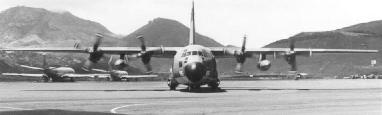
RAF Hercules at Wideawake
Airfield gives an indication of the volcanic
terrain of Ascension Island (Courtesy - MOD, RAF)
|
|
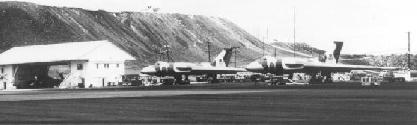
Another view of Wideawake and
the terrain, this time with Vulcan bombers on the
tarmac (Courtesy - MOD, RAF)
|
|
| |
Role - Even then
Ascension was invaluable. The Task Force
could not be completely self-contained and a lot of men
and supplies had to be ferried out to the South Atlantic
by a constant stream of RAF Hercules and VC.10's,
chartered freighters and mainly undisclosed American
aircraft bringing in such stores as the latest Sidewinder
AAM's. These were either delivered to the ships as they
called in or passed by, or in urgent cases, air-dropped
to them on the way to the Falklands or South Georgia. Few
ships spent much time there although most of the Amphibious
Task Group with 3 Cdo Bde did stay to prepare
for the coming landings. In the case of the troops, only
limited preparation was possible as there was no room for
large scale manouevres other than marching, although they
were able to train on the rapidly constructed firing
ranges and practice disembarking from the troopships by
helicopter and landing craft. More importantly, the
opportunity was taken for the hastily loaded ships to
re-distribute some of their stores to other ships, to
receive much needed supplies from the UK, and where
possible to "combat load" for an amphibious
landing. Much of the necessary "cross decking"
was carried out by the helicopters with their vertical
replenishment capabilities, but also taking part were the
Navy landing craft, Royal Corps of Transport Mexeflotes
(pictured below), and locally hired lighters. In all
this movement there were major logistical problems.
Wideawake had one runway and limited dispersal areas and
helicopters could only land there because of the volcanic
dust, there was no port, and the one jetty was three
miles away and not always useable because of the Atlantic
waves.Ascension was
also the main base for RAF operations in
support of the Task Force. Usually refuelled in the air
by a great number of Victor tanker sorties, air attacks
on Stanley, reconnaissance, airdrops, and SAR were
carried out by the resident Vulcans, Nimrods and
Hercules. Added to all the helicopter and transport
movements, these made Wideawake one of the busiest airfields in the world
with up to 400 movements of all types each day.
Responsible for this array
of activities was the British Forces Support Unit
Ascension Island commanded by Capt R. McQueen (awarded CBE) RN. Involving all three services,
some 1000 men, occasionally rising to 1500 did everything
needed to support the Task Force, work the airfield in
cooperation with the resident Americans and defend the
island against possible attack by Argentine forces. In
general the RAF was
responsible for airfield operations and both air and
ground defence, the Army built
and manned the necessary additional facilities, and the Navy [NP 1222, Cmdr G A C Woods (OBE) RN] operated a forward logistical
base for the Task Force ships.
So important to the morale
of the men taking part as well as the operation of the
Task Force was the efficient handling of the vast amounts
of private and official mail passing through the island.
Although involving all services, the Royal
Engineers Postal and Courier Service [WO1 R G
Randall
(MBE) RE] handled up
to 2 tons of airmail daily and 1000 bags of parcels each
week
.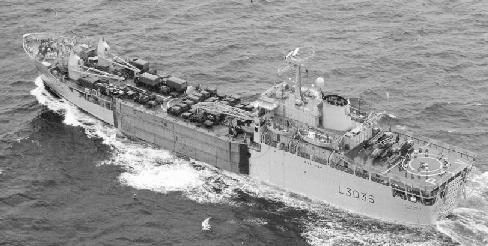
Landing Ship
Logistics RFA Sir Percivale heading south. Lashed alongside is a
"Mexeflote". On the stern are three
Royal Marine Gazelle helicopters
(Courtesy - MOD, Navy)
|
| |
|
|
| |
|
on
to 20. 3 Cdo Bde approaches Ascension
or back to
Falklands War HomePage
revised
31/5/13 |
|