for more
information
January 1919
Far Eastern Waters -
British armoured cruiser 'Kent' arrived at
Vladivostok in Siberia to support Allied forces
April
Russia - Guns
and guns’ crews landed from the 'Kent' at
Vladivostok were by now in action far to the west
in the Urals in support of the White Russians.
May
Caspian
Sea
21st -
Bolshevik destroyer MOSKVITYANIN (1906,
570t, 2-11pdr, 3tt). The Bolsheviks organised a
naval force including old destroyers transferred
from the Baltic for operations on the inland
Caspian Sea. In action against an improvised
British Caspian Flotilla armed with 4in and 6in
guns to the northeast off Alexandrovsk, several
Russian ships were sunk including the
'Moskvityanin'.
June
Arctic
Waters
24th - British
minesweeper 'SWORD DANCE' (1918, 290t,
1-6pdr). As Allied operations continued against
the Bolsheviks on the Dvina River, south of
Archangel, the shallow-draught 'Sword Dance' was
sunk by Russian mines.
Baltic
Sea
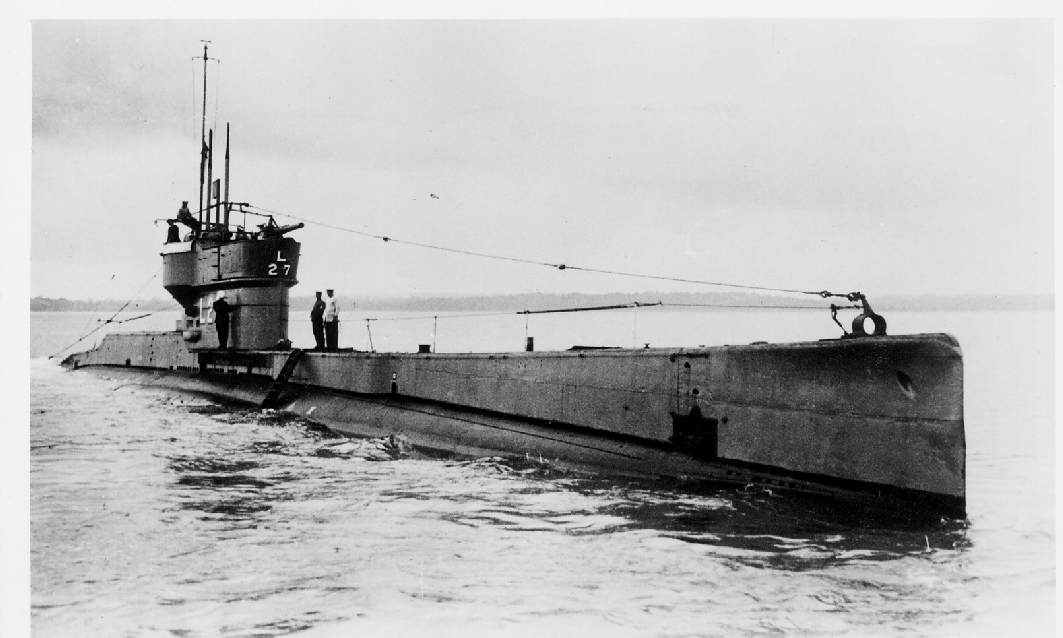
4th - British
submarine 'L.55' (1918, 960t, 6-21in tt,
2-4in). With the British Baltic Squadron
blockading the Bolshevik naval base of Kronstadt
on Kotlin Island laying off Petrograd, warships on
both sides were lost. On the 4th (some accounts
say the 9th) 'L-55' was in action with Russian
patrols and sunk by the gunfire of destroyers
'Azard' and 'Gavriil'. She was later raised and
commissioned into the Soviet Navy as 'L-55' (above
- sister boat L.27, NavyPhotos).
16th/17th -
Bolshevik light cruiser 'OLEG' (1904,
6,600t, 16-5.1in). British light forces based on
the north side of the Gulf of Finland in Finnish
waters sailed to attack Kronstadt. Evading the
protecting destroyer screen, coastal motor boat
'CMB-4' (Lt Agar) armed with a single 14in
torpedo, sank the anchored 'Oleg' during the night
of the 16th/17th, but most of her crew were saved.
'CMB-4' escaped safely under heavy fire. Lt
Augustine Agar RN was awarded the Victoria Cross.
.....
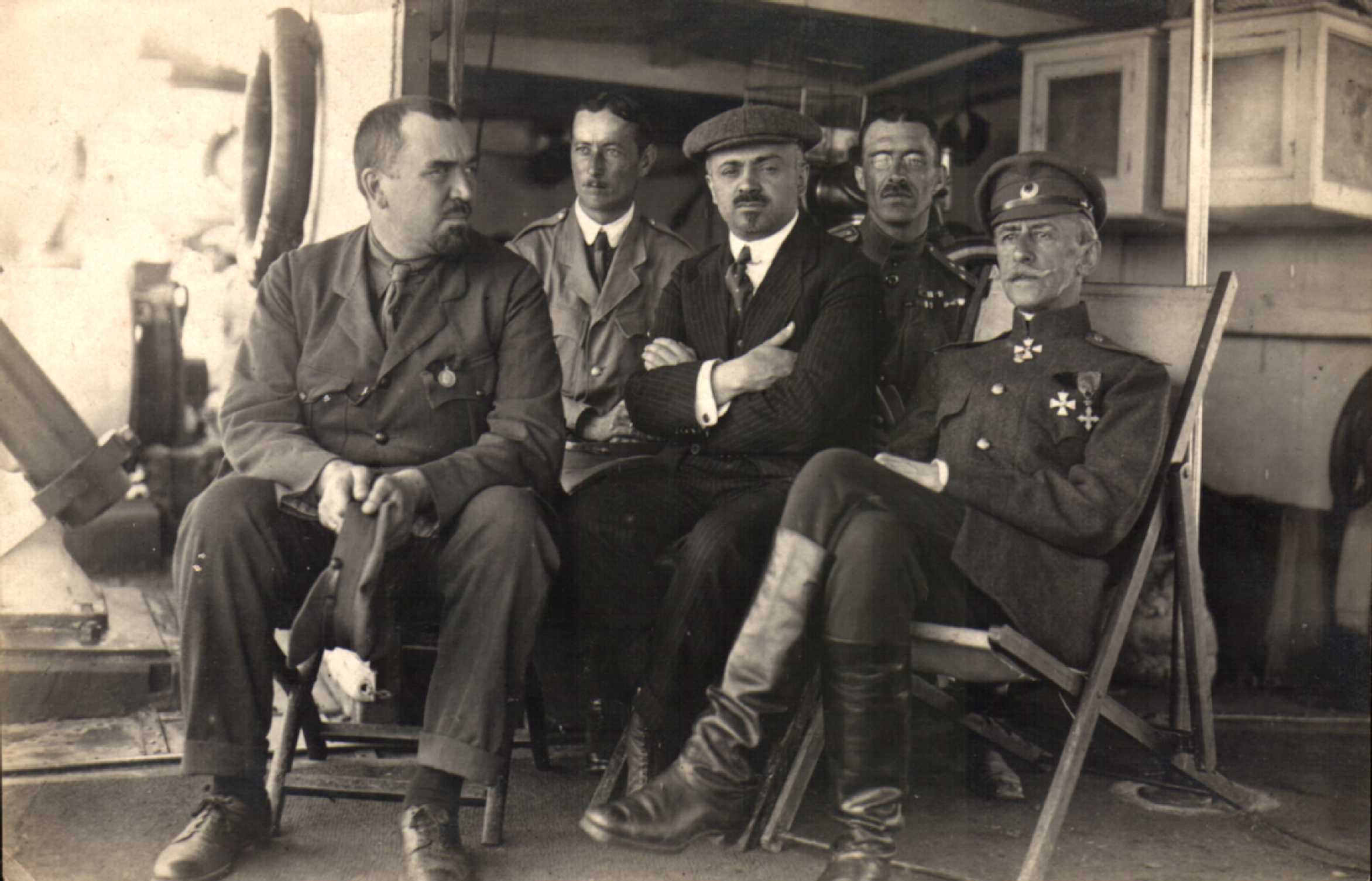
the aftermath of the Russian Revolution
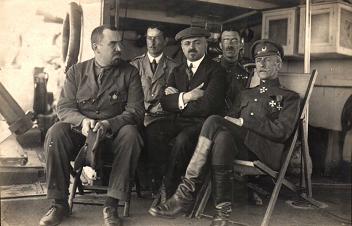
on
the reverse
- "Group of Russian Royalist Officers took
passage in HMS Forester passing Black Sea,
landed at Sverlina, Roumania. Sat. June
21st 1919" (with thanks to
Frederick
Appleby)
July
Arctic
Waters
3rd - British
minesweeper 'FANDANGO' (1918, 290t,
1-6pdr). In operations on the Dvina River,
'Fandango', sister ship of 'Sword
Dance' lost a
few days before, was also mined and sunk.
Baltic
Sea
16th - British
fleet sweeping sloops 'GENTIAN' and 'MYRTLE'
(both 1916, 1,250t, 2-4.7in). With the Bolshevik
bases defended by dense minefields, two more
British ships were lost on mines in the Gulf of
Finland.
August
Baltic
Sea
17th/18th
- Attack on Kronstadt Naval Base - Late on
the 17th, eight British 55ft type Coastal Motor
Boats led by Cdr Claude Dobson in 'CMB-31' headed
out of the Finnish base of Bjorko Sound only 30
miles from Russia's main naval port. Supported by
RAF bombing raids, they broke into the inner
harbour in the early morning. Cdr Dobson directed
the boats headed by CMB's '31', '79' and '88'. Lt
Agar VC in 'CMB-4' remained outside on guard.
As the attacks
developed, old armoured cruiser 'PAMIAT AZOVA'
(1890, 6,000t) serving as submarine depot ship
'Dvina' was hit by 'CMB-79' and sunk. In the
rapidly moving action, 'CMB-79' (1917,
11t, 1 or 2-18in torpedoes) was then lost. The
commanding officer of 'CMB-88' was killed and Lt
Steele, second-in-command took over and pressed
on. Accounts vary, but both Dobson's 'CMB-31' and
Steele's 'CMB-88' appear to have made one hit each
on the two biggest ships. Dreadnought 'PETROPAVLOSK'
(1914, 24,000t, 12-12in) sank in shallow water and
was salvaged later, and pre-dreadnought 'Andrei
Pervozvanny' (1908, 17,400t, 4-12in)
seriously damaged. The British boats failed to hit
the Russian guardship, destroyer 'Gavriil' which
sank two more of the attackers ('CMB-24'
and 'CMB-62' or 'CMB-67' -
accounts vary. The surviving five boats escaped.
Cdr Claude Dobson DSO, RN and Lt Gordon Steele RN
were awarded the Victoria Cross.
September
Baltic
Sea
1st - British
destroyer 'VITTORIA' (1,100t, 4-4in,
4-21in tt). Two recently completed 'V' class
destroyers of the Royal Navy were sunk within a
few days of each other in the Gulf of Finland. On
the night of the 1st, 'Vittoria' was torpedoed by
Bolshevik submarine 'Pantera' off Seiskari Island
some miles to the west of Kronstadt.
4th - British
destroyer 'VERULAM' (1,100t, 4-4in, 4-21in
tt). Three days later "Verulam" was mined in the
Gulf of Finland.
Arctic
Waters
16th - British
monitors 'M-25' and 'M-27' (both
1915, 540t, 1-9.2in). By now the Allies had
decided to withdraw from northern Russia. As the
evacuation got underway, 'M-25' and 'M-27' of the
White Sea Squadron had to be abandoned when the
Dvina River water level fell. They were blown up
to prevent capture by the Bolsheviks.
October
Baltic
Sea
21st October -
Russian destroyers 'GAVRIIL', 'KONSTANTIN' and
'VLADIMIR' (1916/17, 1,260t, 4-4in, 9-18in
tt). As four Russian destroyers of the same class
escaped from the Bolsheviks, three were lost in a
British minefield off Kronstadt in the Gulf of
Finland with heavy casualties. Only 'Azard'
escaped. The ships were to be handed over to the
Royal Navy.
SUMMARY
OF BRITISH LOSSES
In April 1918, seven
submarines had to be scuttled. Between December
1918 and September 1919 - just nine months -
additional British losses amounted to:
1
light cruiser
2
destroyers
2 small
monitors
1 submarine
4
minesweepers
3 coastal
motor boats