1943
JANUARY
1943
Burma - The First
Arakan campaign continued as Indian troops
tried to
move on Akyab.
Monthly Loss Summary:
Pacific Ocean only
- 2 merchant ships of 9,000 tons
|
PROSPECTS
FOR ALLIED
VICTORY - The Russians
gained a famous victory
with the German surrender at
Stalingrad in January 1943. Taken
with the October 1942 British Battle
of
El Alamein and
June 1942 American Battle of Midway,
the three Allied
successes are usually considered as
marking the
turning point in the 40 month old
war against the
Axis powers. The Battle for
Guadalcanal, ending as it did
Japanese
hopes of controlling the South West
Pacific
should also be added to this
roll-call of
victory.
|
FEBRUARY
1943
Burma - Col
Orde
Wingate mounted the first Chindit Operation
behind
Japanese lines, northwest of Lashio. Success was
limited,
losses heavy and the survivors started to
withdraw in
late March 1943. In the south-west, the Arakan
Offensive failed to make any progress.
Monthly Loss Summary:
Indian Ocean - 3
merchant ships of 16,000 tons
MARCH
1943
Burma - In the
Arakan the Japanese went over to the attack and
pushed
back the British and Indian forces which by
mid-May 1943
were back in India. The first of three Allied
Arakan
campaigns was a failure.
Monthly Loss Summary:
Indian Ocean - 10
merchant ships of 62,000 tons
APRIL
1943
Monthly
Loss
Summary: Indian Ocean - 6 merchant ships of
43,000
tons
MAY
1943
Merchant Shipping
War -
Adm Somerville's Eastern Fleet had lost its
remaining
carrier, two battleships and many smaller
vessels to
other theatres. An inadequate anti-submarine and
escort
force was left to deal with the submarines
active in the
Indian Ocean. Japanese boats were again joined
by German
U-boats, and right through until December 1943
not many
more than a dozen German and Japanese boats
inflicted
quite heavy losses throughout the length and
breadth of
the Indian Ocean. Between June and year's end
they sank
over 50 merchantmen. (May 1943 was the
month that saw
the Victory of the Escorts in the Battle of
the Atlantic)
Monthly Loss Summary:
Indian Ocean - 6
merchant ships of 28,000 tons
Indian
Ocean Merchant Shipping
Losses, January 1942 to May 1943
Total 230
British and Allied ships of 873,000 tons
JUNE
1943
Monthly
Loss
Summary: Indian Ocean - 12 merchant ships of
68,000
tons
JULY
1943
Monthly
Loss
Summary: Indian Ocean only - 17 merchant ships
of
97,000 tons
AUGUST
1943
Australia
- John Curtin was re-elected Prime Minister and
the
Labour Party returned to power.
Merchant
Shipping
War - As Axis submarines continued to take
a
toll of Indian Ocean shipping, German "U-197"
was
sunk by RAF aircraft
off Madagascar
on the 20th, the first of two lost in the Indian
Ocean in
1943.
Monthly
Loss
Summary: Indian Ocean - 7 merchant ships of
46,000
tons
SEPTEMBER
1943
SOE
Raid
on Singapore - Working for Special
Operations
Executive, a small group of Australian and
British
servicemen were carried from Australia in an old
fishing
vessel, and on the night of the 24th/25th
penetrated
Singapore harbour in canoes. Several ships were
sunk. In
a similar raid in September 1944 the attackers
were
captured and executed.
Monthly
Loss
Summary: Indian Ocean - 6 merchant ships of
39,000
tons
OCTOBER
1943
Merchant
Shipping
War - RAF aircraft sank their second
U-boat
of 1943 in the Indian Ocean with "U-533" on the
16th in the Gulf of Oman.
Monthly
Loss
Summary: Indian Ocean - 6 merchant ships of
26,000
tons
NOVEMBER
1943
12th
-
On patrol off Penang, Malaya in the Malacca
Strait,
submarine "Taurus" sank the Japanese "I-34"
sailing on a supply trip to
Europe.
Monthly
Loss
Summary: Indian Ocean - 4 merchant ships of
29,000
tons
DECEMBER
1943
Burma
- Under Adm Mountbatten, Supreme Allied
Commander South
East Asia, Gen Slim's 14th Army prepared for a
major
offensive into northern Burma from the area of
Kohima and
lmphal in India. Preceding this would be a Second
Arakan
campaign to the south, and in the far
north a
parallel Chindit and American/Chinese operation
in part
to open a new route to the Burma Road from Ledo
in India.
The Arakan push started late in December.
Throughout the
rest of the war, Adm Mountbatten's plans to
prosecute the
campaign even more vigorously in South East Asia
were
continually frustrated by his lack of amphibious
capability.
Monthly
Loss
Summary: Indian Ocean - 5 merchant ships of
31,000
tons
1944
JANUARY
1944
Indian Ocean
Operations
- Late in the month the British Eastern
Fleet was
considerably strengthened by the arrival of
capital ships
"Queen Elizabeth", "Valiant",
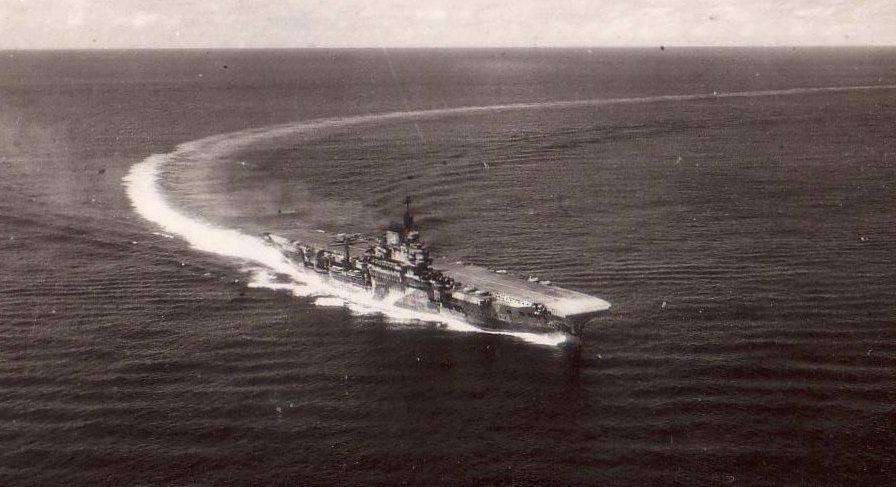
"Renown" and carriers "Illustrious"
and "Unicorn", cruisers and destroyers. To date
only the Ceylon-based submarines had been
available to
carry out offensive operations in the Indian
Ocean, and
in January they had two successes against
Japanese light
cruisers of the 'Kuma' class, both off Penang in
the
Malacca Strait. On the 11th "Tally Ho"
(Lt-Cdr L. W. A. Bennington) sank the "KUMA".
Two weeks later
"Templar" damaged "Kitakami".
Monthly Loss Summary:
Indian Ocean - 8
merchant ships of 56,000 tons
FEBRUARY
1944
11th - As
German
and Japanese submarines continued to attack
Allied
shipping in the Indian Ocean, two Japanese boats
were
sunk, but in the second case only after the loss
of many
lives. First "RO-110" attacked a
Calcutta/Colombo convoy in the
Bay of Bengal and was sunk by the escorts -
Indian sloop
"Jumna" and Australian minesweepers
"Ipswich" and "Launceston".
12th - Off
Addu
Atoll "I-27" attacked a five-ship troop convoy
bound for Colombo from Kilindini in East Africa,
and
escorted by old cruiser "Hawkins" and
destroyers "Paladin" and "Petard".
Transport "Khedive lsmail" went down with over
1,000 men, but "I-27" was hunted and sunk by the
two destroyers.
14th - On
patrol in
the Malacca Strait, submarine "Tally Ho" had
another success (the other was cruiser "Kuma"
the month before) by sinking German ex-Italian
submarine "UIt-23" bound for Europe with cargo
from
the Far East.
Burma - The
Arakan
offensive to the south was slowly progressing
when early
in the month the Japanese started their own
attack,
outflanking and surrounding the British and
Indian
troops. Supplied by air they held out and by
June 1944
were established on a line north of Akyab, where
they
stayed through the monsoon until December.
Monthly Loss Summary:
Indian Ocean - 10
merchant ships of 64,000 tons
MARCH
1944
March -
Submarine "STONEHENGE"
sailed
from Ceylon
for patrol
in the area between Sumatra and the Nicobar
Islands. She
was overdue on the 20th, cause of loss unknown.
Burma - In
the
north, as one Chindit group marched from
Ledo into
Burma, a second one was airlifted to a position
northeast
of lndaw on the 5th. US Gen 'Vinegar Joe'
Stillwell and
his Chinese forces also left from near Ledo and
started
their own march into Burma heading for
Myitkyina. Behind
them the new Burma Road was constructed through
the
mountainous country, but would not link up with
the old
road until January 1945. Major Gen Orde Wingate
was
killed in an air crash on the 24th, and shortly
afterwards the Chindits were used to support Gen
Stillwell's campaign. Further to the south and
west the
Japanese chose this time to start their own
major
offensive into India to pre-empt 14th Army's
planned
attack. By the end of the month they were over
the Assam
border and approaching the British and Indian
defences at
Kohima and lmphal.
Monthly
Loss
Summary: Indian Ocean - 12 merchant ships of
75,000
tons
APRIL
1944
India - On the
14th
freighter "FORT STIKINE" loaded with ammunition
and cotton
caught fire and blew up in Bombay harbour.
Damage was
widespread to both shipping and installations.
Burma - By
the 6th,
the Battles of Kohima & lmphal
started when
the two towns were surrounded. Although the ring
around
Kohima was partly broken on the 18th, the
defenders had
to hold out in the two areas in often desperate
conditions, supplied by air, throughout April
and May
1944.
19th
-
Carrier Attack on Sabang, Sumatra - Adm
Somerville's
Eastern Fleet had almost
enough strength to start offensive operations
although
the loan of US carrier "Saratoga" was necessary
for the first attack on oil installations at
Sabang,
together with shipping and airfields. Sailing
from Ceylon
with "Saratoga" and fleet carrier
"Illustrious", were battleships "Queen
Elizabeth", "Valiant" and the French
"Richelieu", cruisers and destroyers. From a
position to the southwest, bombers and fighters
flew off
from the two carriers for a successful strike on
the 19th
before returning to Ceylon.
Monthly Loss Summary:
There were no
merchant shipping losses in the Indian Ocean in
April and
May 1944
MAY
1944
17th
-
Carrier Attack on Surabaya, Java - Eastern
Fleet carried out another
raid, this time on the oil facilities at
Surabaya and
with the same ships as the Sabang strike.
Afterwards
"Saratoga" returned to the US.
Merchant Shipping
War
- No Allied merchant ships were lost in April
and May
1944 throughout the Indian Ocean, but 29 were
sunk in the
preceding three months, and by never more than
six German
and four Japanese submarines. In return only
four boats
including one transport submarine had been sunk.
The last
was "U-852" off the Gulf of Aden to RAF
aircraft on 3rd May.
Indian
Ocean Merchant Shipping
Losses, June 1943 to May 1944
Total 87
British and Allied ships of 532,000 tons
JUNE
1944
Burma
- By early June, units of 14th Army were
advancing from
Kohima to Imphal, which was completely relieved
on the
22nd after some of the bitterest fighting of the
campaign. By July the Japanese were retreating
back
across the Burmese border. British Fourteenth
Army now
prepared for a main offensive into Burma later
in the
year.
JULY
1944
17th
-
As the Ceylon-based submarines continued to cut
Japanese
supply lines to their armies in Burma,
"Telemachus" on patrol in the Malacca Strait
sank Japanese submarine "I-166" outward bound
for Indian Ocean
operations.
25th
- FAA Attack on Sabang, Sumatra - Aircraft
from
"Illustrious"
and "Victorious" attacked Sabang, after which
three battleships, cruisers and destroyers
bombarded the
area. This was the last Eastern Fleet operation
under the
command of Adm Somerville. He moved on to
Washington DC
as Adm Fraser took over as C-in-C in August.
More carrier
raids were carried out on Sumatra in August and
September.
Monthly Loss Summary:
Indian Ocean - 5
merchant ships of 30,000 tons
AUGUST
1944
8th
-
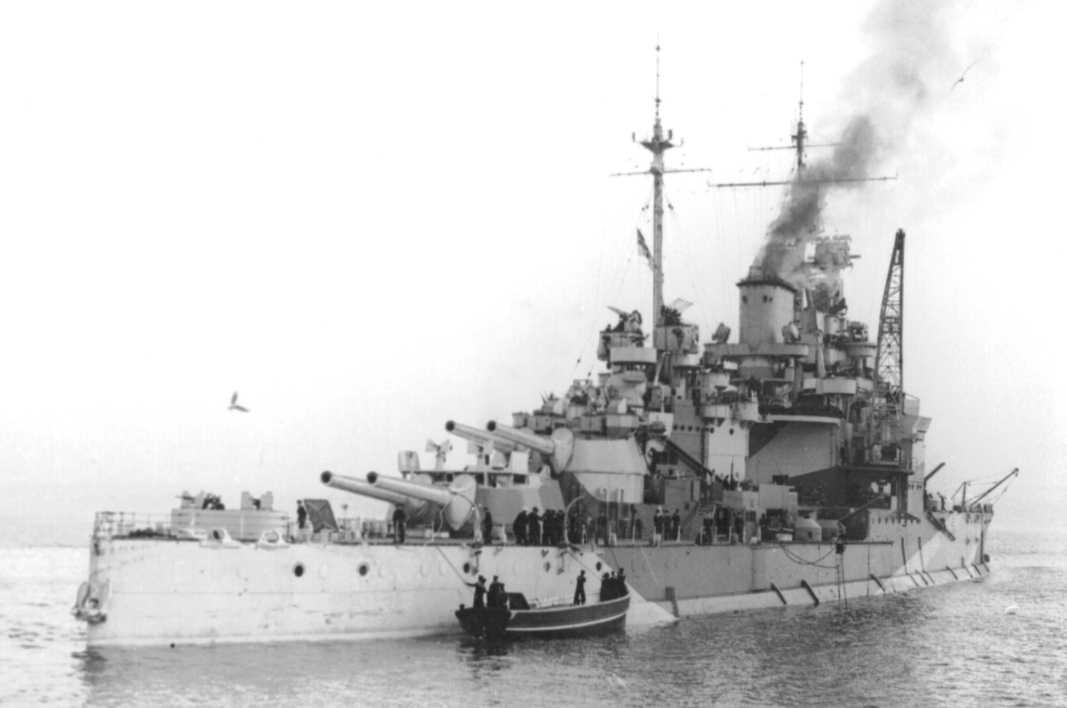
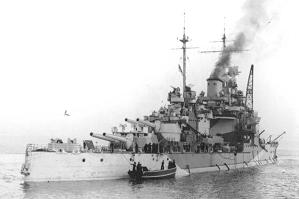
Battleship "Valiant"
(below
- CyberHeritage) was seriously
damaged at Trincomalee,
Ceylon when the floating dock she was in
collapsed.
12th - An
escort
carrier task group was formed to hunt for German
and
Japanese submarines operating in the Indian
Ocean off the
coast of Africa. "U-198"
was located
on the 10th and two days
later, sunk off the Seychelles by frigate
"Findhorn" and Indian sloop
"Godavari".
Monthly Loss Summary:
Indian Ocean only -
9 merchant ships of 58,000 tons
SEPTEMBER
1944
23rd -
Submarine
"Trenchant" on patrol off Penang in the Malacca
Strait sank "U-859" arriving from operations in
the
Indian Ocean. One flotilla of Ceylon-based
submarines
moved to Western Australia to work in East
lndies waters
under American Seventh Fleet command.
Monthly Loss Summary:
Indian Ocean - 1
merchant ships of 5,600 tons
OCTOBER
1944
Burma -
Following
the repulse of the Japanese around Kohima and
lmphal in
the Spring of 1944, 14th Army, now including
East African
troops prepared for the main offensive towards
Mandalay.
There were all the attendant problems of
movement and
supply in mountainous and monsoon country, and
over the
major rivers of Burma. Gen Slim started the
advance in
mid-October and by the middle of November was
over the
Chindwin River and heading for central Burma and
Mandalay, which was taken in March 1945.
Nicobar Islands
-
Between the 17th and 19th, ships and carrier
aircraft of
the Eastern Fleet attacked the Japanese-held
islands to
divert their attention from the US landings on
Leyte in
the Philippines.
NOVEMBER
1944
22nd - Three
days
after sinking a ship in the shallow Malacca
Strait off
the west coast of Malaya, submarine "STRATAGEM"
was
located and
sunk by a Japanese
destroyer on the 22nd.
Monthly Loss Summary:
Indian Ocean - 2
merchant ships of 14,000 tons
DECEMBER
1944
Burma - The
central
Burma campaign towards Mandalay continued. As it
did, the
Third and last Arakan offensive got
underway on
the 11th with British, Indian and West African
troops
aiming for Akyab.
British
Pacific Fleet - The Royal
Navy prepared to
return in force to
the Pacific, but even then as a junior partner
to the
vast US fleets. At the end of November the Eastern
Fleet was dissolved and Vice-Adm Sir
Arthur Power
appointed C-in-C of the newly formed East
lndies
Fleet. He took over some of the ships of
the old Eastern
Fleet from Adm Fraser including capital
ships
"Queen Elizabeth" and "Renown", four
escort carriers and nine cruisers. Now as the
last
U-boats headed back for Europe, Adm Power had
sufficient
convoy escort strength for Indian Ocean
operations. Adm
Fraser became C-in-C, British Pacific Fleet
(BPF) and
early in the month flew to Sydney, his planned
main base,
and then on to Pearl Harbor to discuss with Adm
Nimitz
how the Fleet would be employed. By the end of
the year,
fleet carriers "Illustrious",
"Indefatigable", "Indomitable" and
"Victorious", battleships "Howe" and
"King George V", and seven cruisers including
the New Zealand "Achilles" and
"Gambia" had been allocated to BPF. Adm
Fraser's greatest challenges were to equip and
train his
aircrews to US Navy standards of operation and
to
assemble a balanced fleet train. This would
enable him to
supply and support the fleet so it could operate
alongside, but independent o,f the Americans in
the vast
stretches of the Pacific. Even at the end he
lacked many
of the ships needed, especially fast tankers.
Rear-Adm
Sir Philip Vian took command of the BPF carriers
and led
"Indomitable" and "Illustrious" on an
attack against Belawan Deli, northern Sumatra in
mid-month. More raids took place on Sumatra in
January
1945.
1945
JANUARY 1945
3rd - On
patrol to
the north of Sumatra, "SHAKESPEARE" surfaced to
engage a merchant
ship. Hit by return gunfire and later aircraft
attack,
she reached Ceylon, but was not fully repaired.
16th - The
last
submarine sinking was on or around the 16th.
Minelayer "PORPOISE" on patrol in the Malacca
Strait
and minelaying off Penang, was probably sunk by
Japanese
aircraft. (Some sources suggest the 19th.)
Burma - Only
now
did the Chinese forces in the far north,
pushing
on from Myitkyina, reach the old Burma Road
allowing the
Ledo Road link-up to be made. In the centre,
14th
Army fought on towards Mandalay throughout
January and
February. In the south the Arakan
offensive moved
on by a series of amphibious hops aimed at
occupying
suitable sites for air bases to support the
central Burma
campaign. 3rd/21st
- Landings at Akyab & Ramree
Island - Early
on
the 3rd, British and Indian forces
landed at Akyab
from destroyers and smaller vessels of the
Royal,
Australian and Indian Navies to find the
Japanese had
gone. On the 21st more British and
Indians were
landed on Ramree Island with support and cover
partly
provided by battleship "Queen Elizabeth" and
escort carrier "Ameer". The few Japanese
resisted in their usual manner into February.
24th/29th
-
Fleet Air Arm Attack on Palembang - As
the British Pacific
Fleet
transferred from Ceylon to Fremantle en route to
Sydney,
Australia, successful strikes were made by
aircraft from
carriers "Indomitable",
"Illustrious", "Indefatigable" and
"Victorious" on oil installations around
Palembang, southern Sumatra on the 24th
and 29th.
Adm Vian was in command.
Monthly Loss Summary:
Very few Allied
merchant ships were lost in the Indian Ocean for
the rest
of the war
FEBRUARY
1945
11th -
Supporting
operations on Ramree Island, south of Akyab in
Burma,
destroyer "PATHFINDER"
was hit by
Japanese bombers and went to
reserve, the 153rd and last destroyer or escort
destroyer
casualty of the Royal Navies.
British Pacific
Fleet
- Early in the month, the BPF arrived in Sydney
for
replenishment. Adm Fraser stayed ashore as
C-in-C. BPF
had been allocated Manus in the Admiralty
Islands as its
intermediate base.
MARCH
1945
Burma
- On the central front the attacking
British and
Indian divisions took Mandalay on the 20th after
a fierce
struggle. As the Japanese started to retreat,
14th Army
pushed on south towards Rangoon until early May.
APRIL
1945
Burma
- As the Japanese started to retreat, 14th Army
pushed on
south towards Rangoon until early May.
MAY
1945
Burma - Conclusion
- Concerned
that 14th Army coming from the north would not
reach
Rangoon - the capital and major port of Burma,
before the
monsoon broke, the go-ahead was given for
airborne and
amphibious landings. On the 1st, Gurkha
paratroops landed
near the coast. Early next morning the main
landings took
place. 2nd
-
Landings Near Rangoon, Operation 'Dracula' - Under
the
naval command
of
Rear-Adm B. C. S. Martin, an Indian division was
carried
from Ramree island in landing ships and craft
and put
ashore at Rangoon, covered by escort carriers,
cruisers
and destroyers (Cdre G. N. Oliver). At the same
time,
diversionary attacks were made on the Andaman
and Nicobar
Islands by Vice-Adm H. T. C. Walker with
battleships
"Queen Elizabeth" and the French
"Richelieu" and aircraft from two escort
carriers. Rangoon was entered on the 3rd by the
Indian
landing force to find the Japanese gone. On the
6th they
met up with 14th Army units just a few miles to
the
north. The rest of the war was spent mopping up
the
Japanese unable to escape to Thailand.
16th
-
Sinking of the "Haguro", Last Major Surface
Warship Action of the War - Japanese
heavy cruiser "Haguro"
sailed for the Andaman Islands to evacuate the
garrison.
She was reported by East lndies Fleet submarines
in the
Malacca Strait and Adm Walker set out with his
escort
carriers to catch her. They were are sighted on
the 11th
and "Haguro" turned back. She tried again a few
days later. This time 26th Destroyer Flotilla
(Capt M. L.
Power) with "Saumarez", "Venus",
"Verulam", "Vigilant" and
"Virago" was waiting off Penang. In a classic
night torpedo action they attacked from all
sides and
send
"HAGURO" to
the bottom early on the 16th.
19th - On
patrol in
the Java Sea, submarine "TERRAPIN" attacked an
escorted Japanese
tanker and was badly damaged by depth charges in
the
counter-attack. She was not repaired, the last
Royal Navy
submarine casualty of the war.
Borneo -
Australian
forces under Gen MacArthur started landing
operations on
Borneo, partly to recover the oil fields. On the
1st they
went ashore at Tarakan on the
east coast of Dutch Borneo,
covered by ships of Seventh Fleet including the
Australian cruiser "Hobart". Similar assaults
took place at Brunei Bay on
the north coast of British
Borneo on 10th June, after which the Australians
advanced
south down the coast of Sarawak. In the last
major
amphibious operation of the war on
the 1st
July, the Australians landed at Balikpapan,
south of Tarakan on the east
coast. Tough fighting was needed to secure the
port
Indian
Ocean Merchant Shipping
Losses, June 1944 to May 1945
Total 21
British and Allied ships of 134,000 tons
JUNE
1945
8th -
As Japanese heavy cruiser "ASHIGARA"
(sister-ship to "Haguro")
carried troops from Batavia to Singapore, she
was
torpedoed five times by submarine "Trenchant"
and sank in the Banka Strait off southeast
Sumatra.
JULY
1945
Australia -
Prime
Minister John Curtin failed to see the end of
the war,
dying on the 5th after an illness. Acting PM,
Joseph
Chiffley, succeeded him.
24th/26th
Last
Major Warship Casualties of the RN in the War
- In
East
lndies Fleet operations against the Phuket
Island area
off the west coast of southern Thailand,
including mine
clearance, fleet minesweeper "SQUIRREL"
was
mined and sunk on the
24th.
Two days later on the 26th, kamikaze
aircraft
attacked for the first and last time in the
Indian Ocean
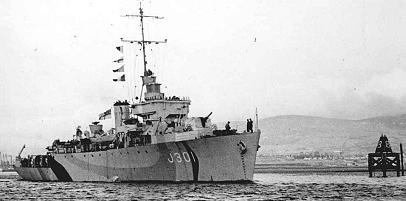
theatre. Fleet minesweeper "VESTAL" (below
- Navy Photos)
was
hit and scuttled. Heavy cruiser "Sussex" was
very slightly
damaged by a near
miss.
31st
-
Sinking of the "Takao" - Japanese
heavy cruiser
"Takao", previously damaged by US submarines on
passage to the Battle of Leyte Gulf, was now
laying off
Singapore in the Johore Straits. On the night of
the
30th/31st, midget submarines "XE-1" (Lt Smart)
and "XE-3" (Lt Fraser) were released by towing
submarines "Spark" and "Stygian" and
managed to reach the cruiser to drop their
charges.
"XE-3" was almost trapped beneath the hull of
"Takao" on a falling tide. "TAKAO"
was badly
damaged in the resulting
explosions and sank to the bottom. Other XE
craft cut or
damaged the undersea telephone cables off Saigon
and Hong
Kong at this time. Lt Ian Fraser RNR and his
diver,
Leading Seaman James Magennis were awarded the
Victoria Cross.
AUGUST
1945
6th
-
B-29 Superfortress "Enola Gay", flying from
Tinian dropped the first atomic bomb on
Hiroshima. The equivalent of 20,000 tons
of TNT killed 80,000 people.
8th
-
Russia declared war on Japan and invaded
Manchuria early
next day overwhelming the Japanese defenders.
9th
-
The
second A-bomb
was detonated
over
Nagasaki and over 40,000 people died.
15th
-
VJ-Day:
After days of
internal argument, Emperor Hirohito over-rode
the
politicians and military, and broadcast Japan's
unconditional surrender over the radio.
INDIAN
OCEAN MERCHANT SHIPPING
LOSSES, 1939-1945
Total 385
British and Allied ships of 1,790,000 tons lost
SEPTEMBER
1945
2nd -
Gen MacArthur accepted Japan's surrender on
behalf of the
Allied powers on the quarterdeck of US
battleship
"Missouri".
Amongst the signatories of the surrender
document were
Adm Sir Bruce Fraser for Great Britain, Gen
Blamey for
Australia, Col Moore-Cosgrove for Canada, Air
Vice
Marshal lsitt for New Zealand and, for the
United States,
Adm Nimitz.
Royal Navy -
As
ships of the Royal and Dominion Navies
repatriated Allied
prisoners of war and transported food and
supplies
throughout South East Asia, other surrenders
followed
during the next few days. 6th - On
board light carrier
"Glory" off
the by-passed Japanese stronghold of Rabaul,
Australian
Gen Sturdee took the surrender of the Bismarck
Archipelago, New Guinea and the Solomon
Islands. Local surrenders
in the
area took place on Australian warships. 12th
- South
East Asia was surrendered to Adm
Mountbatten at a
ceremony in Singapore. 16th - Arriving
at Hong
Kong in cruiser "Swiftsure", Rear-Adm C.
H.
J. Harcourt accepted the Japanese surrender.