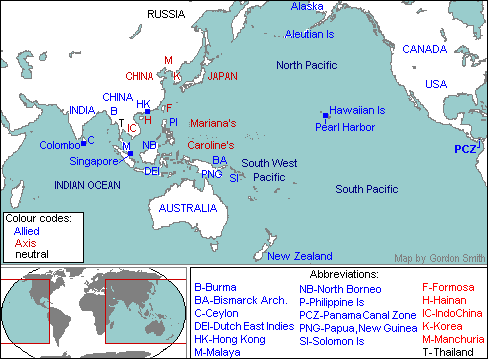
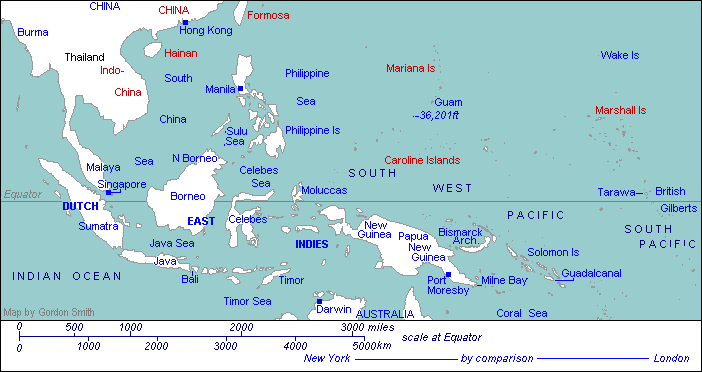
Only when Japan sought to extend the
southeast and
eastern perimeters - at Guadalcanal and
Midway
Island respectively in mid-1942 did it
suffer the
first defeats. America's growing power
would then
make Allied victory inevitable.
Militarily
-
Allied and
Japanese naval forces were about
balanced in numbers:
|
Major
Warship
types
|
ROYAL
NAVIES
|
DUTCH
NAVY
|
US
ASIATIC FLEET
|
US
PACIFIC FLEET
|
ALLIED
TOTALS
|
JAPANESE
NAVY
|
| Battleships
|
2
|
-
|
-
|
8
|
10
|
10
|
| Carriers
|
-
|
-
|
-
|
3
|
3
|
11
|
| Cruisers
|
10
|
3
|
3
|
21
|
37
|
40
|
| Destroyers
|
13
|
7
|
13
|
67
|
100
|
112
|
| Submarines
|
-
|
15
|
29
|
27
|
71
|
63
|
|
TOTALS
|
25
|
25
|
45
|
126
|
221
|
236
|
There the
comparison ended .....
The Imperial
Japanese Navy
had far
more carriers, its
surface task forces were well trained,
especially
in night-fighting, and they had no
command or
language difficulties. They also
introduced the
Allies to a secret and powerful weapon
in the
24in Long lance torpedo. In contrast,
the Allied ships were scattered and
had no central command. Their main bases
at
Singapore and Pearl Harbor were 6,000
miles
apart, and most of the strength was
concentrated
with the US Pacific Fleet. For its
conquests, the Japanese Army fielded
only slightly more troops,
but these were usually better trained,
and also
experienced in amphibious operations.
They had
air superiority both overall and
locally. Only
the US Pacific Fleet posed an immediate
danger to
Japanese plans. Hence the decision to
attack it
in Pearl Harbor rather than wait for it
to try to
fight through to the Philippines. The
Japanese
chose the time and place of their
landings, all
well escorted by cruiser and destroyer
forces.
Air cover was maintained by land-based
aircraft
or from carriers and seaplane carriers
as
necessary, and battleships and cruisers
provided
distant support. By this time the
annihilation of
the Allied capital ships made their
presence
unnecessary.
The
few Allied maritime sorties - some
surface, but
mainly by aircraft and submarine - had
few
successes against the invasion fleets.
And in
return they suffered heavy losses.
|
Declarations and
Outbreak of War - Because of the
International
Dateline, events that took place on the 7th in
Hawaii as
far as Washington and London were concerned, were
already
into the 8th in Hong Kong and Malaya. By the 8th:
(1)
Japan had declared war on Britain and the US;
(2)
Britain, Australia, Canada, New Zealand, South
Africa,
Holland, the United States and a number of Central
American and Caribbean states had declared against
Japan;
(3) China declared war against the Axis powers.
Using the
compass directions
outlining the Japanese strategy above ,
attacks
in December 1941 proceeded as follows:
West - Hong Kong -
The territory was invaded from mainland China on
the 8th
December, and within five days the defenders had
withdrawn to Hong Kong Island. Fighting carried on
until
Christmas Day when the British and Dominion troops
surrendered.
South West - Thailand,
Malaya, Burma - Japanese forces landed on
the Kra
Isthmus of Thailand and northeast Malaya on the 8th.
From there they drove down the west coast of
Malaya
towards Singapore, outflanking the defences by
land and
sea. Follow-up landings took place later in the
month and
in January 1942. By the 13th December they
had
crossed from Thailand into the southern tip of
Burma, but
stayed there for the time being.
10th
- Loss of
“Repulse” and “Prince of Wales”: the
Sinking of Force Z (map below) -
By the 8th,
the battlecruiser and
battleship had assembled at Singapore as Force Z
under
the command of Adm Sir Tom Phillips. That evening
they
sailed with four destroyers to attack the Japanese
landing on the northeast Malay coast. Fighter
cover was
requested but not readily available. In the
evening of
the 9th, Force Z was well up into the
South China
Sea. Japanese aircraft were spotted and Adm
Phillips
decided to return. Around midnight he received a
false
report of landings at Kuantan, further down the
Malay
Peninsular and set course for there. The ships had
by now
been reported by a submarine, and a naval aircraft
strike
force was despatched from Indochina. Attacks
started
around 11.00 on the 10th December, and in
less
than three hours “PRINCE OF WALES” and “REPULSE”
had been hit by a number of
torpedoes and sent to the bottom.

Following the Pearl
Harbor attack, not one of the Allies' 10
battleships
in the Pacific area remained in service.
South - Northern
Borneo
and Philippines Islands - The first landings
in
northern Borneo took place in Sarawak and Brunei
on the
16th December, and continued through until late
January
1942. In the Philippines, the island of Luzon was
the
main target. Between the 10th and 22nd, landings
were
made in the north of the island, in the south, and
at
Lingayen Gulf in the west. The Japanese forces
made a
combined drive on the capital of Manila, which was
declared an open city. They entered on 2nd January
1942
by which time preparations were being made to
attack Gen
MacArthur's US and Filipino troops now withdrawn
into the
Bataan Peninsular just to the west of Manila. The
southern island of Mindanao was invaded on 20th
December
1941.
East - Hawaiian
Islands, Guam, Wake Island and British Gilbert
Islands
- On the morning of the 7th local time (shortly
after the
Malay landings) the Japanese Strike Force aircraft
hit
Pearl Harbor on the Hawaiian island of Oahu. In
the Attack on Pearl
Harbor,
battleships “ARIZONA”
and
“OKLAHOMA”
were
total losses,
three more sank but
were later re-commissioned, and the remaining
three
damaged. Many were killed and a considerable
number of
aircraft destroyed. Although the Pacific
battlefleet
ceased to exist, the three priceless fleet
carriers
“Enterprise”, “Lexington” and
“Saratoga” were fortunately absent and the
large oil stocks and important repair
installations left
virtually untouched. By the 10th, Guam in the
Mariana
Islands was captured and Makin and Tarawa in the
British
Gilberts occupied. Tarawa was then abandoned until
the
following September 1942. Wake Island was attacked
on the
11th December, but the Japanese were driven off
with the
loss of two destroyers by the US Marine defenders.
A
later attempt on the 23rd succeeded.
Monthly Loss Summary
Indian
Ocean - 5 merchant ships of 800 tons
Pacific Ocean - 241 merchant ships of 432,000 tons
1942
JANUARY
1942
Allied Command -
Early in the month, British Gen Wavell was
appointed to
command ABDA (American, British, Dutch,
Australian)
forces responsible for holding Malaya and the
Dutch East
Indies.
West - Malaya and
Burma
- In their drive on Singapore, the Japanese
captured
Kuala Lumpur on the 11th. To the north they
crossed into
southern Burma from the Kra Isthmus on the 15th,
and on
the 20th started the invasion of Burma from
central
Thailand. Thailand shortly declared war on Britain
and
the United States. On the last day of January, the
retreating British, Australian and Indian troops
withdrew
into Singapore Island, after being driven down the
length
of the Malay Peninsula. By then carrier
"Indomitable" had flown off 48 Hurricanes for
Singapore via Java.
South - Philippines
and
Dutch East lndies - As the US and Filipinos
were
slowly pushed into Bataan, the Japanese began the
invasion of the Dutch East lndies from southern
Philippines. First landings took place on the 11th
at
Tarakan in Borneo and in the Celebes. More
followed later
in the month, but which time they had reached the
Moluccas in the drive south towards Java. 17th
-
Japanese submarine "I-60" tried to pass through
the Sunda Strait for
the Indian Ocean. She was located and sunk by
destroyer
"Jupiter" escorting a convoy to Singapore. 20th
- Submarine "I-124" minelaying off Darwin,
northern Australia,
was sunk by Australian minesweepers
"Deloraine", "Katoomba",
"Lithgow" and US destroyer "Edsall".
Southeast - Bismark
Archipelago - The first Japanese move
towards the
southeast took place on the 23rd with landings at
Kavieng, New Ireland and Rabaul, New Britain.
Rabaul
became the major Japanese base in the South West
Pacific
and helped dictate the whole strategy of Allied
moves in
the next two years.
Monthly Loss Summary
Indian
Ocean - 13 merchant ships of 46,000 tons
Pacific Ocean - 30 merchant ships of 71,000 tons
FEBRUARY
1942
West - Malaya,
Singapore and Burma - On the 8th, Japanese
forces
started crossing over to Singapore Island. Heavy
fighting
took place, but by the 15th Singapore surrendered
and
over 80,000 mainly Australian, British and Indian
troops
were doomed to captivity. Many did not survive as
POW's.
The Allies had lost the key to South East Asia and
the
South West Pacific. In Burma the Japanese pushed
on
towards Rangoon.
South - Dutch East
lndies - The two-pronged advance on Java
continued
with airborne landings on Palembang in southern
Sumatra
on the 14th, followed up by landings from the sea
one day
later by forces carried from Indochina. A few days
later
the islands of Bali and Timor were invaded from
the
Celebes and Moluccas respectively. The scene was
set for
the conquest of Java.
27th
February-1st March - Battles of the
Java Sea - ABDA's
main naval force was commanded by the Dutch Adm
Doorman
and consisted of a mixed squadron of cruisers and
destroyers for the defence of Java: heavy cruisers
"Exeter" and the US "Houston", light
cruisers "Perth" (Australian), "De
Ruyter" and Java" (both Dutch), destroyers
"Electra", "Encounter",
"Jupiter", plus two Dutch and four American.
They put to sea on the 26th on the news
that
invasion convoys were approaching. Failing to find
them
they headed back to Surabaya the next day, but
before
getting in, more reports arrived and the Allied
force
went out again towards a position to the
northwest. The
main battle started on the 27th at around
16.00
against the two heavy, two light cruisers and 14
destroyers covering the Japanese transports. Both
Allied
heavies opened fire at long range, but "Exeter"
was soon hit
and her speed reduced. In
the resulting confusion one of the Dutch
destroyers was
torpedoed and sunk. As "Exeter" returned to
Surabaya with the second Dutch destroyer, the
Royal Navy
destroyers went in to attack and
"ELECTRA"
was sunk
by
gunfire. Adm Doorman headed back south towards the
Java coast and sent off the US destroyers to
refuel. He
then turned to the north with his remaining four
cruisers
and two British destroyers. By now it was late
evening
and
"JUPITER"
was lost
probably
on a Dutch mine. "Encounter" picked up
survivors from the first Dutch destroyer and
shortly
followed the Americans to Surabaya. The four
cruisers,
now without any destroyers, were in action
sometime
before midnight and both "DE RUYTER"
and
"JAVA" were
blasted apart
by the big Japanese
torpedoes. "Perth" and "Houston" made
for Batavia, further west along the north coast of
Java.
The next evening, on the 28th, "Perth"
and "Houston" left Batavia and sailed west for
the Sunda Strait to break through to the Indian
Ocean.
From Surabaya three of the US destroyers went east
and
eventually reached safety through the shallow Bali
Strait. "Exeter's" draught was too great for
this route and the damaged cruiser had to make for
the
Sunda Strait accompanied by destroyer
"Encounter" and US destroyer "Pope. "
28th/1st
March - BattIe of the Sunda
Strait - Late that
evening "PERTH" and "HOUSTON" ran into the
Japanese invasion fleet in the
Strait and attacked the transports. They were soon
overwhelmed by the gunfire and torpedoes of the
covering
cruisers and destroyers and sank in the opening
minutes
of the 1st March. A Dutch destroyer following
astern
suffered the same fate.
Later on the morning of
the 1st March, "EXETER", "ENCOUNTER" and "POPE"
fought a lengthy action with a
cruiser force to the northwest of Surabaya before
they
too succumbed. Of the entire Allied force in the
Java
Sea, only three old US destroyers managed to get
away.
Australia -
Aircraft from four of the Pearl Harbor Strike
carriers
raided Darwin, Northern Territories on the 19th.
One
American destroyer and a number of valuable
transports
were lost.
Monthly Loss Summary
Indian
Ocean - 18 merchant ships of 38,000 tons
Pacific Ocean - 54 merchant ships of 181,000 tons
MARCH
1942
West - Burma -
Rangoon, the entry port for the Burma Road, fell
on the
8th. Towards the end of the month the Andaman
Island
group in the Indian Ocean flanking the south of
Burma was
occupied.
South - Philippines
and
Dutch East lndies - As the US and Filipinos
struggled
to hold on to Bataan, Gen MacArthur was ordered to
leave
for Australia. There he assumed the post of
Supreme
Commander, South West Pacific. US Adm Nimitz was
to
command the rest of the Pacific. The Java landings
went
ahead on the 1st and Batavia, the capital of all
the DEI,
fell. The Allied surrender was agreed on the 9th.
On the
12th, northern Sumatra was occupied and the rest
of March
was spent consolidating the Japanese hold
throughout the
many islands. Japan's southern perimeter had been
secured
in less than four months. Strong Japanese naval
forces
patrolled the Indian Ocean south of Java to stop
the
escape of Allied shipping.

South East -
Bismarck
Archipelago, New Guinea, British Solomons
Islands -
The Bismarck Sea was secured with two series of
landings.
To the north the Japanese took Manus and other
parts of
the Admiralty Islands. In northern New Guinea,
they
landed in the Huon Peninsula at Lae, Salamaua and
Finschhafen. When they occupied the northern
island of
Bougainville, the scene was set for the fierce
Solomons
Islands battles to come.
Monthly Loss Summary
Indian
Ocean - 65 merchant ships of 68,000 tons
Pacific Ocean - 98 merchant ships of 184,000 tons
APRIL
1942
5th-9th
- Japanese Carrier Attacks on
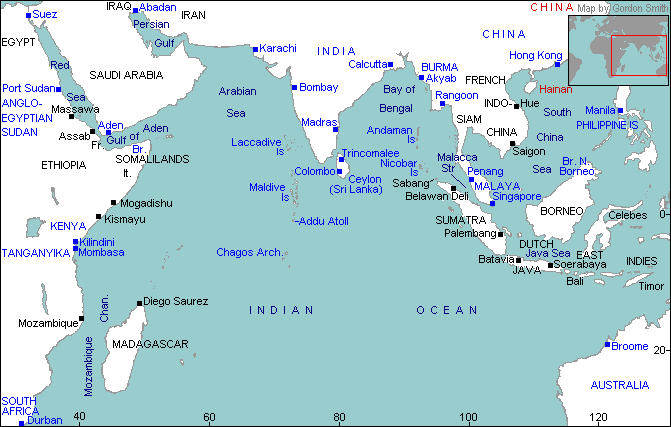
Ceylon - A new
British Eastern Fleet had been assembled under the
command of Adm Sir James Somerville, recently of
Force H.
The variety of ships were split into two groups. A
fast
group included battleship "Warspite", carriers
"Indomitable" and "Formidable", heavy
cruisers "Cornwall" and
"Dorsetshire", two light cruisers plus
destroyers. In the slower group were four 'R'
class
battleships, old carrier "Hermes" and some
cruisers and destroyers. Two Australian destroyers
accompanied each group. As the Ceylon bases of
Colombo
and Trincomalee were poorly defended and too far
forward,
Adm Somerville was operating out of the secret
base of
Addu Atoll in the Maldive Islands SW of Ceylon.
Early in
April, two Japanese forces headed into the Indian
Ocean.
One under Adm Ozawa with carrier "Ryujo" and
six cruisers mades for the Bay of Bengal and east
coast
of India. In a matter of days 23 ships of 112,000
tons
were sunk. Japanese submarines sank a further five
off
the Indian west coast. Bad as this threat was, the
real
one came from the carrier strike force of Adm
Nagumo with
five Pearl Harbor carriers - "Akagi",
"Hiryu", "Soryu", "Shokaku"
and "Zuikaku" - plus four battleships and three
cruisers.
The Japanese fleet was
first sighted on the 4th south of Ceylon,
and
shipping cleared from the ports. In the morning of
the 5th
a heavy raid on Colombo sank destroyer
"TENEDOS"
and armed merchant cruiser "HECTOR". Heavy
cruisers "CORNWALL"
and "DORSETSHIRE" were to the southwest,
sailing from Colombo to rejoin the Royal Navy's
fast
group. Found at noon they soon went to the bottom
under a
series of aircraft attacks. But Adm Nagumo had not
yet
finished. As Adm Somerville's two groups searched
for the
Japanese from a position between Addu Atoll and
Ceylon,
they circled round to the east. From there, on the
9th,
Japanese aircraft found the shipping cleared from
Trincomalee and back on its way in. Carrier
"HERMES", Australian destroyer "VAMPIRE"
and corvette "HOLLYHOCK"
were
amongst those that soon went down.
The Japanese ships left the Indian Ocean, never to
return
again in force. Not knowing this, the surviving
ships of
the Royal Navy withdrew - the slow group to
Kilindini in
East Africa and the other to the Bombay area.
Philippines -
Conclusion - Japanese units made their final
push on
Bataan and on the 9th, the Americans and Filipinos
surrendered. The island fortress of Corregidor
held out
until the 6th May. Some resistance continued on
other
Philippines islands. The infamous "Bataan
March" of American and Filipino POW's followed.
The
Doolittle Raid - American
B-25 bombers under the command of Col Doolittle
took off
from US carrier "Hornet" for the first ever
raid on Japan on the 18th. damaged was slight, but
the
strategic implications were to prove fatal to the
Japanese.
Monthly Loss Summary
Indian
Ocean - 31 merchant ships of 154,000 tons
Pacific Ocean - 7 merchant ships of 14,000 tons
|
Strategic
and
Maritime Situation - Indian and
Pacific
Oceans
To the west
and south the Japanese had
secured their
perimeter to plan. They would also do so
in the southwest
as the British, together with the
Chinese were
steadily driven out of Burma. The debate
was now
whether or not to push out to the southeast
towards Australia and New Zealand, and eastwards
to the United States. Japanese gains had
been at
little cost, not least on the naval side
as can
be seen from the losses up to end of
April from
all causes:
|
Major
Warships |
British
|
Australian
|
Dutch
|
US
|
ALLIED
|
JAPANESE
|
| Battleships
|
2
|
-
|
-
|
2 +
6*
|
4
|
-
|
| Carriers
|
1
|
-
|
-
|
-
|
1
|
-
|
| Cruisers
|
3
|
1
|
2
|
1
|
7
|
-
|
| Destroyers
|
7
|
1
|
7
|
5
|
20
|
5
|
| Submarines
|
-
|
-
|
8
|
4
|
12
|
7
|
|
Totals
|
13
|
2
|
17
|
12
|
44
|
12
|
* 6
battleships sunk at their moorings
or
damaged.
Now it was
the
Allies' turn to establish a defence
perimeter
running from the Hawaiian Islands around
to
Australia and New Zealand. With most of
the ANZAC
forces in North Africa, it was left to
the
Americans to garrison many of the
islands needed
to protect the supply routes from the US
to the
two Dominions. By now they were
occupying the
Line Islands south of Hawaii as well as
Samoa,
Tonga, New Hebrides and New Caledonia.
The
Australians were reinforcing Port
Moresby in
Papua New Guinea and New Zealanders
landing in
Fiji. The "Doolittle Raid" made a
decisive impact on Japanese strategy.
The Allies
had to be kept away from the homeland.
Japanese
conquests would be extended both to the
southeast
and east. Landings would be made at Port
Moresby
to bring Australia within bomber range,
the
southern Solomons and beyond would be
taken to
cut US-Australia supply lines, and
Midway Island
and the Aleutians occupied to isolate
Pearl
Harbor. Each of these three moves led to
three
famous battles - (1) Coral Sea, (2)
Guadalcanal, and (3) Midway, each
one a step-too-far.
Thereafter the Japanese
would be on the defensive.
|
MAY 1942
8th -
Landings at Diego Saurez, Madagascar - Concerned
about the Japanese
carrier sorties into the Indian Ocean and the
vulnerability of the Cape of Good Hope/Middle East
convoy
routes, Britain decided to take Diego Saurez at
the north
end of Vichy French Madagascar. Under the command
of
Rear-Adm E. N. Syfret (recently appointed to Force
H), a
large force of ships including battleship
"Ramillies" and carriers
"Indomitable" and "Illustrious"
assembled at Durban, South Africa towards the end
of
April. The assault took place on 5th May in
Courrier Bay
to the west of Diego Saurez. By the 7th the
fighting was
over and the important anchorage was in British
hands. On
the night of the 30th, Japanese submarines
"I-16" and "I-20" launched midget
submarines for attacks on Diego Saurez.
"Ramillies"
was
torpedoed and
badly
damaged and a tanker sunk. By September the
complete
occupation of Madagascar became necessary.
Burma - On 29th
April, Lashio was captured and the Burma Road cut
in the
north. Supplies for China now had to be flown over
high
mountains known as the 'Hump' for nearly three
years
until a new road was finally completed in early
1945.
Mandalay fell on the 1st and by mid-month the
retreating
British Army was crossing the border into India.
Chinese
forces were also back in China as well as India. With
the
conquest of Burma, Japan's western defence line
was
in place.
Papua New Guinea and
British Solomon Islands - Sailing from
Rabaul, a
Japanese invasion force headed for Port Moresby,
Papua
New Guinea covered by light carrier "Shoho" and
cruisers. Distant cover was given by a carrier
strike
force of two fleet carriers. From the Coral Sea,
aircraft
of US carriers "Lexington" and
"Yorktown" searched for them. First success in
the Battle
of the Coral Sea (step-too-far
1)
went
to the Americans on the
7th when
their planes sank "SHOHO" off the eastern tip of
New Guinea. Next
day, on the 8th, more aircraft strikes put fleet
carrier "Shokaku" out of action on one side and
sank
"LEXINGTON" and damaged "Yorktown" on the other. A
draw in naval
terms, the battle was a strategic defeat for the
Japanese
as the invasion ships turned back, leaving Port
Moresby,
so close to the north tip of Australia, safe for
now.
Throughout the battle, neither side's ships
sighted each
other - the first time in naval history a major
action
had taken place in this way. Before the battle
started,
the Japanese took the opportunity to occupy a
small
island called Tulagi in the southern Solomons,
close to
the larger unknown island of Guadalcanal.
Monthly Loss Summary
Indian
Ocean - 4 merchant ships of 22,000 tons
Pacific Ocean - 5 merchant ships of 17,000 tons
JUNE
1942
Midway and the
Aleutians - Adm Yamamoto, with over 130
ships in a
number of separate groups, set out to seize Midway
island, occupy the western Aleutians, attack the
eastern
end, and draw out the Pacific Fleet for
destruction. At
the heart of the armada was the First Carrier
Fleet (Adm
Nagumo) with four of the Pearl Harbor attack
carriers.
The Americans had far fewer ships, but these
included
carriers "Enterprise", "Hornet" and
"Yorktown" barely repaired after the Battle of
the Coral Sea. Battle of Midway (step-too-far
2) - On the 3rd, Dutch
Harbor, close to Alaska,
was attacked from two light carriers. But the main
battle
was far to the south off Midway between the
carrier
aircraft of both sides. On the 4th/5th in the
close run
battle, all four Japanese carriers - "AKAGI",
"HIRYU", "KAGA" and "SORYU" went
down.
"YORKTOWN"
was
badly damaged and
finished off by a
Japanese submarine on the 7th. The Japanese forces
retreated, Midway was spared, and the Allies had
their
first major strategic victory of World War 2.
However,
the Japanese Navy remained strong, with more
carriers in
the Pacific than the Americans. The occupation at
this
time of Attu and Kiska
in the Aleutians was of little consequence.
Monthly Loss Summary
Indian
Ocean - 18 merchant ships of 90,000 tons
Pacific Ocean - 6 merchant ships of 31,000 tons
JULY
1942
Papua, New Guinea
-
After failing to take Port Moresby by sea at the
time of
the Battle of the Coral Sea, the Japanese planned
to land
on the north coast at Buna and Gona and advance
overland
by way of the Kokoda Trail. They landed on the
21st and
moved south, just as the Australians were
preparing to
defend Kokoda itself and push north on Buna. The
Japanese
captured Kokoda on the 29th, and throughout August
slowly
pushed the Australians back south towards Port
Moresby.
Monthly Loss Summary
Indian
Ocean - 9 merchant ships of 47,000 tons
Pacific Ocean - 6 merchant ships of 32,000 tons
AUGUST
1942
Guadalcanal
(step-too-far 3), British
Solomon Islands - The
Japanese were now extending their hold in the
southern
Solomons and building an airfield on the island of
Guadalcanal. From there they could move against
the New
Hebrides, New Caledonia and other islands along
the
supply routes to Australia and New Zealand. After
the
Japanese presence was discovered, the US 1st
Marine
Division landed on the 7th, soon capturing the
airstrip
which was renamed Henderson Field. Close cover was
provided by a force of American and Australian
cruisers. 9th - Battle of
Savo Island - In
the early hours of the 9th a Japanese force of
seven
cruisers and a destroyer headed for Savo Island to
the
north of Guadalcanal to get at the US transports.
Instead
they stumbled on five patrolling cruisers. Taken
completely by surprise, heavy cruisers "CANBERRA"
and the American
"ASTORIA", "QUINCY"
and
"VINCENNES"
were hit
by a torrent of gunfire and torpedoes
and sank in an area soon known as lronbottom
Sound. The
fifth cruiser "Chicago" escaped and Australian
cruisers "Australia" and "Hobart"
were close by but took no part in the action. The
transports were untouched. From now on, as both
American
and Japanese forces tried to bring in supplies and
reinforcements, numerous naval battles were fought
in and
around the southern Solomons. Battle of the
Eastern Solomons -
On the 24th, Japanese and American carrier groups
covering supply operations to Guadalcanal were in
action
to the east of the Solomons island chain. Japanese
light
carrier on "RYUJO"
was
sunk and the American "Enterprise" damaged. From
now on the Japanese
relied increasingly on 'Tokyo Express' destroyers
to
bring in supplies by night down 'The Slot' - the
waters
between the islands of the Solomons.
Papua, New Guinea
-
In their move on Port Moresby, Japanese
troops
landed at Milne Bay at the extreme southeast tip
of Papua
on the 25th. The
mainly Australian resistance was strong and by the
30th,
the invaders were starting to evacuate. By
early
September they had gone - the first major
setback
Japanese forces had experienced on land.
Monthly Loss Summary
Indian
Ocean - 1 merchant ship of 5,000 tons
Pacific Ocean - 3 merchant ships of 1,500 tons
SEPTEMBER
1942
Papua, New Guinea
-
In
mid-month the Japanese reached their furthest
point down
the Kokoda Trail, within 30 miles of Port
Moresby. Australian troops now went over to
the attack and slowly drove north towards Kokoda.
Guadalcanal, British
Solomon Islands - As the two sides struggled
to build
up their forces, more fighting took place for
possession
of Henderson Field. US carrier "WASP"
was torpedoed
by submarine
"I-19" on the 15th, yet another casualty of the
attempts to reinforce the island. Only carrier
"Hornet" remained operational in the South
Pacific, but she was joined by the repaired
"Enterprise" in October.
British Gilbert
Islands
- After a brief stay in December 1941, Japanese
forces
reoccupied and started fortifying the atoll of
Tarawa.
This
was as far as they get
......
For
the complete period 1941 to 1945, see
Indian
Ocean/SE
Asia Campaigns
and
Pacific
Ocean Campaigns