Events until
November 1941
Since November 1939 when
"Graf Spee" first entered the Indian Ocean,
German raiders had hunted there as well as in the
Pacific. The Royal and Dominion Navies had not only
been
busy tracking them down, but also escorting
Australian,
India, New Zealand and other troops of the British
Empire
to the theatres of war. All this time Japan had
manoeuvred to complete the conquest of China. By the
end
of 1938, northeast China as far south as Shanghai,
together with the major ports was in Japanese hands.
In
February 1939 Japan occupied the large island of
Hainan
in the South China Sea. By early 1940, events were
moving
inexorably towards a total world war:
1940
March
- Japan established a Chinese puppet-government in
Nanking.
June/July - With
its possession of the Chinese ports, Japan wanted to
close the remaining entry points into China.
Pressure was
put on France to stop the flow of supplies through
Indochina, and on Britain to do the same with the
Burma
Road. Both complied, but Britain only until October
1940,
when the road was reopened.
September - Vichy
France finally agreed to the stationing of Japanese
troops in northern Indochina.
1941
April - Five Year
Neutrality Pact between Japan and Russia benefited
both
powers. Russia could free troops for Europe and
Japan
concentrate on expansion southwards.
 July
- The demand
for bases in southern Indochina was now conceded by
Vichy
France. Britain, Holland and the United States
protested
and froze Japanese assets, but the troops went in.
The
Dutch East lndies cancelled oil delivery
arrangements and
the Americans shortly imposed their own oil embargo.
Japan had lost most of her sources of oil.
July
- The demand
for bases in southern Indochina was now conceded by
Vichy
France. Britain, Holland and the United States
protested
and froze Japanese assets, but the troops went in.
The
Dutch East lndies cancelled oil delivery
arrangements and
the Americans shortly imposed their own oil embargo.
Japan had lost most of her sources of oil.
September - Japan
and the US continued to negotiate over their
differences,
but as oil stocks rapidly declined Japan accelerated
preparations for war.
October - War
Minister Gen Tojo became Japanese Prime Minister.
Also in
October Australia saw the fall of the Country Party
of
former Prime Minister Robert Menzies who resigned
earlier
in August. John Curtin and the Labour Party came to
power.
November - As
talks
dragged on and the United States demanded the
departure
of Japan from China as well as French Indochina, the
Pearl Harbor Strike Force sailed into the North
Pacific.
Vice-Adm Nagumo commanded fleet carriers
"Akagi", "Hiryu", "Kaga",
"Soryu", "Shokaku" and
"Zuikaku", plus two battleships, cruisers and
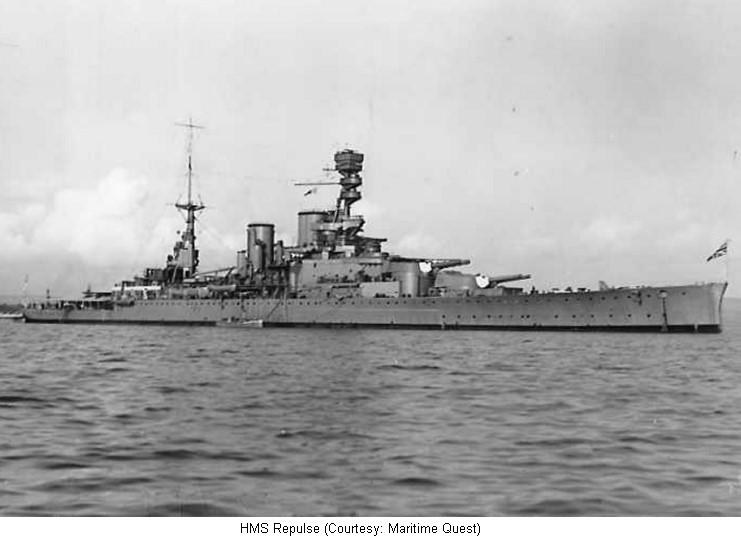
destroyers. Britain's limited naval deterrent to
Japanese expansion, capital ships
Prince of Wales and Repulse
(pictured - Maritime Quest) met at Colombo,
Ceylon on the 28th,
en route to Singapore. Without fleet carrier
Indomitable
they lacked any ship-borne
aircraft support.
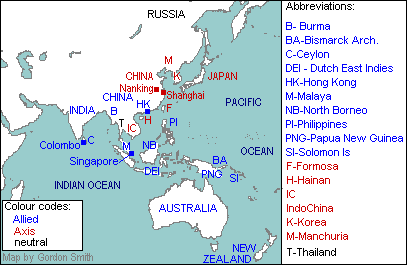
Strategic and Naval
Background
Allied
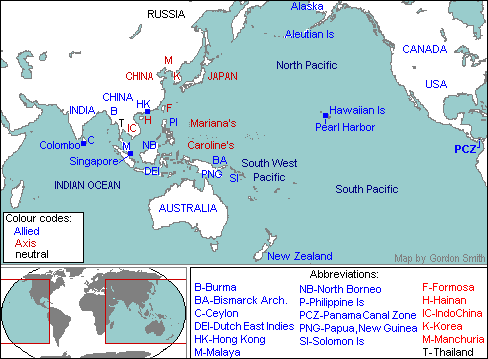 Britain
and
Commonwealth Nations - Responsible for
defending India, Ceylon,
Burma, Malaya, northern Borneo, Hong Kong,
Australia, New
Zealand, the Papua New Guinea/Bismarck
Archipelago/Solomon Islands chain, and numerous
island
groups throughout the Indian Ocean and Central and
South
Pacific. Few forces could be spared from existing
war
zones to protect this vast spread of territory and
its
supply routes. Britain's main base was at Singapore
with
the two recently arrived big ships. Three old
cruisers
and some destroyers were in Malayan waters, and a
few old
destroyers at Hong Kong. By now the surviving seven
cruisers and smaller ships of the Royal Australian
and
New Zealand Navies were back in the area.
Britain
and
Commonwealth Nations - Responsible for
defending India, Ceylon,
Burma, Malaya, northern Borneo, Hong Kong,
Australia, New
Zealand, the Papua New Guinea/Bismarck
Archipelago/Solomon Islands chain, and numerous
island
groups throughout the Indian Ocean and Central and
South
Pacific. Few forces could be spared from existing
war
zones to protect this vast spread of territory and
its
supply routes. Britain's main base was at Singapore
with
the two recently arrived big ships. Three old
cruisers
and some destroyers were in Malayan waters, and a
few old
destroyers at Hong Kong. By now the surviving seven
cruisers and smaller ships of the Royal Australian
and
New Zealand Navies were back in the area.
United
States -
Apart from the defence of its Western seaboard,
Panama
Canal Zone, Alaska and the Aleutians, Hawaiian
Islands
and various islands in the Central Pacific, the US
had
responsibilities towards the Philippines. In the
event of
attack, the defenders were expected to hold out
until
relieved by the US Pacific Fleet fighting its way
from
the main base at Pearl Harbor, a distance of 4,500
miles.
In the Philippines was the Asiatic Fleet with three
cruisers, 13 destroyers and 29 submarines. The
Pacific
Fleet itself consisted of eight battleships, three
fleet
carriers, 21 cruisers, 67 destroyers and 27
submarines.
Dutch - Naval
forces allocated to the
defence of the many islands of the Dutch East lndies
included three cruisers, seven destroyers and
fifteen
submarines.
Japan
Already established in
Korea, Manchuria, northeast China and its main
ports,
Hainan, Formosa, and the Mariana, Caroline and
Marshall
Island groups, Japan now had the whole of French
Indochina. Japan's main aim was still the conquest
of
China, for which the oilfields of the Dutch East
lndies
(DEI) were indispensable. Also important was the
closing
of the Burma Road over which Allied supplies
continued to
roll. Both moves meant war with Britain and the US,
and a
vital part of the Japanese strategy was the
establishment
of a huge defence perimeter stretching from Burma
right
around to the Aleutian Islands of Alaska. Only in
this
way could it hope to hold off the United States once
its
manpower and industrial resources were mobilised.
Japan went to war with both the strategic and
military advantages:
Strategically -
Japan was well placed to
occupy the territory needed for the defence
perimeter:
|
In the
West -
much of China was occupied and the
Neutrality
Pact with Russia, coupled with the German
invasion meant Japan had little to fear for
now
from this direction. Hong Kong could be
taken easily from
adjacent occupied China.
|
JAPAN
|
To the
East were
the vast distances of the Pacific. By taking
the
US islands of Guam and Wake, and some of the
British
Gilbert Islands,
the mandated islands (Marshalls,
Caroline's, Marianas) were further protected.
America was also kept at bay. |
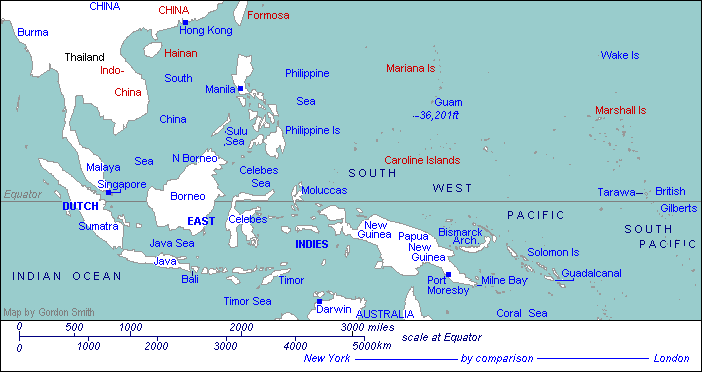
Only when Japan sought to
extend the southeast and
eastern perimeters - at Guadalcanal and Midway
Island
respectively in mid-1942 did it suffer the first
defeats.
America's growing power then made Allied
victory inevitable.
Militarily -
Allied and Japanese naval
forces were about balanced in
numbers:
|
Major
Warship
types
|
ROYAL
NAVIES
|
DUTCH
NAVY
|
US
ASIATIC FLEET
|
US
PACIFIC FLEET
|
ALLIED
TOTALS
|
JAPANESE
NAVY
|
|
Battleships |
2
|
-
|
-
|
8
|
10
|
10
|
|
Carriers |
-
|
-
|
-
|
3
|
3
|
11
|
|
Cruisers |
10
|
3
|
3
|
21
|
37
|
40
|
|
Destroyers |
13
|
7
|
13
|
67
|
100
|
112
|
|
Submarines |
-
|
15
|
29
|
27
|
71
|
63
|
|
TOTALS |
25
|
25
|
45
|
126
|
221
|
236
|
There the
comparison ended .....
The Imperial Japanese
Navy had far more
carriers, its surface task forces were well trained,
especially in night-fighting, and they had no
command or
language difficulties. They also introduced the
Allies to
a secret and powerful weapon in the 24in Long lance
torpedo. In contrast, the Allied ships were
scattered and had no central
command. Their main bases at Singapore and Pearl
Harbor
were 6,000 miles apart, and most of the strength was
concentrated with the US Pacific Fleet. For its
conquests, the Japanese Army fielded only slightly
more troops, but
these were usually better trained, and also
experienced
in amphibious operations. They had air superiority
both
overall and locally. Only the US Pacific Fleet posed
an
immediate danger to Japanese plans. Hence the
decision to
attack Pearl Harbor rather than wait for the
Americans to
try to fight through to the Philippines. The
Japanese
chose the time and place of their landings, all well
escorted by cruiser and destroyer forces. Air cover
was
maintained by land-based aircraft or from carriers
and
seaplane carriers as necessary, and battleships and
cruisers provided distant support. By this time the
annihilation of the Allied capital ships made their
presence unnecessary.
The few Allied maritime
sorties - some
surface, but mainly by aircraft and submarine -
had
few successes against the invasion fleets. And in
return they suffered heavy losses.