Background
Events - September 1939-March 1940
Battle
of Atlantic starts,
'Phoney War' on land, Battle of River Plate
1939
Friday,
1 September
Germany invaded Poland
Baltic - the first shots of the war were fired by German
battleship SCHLESWIG HOLSTEIN at the Polish Gdansk (Danzig)
fortifications of
Westerplatte. She had arrived six days earlier when Hitler
seized the Polish
port of Gdansk for Germany, renaming it Danzig.
German naval forces - for the invasion of Poland
were under the Command of
Naval Group Command East (Adm Conrad Albrecht):
Commander
Reconnaissance
Force (Vize Adm Hermann Densch) had under his command
light
cruisers KÖLN, LEIPZIG,
NÜRNBERG.
Officer
Commanding
Torpedo Boats (Konter Adm Gunther Lutjens) commanded
destroyers BERND VON
ARNIM, BRUNO HEINEMANN, ERICH STEINBRINCK, FRIEDRICH
ECKHOLDT, FRIEDRICH IHN,
GEORG THIELE, LEBERECHT MAAS, RICHARD BEITZEN, WOLFGANG
ZENKER and the 1st
MTB Flotilla with S.10, S.11,
S.12, S.13, S.18, S.19 and depot ship TSINGTAU.
BRUNO
HEINEMANN had
a water feed pump break down and was forced to withdraw
for repairs at Wilhelmshaven.
Officer
Commanding
Minesweepers (KptzS Friedrich Ruge in old torpedo boat
T.196) commanded escort
ships F.7, F.8, F.9, F.10, the 1st Minesweeping Flotilla
with minesweepers M.1,
M.3, M.4, M.5, M.7, M.111, M.132, the Experimental Barrage
Command with old minesweepers
ARKONA, NAUTILUS, OTTO BRAUN, PELIKAN, SUNDEWALL and the
3rd Motor Minesweeping
Flotilla with motor minesweepers R.33, R.34, R.35, R.36,
R.38, R.39, R.40.
German submarine forces
- Officer Commanding U-boats
East (FKpt Oskar Schomburg) commanded U.5, U.6, U.7, U.14,
U.18, U.22, U.31,
U.32, U.35, U.57.
U.5,
U.6, and U.7
patrolled the Kattegat near Laeso.
U.22
patrolled
inside the Irben Strait.
U.31,
U.32, U.35
were off the Gulf of Danzig
for minelaying and U.14 and
U.18 on patrol off the Gulf
of Danzig.
U.57
patrolled off
Libau.
On the
2nd, U.22
and U.57 were withdrawn to provide relief for the other
patrols. Both boats
proceeded to Memel for refuelling, then departed on the 3rd. U.57 arrived at Kiel
on the 5th and departed that
day for patrol off Laeso.
On the
7th, the Gulf of Danzig U-boats were ordered to the North
Sea.
On the
10th, the
Baltic patrols were cancelled and the submarines returned
to patrols and the U-boat Training School.
Polish
naval operations
- the Polish Fleet sortied from
Gdynia, but not before Polish torpedo
boat MAZUR was sunk in German air
attacks. Destroyer WICHER, minelayer GRYF, and
minesweepers CZAJKA, CZAPLA,
JASKOLKA, MEWA, RYBITWA, ZURAW were able to leave port to
conduct the mining of Gdansk Bay,
code named Exercise RURKA.
In
Puck Bay, near Gdynia,
the Polish force was attacked
by German dive bombers, and minelayer GRYF and minesweeper
MEWA seriously
damaged. GRYF was forced to jettison her mines to prevent
the explosion of
those still on deck and was unable to begin Exercise
RURKA. MEWA was towed to
Hela by RYBITWA.
Submarines
ORZEL
and WILK departed Gdynia
for patrol in the Gulf of Gdansk and RYS, SEP, ZBIK also
sailed
from Gdynia for patrol in Puck
Bay off Hela to attack German
surface ships.
WILK attacked German destroyer ERICH STEINBRINCK
unsuccessfully and was then damaged by depth charges
dropped by her and
FRIEDRICH IHN, but was able to continue on patrol.
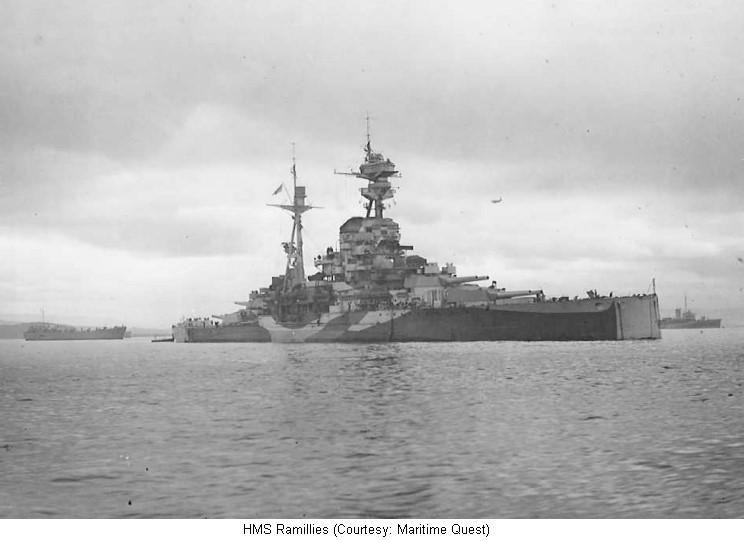
British
Home waters
- battleship RAMILLIES
(above - Maritime Quest)
departed Scapa
Flow
for escort duties from Devonport.
Aircraft
carrier
COURAGEOUS
with destroyer STURDY, after departing Portsmouth on 31
August, arrived at Portland at 1700. Destroyers ARROW
arrived there at 1550, ACASTA, which had departed Portland
at 0640 that morning, and
ANTHONY arrived at 1615, and ACHATES at 1745.
Aircraft
carrier
HERMES,
sailing from Plymouth, arrived at Portland at 2015, and
destroyer ACHERON
on the 2nd. Here they joined destroyer ANTELOPE which was
already at Portland.
Central
and South Atlantic
– Destroyers DOUGLAS and
WISHART departed Gibraltar for patrol. French destroyer BASQUE also left Gibraltar.
Heavy
cruiser EXETER arrived at Freetown
from Devonport and later the
same day, departed for Cape Verde
Island.
Heavy
cruiser CUMBERLAND,
which had departed Plymouth on 31 August after EXETER, was
also en route for Freetown.
Mediterranean
- destroyer ICARUS was damaged
in collision with Greek steamer MICHALIS (4680grt) off
Alexandria, while they were alongside
each other at sea. ICARUS's hull was stove in, and she and
the Greek steamer
were escorted to Alexandria
by destroyer INTREPID.
Following temporary repairs, ICARUS proceeded on the 10th
for repairs at Malta completing on 8 October.
Saturday, 2
September
British
Home waters
- battlecruiser RENOWN
escorted by destroyer SARDONYX departed Portsmouth for
Scapa Flow, arriving on the 4th.
Aircraft
carrier
COURAGEOUS
escorted by destroyer STURDY departed Portland before
dawn, and arrived at Plymouth later that day.
Destroyer
ENCOUNTER
departed Portland
at 0545 and arrived at Plymouth.
Baltic
- Polish naval auxiliary ships GYDNIE (538grt) and
GDANSK (538grt)
were
sunk by German bombing in the Gulf of Gdansk.
Polish
submarine SEP unsuccessfully attacked German destroyer
FRIEDRICH IHN at 1238
with one torpedo, north of Heisternest. SEP was damaged in
the counterattack,
but able to continue on patrol.
German
waters
- Commander Reconnaissance
Forces with light cruisers KÖLN, LEIPZIG, NÜRNBERG in the
Baltic was
ordered to the North Sea.
U-boat
movements
- U.31, U.32, and U.35 were in
the Baltic near Hela to mine the approaches to the Gulf of
Danzig. However, the escape of the
Polish destroyers made these operations unnecessary and
they were transferred
from the Baltic to the Atlantic, first arriving at Wilhelmshaven.
From there:
U.32
set out on patrol on the 5th,
U.31
and U.35 on the 9th,
U.31
and U.35 were ordered to patrol areas west and south of
England, respectively, and U.32 to lay
mines off the Bristol Channel on the 17th.
French
Force de Raid, Atlantic
- the
Brest-based Force of
battlecruisers DUNKERQUE, STRASBOURG,
light cruisers GEORGES
LEYGUES, GLOIRE, MONTCALM and large destroyers
L'AUDACIEUX, LE FANTASQUE, LE
MALIN, LE TERRIBLE, LE TRIOMPHANT, L'INDOMPTABLE, MOGADOR,
VOLTA was ordered to Casablanca at high speed to protect
the
North African ports from attack from the sea, departing at
2000/2nd. The 2nd
Destroyer Division of destroyers FOUGUEUX, FRONDEUR,
L'ADROIT and 5th Division
BRESTOIS, BOULONNNAIS, FOUDROYANT left Brest on the 2nd as
local escort and to
carry out an anti-submarine sweep in the local approaches.
The local escort
returned to Brest
on the 3rd.
Minelaying
cruiser
LA TOUR D'AUVERGNE (former PLUTON), also at Brest, sailed
with the Force de Raid
to lay a defensive minefield off the Moroccan coast. She
was detached on the
4th and arrived, unescorted, at Casablanca on the 5th,
where she remained
until her loss on the 13th.
When intelligence revealed the threat did not exist, the operations
were cancelled and the forces arrived back at Brest
at 0740 on the 6th. They
received an additional escort from the 4th Destroyer
Division with destroyers
BOURRASQUE, ORAGE, OURAGAN, which departed Brest on the
5th.
French naval forces, Mediterranean
- The French 2nd Second
Squadron, battleships PROVENCE,
BRETAGNE, LORRAINE with the nine destroyers of
the 1st Destroyer Flotilla, which had departed Toulon 31
August, arrived at Oran on the 2nd. The Squadron
carried on and arrived at Gibraltar on the 3rd.
The
French 3rd Squadron arrived back at Toulon on the 2nd
after covering
convoy R.3.
Later
that day, heavy cruisers, ALGÉRIE,
COLBERT, DUPLEIX, FOCH, TOURVILLE with destroyers
CHEVALIER PAUL, TARTU, VAUQUELIN of the 5th Large
Destroyer Division, GERFAUT and VAUTOUR of the 7th Large
Division, and CASSARD,
KERSAINT,MAILLÉ BRÉZÉ of the 9th Large Division departed
Toulon and arrived at Oran on the 3rd.
Mediterranean -
Light cruiser
ARETHUSA
and the 3rd Destroyer Flotilla (less IMOGEN and ICARUS)
departed Alexandria to patrol between Cape
Matapan and Crete.
The
destroyers arrived at Malta on the 4th, where they joined
IMOGEN which earlier had been sent to Marseilles with
dispatches, reaching Malta on the 3rd. All the destroyers
then carried on to Gibraltar, arriving on the 5th to operate out of there on anti-submarine duties
in the Atlantic.
Central
and South Atlantic
- Convoy AB.1 of British
tankers BRITISH ARDOUR (7124grt, Cdre Mr H Fulcher),
BRITISH LOYALTY (6993grt),
BRITISH PRINCESS (7019grt), BRITISH MOTORIST (6891grt),
BRITISH PROGRESS
(4581grt) and steamers CITY OF HEREFORD (5105grt), CITY
OF SHANGHAI (5828grt)
ROWANBANK (5102grt) departed Gibraltar for Capetown.
BRITISH FAITH (6955grt)
had broken down just after weighing anchor and did not
proceed with the convoy.
Light
cruisers DAUNTLESS
and DESPATCH
(9th Cruiser Squadron) departed Gibraltar at 1930 and
proceeded with the
convoy.
Destroyers
DOUGLAS,
WATCHMAN, WISHART, WRESTLER of the 13th Destroyer Flotilla
joined the
convoy at 2200/2nd and carried out anti-submarine sweeps,
before leaving at
0805/3rd.
Light
cruiser DURBAN departed Gibraltar
for Freetown where she arrived on the 8th
with seaplane tender ALBATROSS.
DAUNTLESS
was
detached on the 11th and arrived at Freetown on the 13th.
On
the 13th DESPATCH turned the convoy over to DURBAN which
had departed Freetown on the 12th.
DESPATCH
reached
Freetown on the 14th. DURBAN
reached Capetown on the 29th.
Indian
Ocean
- destroyers DECOY, DEFENDER,
DELIGHT, DUCHESS which had departed Hong Kong
on 28 August, left Singapore on the 2nd en route to join
the Mediterranean Fleet.
Pacific
- New Zealand light cruiser ACHILLES
en
route to the West Indies from New
Zealand received orders to patrol off
the west coast of South America.
Sunday, 3 September
Declarations
of war
- Great Britain and France declared war on Germany at 1115
and 1700 respectively. Australia,
New Zealand, and British India also declared war.
Home
Fleet, including German
shipping -
Adm
Forbes was some 400 miles west of the Hebrides having just
completed a sweep to
the west to cover the trade routes with his battlefleet
and destroyers were
SOMALI, ASHANTI, BEDOUIN (defects corrected), ESKIMO,
PUNJABI, TARTAR of the
6th Destroyer Flotilla and FAULKNOR, FEARLESS, FIREDRAKE,
FORTUNE, FOXHOUND of
the 8th Flotilla. ASHANTI
and SOMALI had refuelled at Scapa Flow on the 2nd and the
rest of the
destroyers departed earlier on the 3rd, also after
refuelling at Scapa.
Destroyers
MASHONA
and MATABELE of the 6th Flotilla and FAME, FORESIGHT,
FORESTER, FURY of
the 8th departed Scapa Flow that evening to join Forbes at
sea., FORESTER and
FURY carried out anti-submarine attacks at 2140, WNW of
Rockall in 58-53N,
18-42W.
Adm
Forbes was also looking for German liner BREMEN
(51,656grt) which was known to
have departed New York
on 30 August. However, BREMEN evaded British patrols and
arrived at Murmansk
on the 6th.
Destroyer
SOMALI
did capture German steamer HANNAH
BOGE (2372grt) which had departed Shediac Bay in New
Brunswick on 26
August. She was intercepted at 63‑20N, 16‑35W, taken to
Kirkwall, arriving on the 5th, and
later renamed CROWN ARUN in British service.
That
evening at 1840, on report of German warships leaving
Schillig Roads, the Home
Fleet was deployed to the east of the Fair Isle Channel,
arriving on station at
0600 on the 5th.
During
the evening of 3 September, destroyer ESKIMO experienced a
turbine problem and
was returning to Scapa Flow alone when she encountered FAULKNOR, FIREDRAKE and
FOXHOUND. She was at first taken for German, but no shots
were fired and the
encounter ended uneventfully. ESKIMO safely arrived at
Scapa
Flow and the defects were corrected
on the 11th.
Loss
of British liner Athenia
- U.30 torpedoed ATHENIA
(13,581grt) south of Rockall Bank in 56‑44N, 14‑05W. Soon
on the
scene were destroyers ELECTRA, ESCORT, American steamer
CITY OF FLINT (4963grt), Norwegian
steamer KNUTE NELSON (5749grt), Swedish pleasure yacht
SOUTHERN CROSS.
Lost
with ATHENIA, which sank on the 4th, were 93 passengers
and 19 crew members.
The 376 survivors were picked up by SOUTHERN CROSS and of
these, 220 were
transferred to CITY OF FLINT
and the other 156 to the
destroyers.
Adm
Forbes had also dispatched destroyer FAME from his screen
at 2300 to
assist. When she was not needed to lift survivors, FAME
carried out anti-submarine
sweeps in the area.
KNUTE
NELSON took the survivors to Galway and the rest were taken to Greenock.
CITY OF FLINT
later took 223 American
survivors to Halifax,
arriving on the 13th, and
escorted into port by US Coast Guard cutters BIBB (WPG.31)
and CAMPBELL
(WPG.32).
British
northern waters -
battleship ROYAL
SOVEREIGN
arrived at Scapa Flow at 1030/3rd, escorted by destroyers FAULKNOR, FORTUNE,
ESKIMO, TARTAR.
Destroyer
VALOROUS
and sloop ENCHANTRESS departed Rosyth on the 2nd for
patrol in the Pentland Firth.
British
east coast
- coastal minelayer PLOVER
laid mines off Bass Rock in the Firth of Forth in
Operation BRM.
Destroyers
BROKE,
WANDERER, WHITEHALL
of the 15th Destroyer Flotilla
departed Rosyth for patrol on the 1st. WANDERER and
WHITEHALL carried out an anti-submarine
sweep off Blyth, both destroyers arriving at Scapa Flow on
the 4th.
German
trawler SOPHIE BUSSE (215grt) was
seized by British forces at Grimsby
and renamed ELSIE CAM in British service.
Destroyer
WITCH,
17th Flotilla departed Rosyth for Harwich on 31 August.
(30th Destroyer
Division, 17th Flotilla was at Milford Haven for escort
duties.)
Escort
vessel/destroyer WHITLEY and sloop PELICAN departed
Harwich on the 3rd
German
steamer POMONA
(3457grt) was seized by
British forces at London.
Although the crew set her on
fire, the ship was saved and renamed EMPIRE MERCHANT in
British service.
Humber Force
- light cruisers GLASGOW,
SOUTHAMPTON and destroyers JERVIS, JACKAL, JAVELIN, JERSEY
had departed the Humber on the 1st and were sweeping
off the Norwegian coast for German shipping.
Destroyers
JANUS
and JUNO arrived in the Humber
for operations on the 3rd
after working up.
Destroyer
JUPITER
was at Grimsby
repairing defects and arrived
at Rosyth on the 6th.
The
Humber Force arrived at Rosyth on the 7th after this
patrol.
British
North
Sea
submarine patrols
- began off Horn Reef, in the
approaches to the Kiel Canal and Wilhelmshaven,
and on the extension of the
Montrose-Obrestad air patrol line - the last sixty miles
of which was beyond
the range of the Anson aircraft then in service.
Operating
off
the Norwegian coast and stationed twelve miles apart were
2nd Flotilla
submarines SEAHORSE, which had departed from Dundee on 24
August, SPEARFISH from Portland on 25 August, STURGEON
from Portland on 27 August, SWORDFISH, also
from Dundee.
SPEARFISH
was
attacked by a U-boat on the 3rd but dived when torpedo
tracks were seen and
escaped unharmed.
STURGEON
was
bombed by friendly aircraft in 56-34N, 01-04W at 1620 and
1642/4th.
SEAHORSE
was
also attacked by friendly aircraft, a RAF Coastal Command
Anson of 233
Squadron, east of Dundee, at 2007/5th. She sustained minor damage, a claim made by the
aircraft, but the Anson herself crashed into the River
Eden because of fuel
leaking from a damaged tank. The crew were rescued from
their dinghy.
Submarines
STERLET,
OXLEY, and TRITON departed Dundee on patrol on 3, 4, and 5 September, respectively.
Submarines
H.32,
L.26, L.27, UNDINE, UNITY, URSULA of the 6th Flotilla
departed Blyth on 31 August for patrols in
the Heligoland Bight, being withdrawn for refuelling at
dusk on the 11th and
arriving back at Blyth after dawn on the 13th.
Danish
waters
- Danish fishing vessel NORDSTRAND (30grt) was
sunk 70 miles
west of Horn Reef Light by a mine.
German
waters
- after being arrested for a debt on 28 August, steamer NAPHTHA
SHIPPER (5897grt) was seized by German forces at
Hamburg and renamed ALTENGAMME in
German service.
Baltic
- U.14 attacked Polish
submarine SEP south of Aland
Island in the Baltic without success.
U.18 also encountered a Polish boat on the 3rd, but was
unable to attack.
Polish
destroyer WICHER and minelayer GRYF, along with other
smaller Polish units,
were anchored at Hela, when they were attacked and damaged
by German destroyers
LEBERECHT MAAS and WOLFGANG ZENKER. MAAS sustained some damage and four dead from a shore
based battery hit and the German ships were forced to
withdraw without
destroying the Polish ships. MAAS was repaired at Swinemünde, completing on the 10th and
Norwegian steamer BJORNVIK (812grt) was damaged by the
German ships gunfire at Gdynia.
Failing to deal with the
Polish ships, the German destroyers called in the
Luftwaffe which sank WICHER, GRYF,
minesweeper MEWA,
and gunboat GENERAL HALLER two hours
later. German forces later raided GRYF, which was sunk as
a target ship ten
miles north of Gydnia.
German
MTB S.23 sank Polish pilot vessel LLOYD BYDGOSKI
(80grt) at 54-35N,
19-08E near Hela.
Polish
submarine WILK laid twenty mines east of Hela at 54-31N, 18-48E.
German
minelaying operations
- Beginning on the 3rd and
continuing through to the 17th, German light cruisers
EMDEN, KÖLN, KÖNIGSBERG, LEIPZIG, NÜRNBERG and sloop
GRILLE
covered minelaying operations from Terschelling 150 miles
northward into the
Heligoland Bight.
Destroyer
HANS
LODY was damaged on the 4th by
an explosion of her anti-sweep device while loading mines.
Her stern was
damaged.
The
first operation departed late on the 4th with three
groups: First group – KÖLN,
KÖNIGSBERG and destroyers DIETHER VON ROEDER and HANS
LÜDEMAN; second group - sloop
GRILLE with destroyers HERMANN KÜNNE and KARL GALSTER;
third group - minelayers
COBRA and ROLAND with destroyers ERICH GIESE and THEODOR
RIEDEL.
Minefield
F
(Martha Hans) was laid by COBRA, ROLAND, GIESE and RIEDEL
from Cuxhaven on the 4th, where they
returned after the operation.
Minefield
A
(Martha Ida) was also laid COBRA, ROLAND, GIESE and RIEDEL
sailing from Cuxhaven on the 5th.
Two
barrages of Martha Gustav were laid on the 8th by COBRA
and ROLAND, this time
with destroyer FRIEDRICH IHN. After the operation, the
ships proceeded to Emden.
Minefield
B
(Martha Eins), was laid on the 13th by minelayers COBRA,
KAISER, ROLAND from Wilhelmshaven and by HANSESTADT DANZIG
with
destroyers BERND VON ARNIM, FRIEDRICH ECKHOLDT, THEODOR
RIEDEL. Torpedo boats
of the 6th Flotilla escorted the operation.
Minefield
C
(Martha Zwei), was laid on the 15th by COBRA, HANSESTADT
DANZIG, KAISER,
ROLAND, and destroyers ARNIM, STEINBRINCK, ECKHOLDT,
RIEDEL with Torpedo and
S-boats screening the operation.
Minefield
G
(Martha Drei), was laid on the 17th by COBRA and
HANSESTADT DANZIG, escorted
by torpedo boats of the 6th Flotilla.
U-boat
operations
- U.12, U.36, U.56, U.59, U.58
were on a patrol line off Great Fisher Bank and U.13,
U.15, U.17, U.21, U.23 in
the southern North Sea.
U.16,
which departed Wilhelmshaven
on the 2nd, laid mines in Tees Bay off Hartlepool on the
5th. Before returning
to Wilhelmshaven on the 8th, she reconnoitred the approaches to Scapa
Flow in the Pentland Firth.
U.20
was on passage for patrol in the northern North Sea off
Utsire.
U.23,
off Flamborough to lay mines, was recalled to
Wilhelmshaven before the minefield was laid.
They were laid by U.15 on the 6th.
U.24
had departed Wilhelmshaven
on the 2nd to lay mines off Dunkirk, but the operation was
cancelled, and she returned to Kiel on the 5th.
Minelaying
off
Dover and Calais
had already been cancelled due
to shortage of boats.
Dover
Straits
- destroyers CODRINGTON,
BASILISK, BEAGLE, BLANCHE, BOADICEA, BOREAS, BRAZEN,
BRILLIANT departed Dover on 31 August for patrol in the
English
Channel.
The patrols were divided into two sectors - a north patrol
area between Goodwin Sands and Sandetti Bank, and a south
patrol area between the South Goodwins and Ruytingen Bank.
English
Channel - in
the Western Approaches Command, destroyers ESCORT and
ELECTRA of the 12th
Destroyer Flotilla departed Portland
for patrol on the 2nd.
ENCOUNTER departed Portland
on the 2nd to join sister ship
ECLIPSE at Plymouth,
and EXMOUTH and ESCAPADE,
also of the 12th Flotilla departed Portland on the 3rd.
Destroyer
KEITH,
17th Destroyer Flotilla departed Plymouth on the 3rd.
French
Channel coast
- destroyers MALCOLM,
VANSITTART, WIVERN, 16th Flotilla from Portsmouth arrived
at Le Havre on the 3rd.
Central
and South Atlantic
- light cruisers CAPETOWN
and
COLOMBO
departed Gibraltar for patrol west of Portugal in the area
of 38N, 20W,
and arrived back on the 12th.
Light
cruiser DANAE
departed Freetown
for Simonstown, arriving on
the 11th.
Light
cruiser AJAX sailed from Rio de Janiero on 30 August and on the 3rd
in 33‑30S, 53‑30W captured German steamer OLINDA
(4576grt) which had departed Montevideo on the 2nd. As
AJAX could not spare a prize crew, OLINDA was sunk with
scuttling
charges after the crew was placed aboard British tanker
SAN GERALDO (12,915grt). AJAX had the distinction of
firing
the first British shots of the war.
Australian
Navy
- heavy cruiser CANBERRA
departed Garden Island, Sydney for patrol late on the 2nd,
followed by light cruiser HOBART
and destroyer VOYAGER on the 3rd. HOBART patrolled the
trade route
between Gabo Island
and Wilson's Promontory and VOYAGER in
the vicinity of Cape Howe.
Destroyer
VENDETTA,
also after departing Garden Island, and on patrol 100
miles east of
Port Stephens sighted steamer SPEYBANK (5154grt).
Destroyer
VAMPIRE
was on patrol off Cape Otway looking for Italian steamer
ROMOLO (9780grt) which later arrived at Brisbane.
Sloops
SWAN and YARRA were on anti-submarine patrol off Sydney.
Monday, 4 September
Western
Atlantic
- German steamer CHRISTOPH V DOORNUM (3751grt) was
seized by Canadian forces at Botwood, Newfoundland, and
renamed EMPIRE COMMERCE
in British service.
Faeroes
- destroyer FORTUNE attacked a
submarine contact 30 miles south of Munken Rock in 61-11N,
07-39W.
British
northern waters
- battleships ROYAL
OAK
and
ROYAL SOVEREIGN
departed Scapa Flow, escorted by destroyers BROKE
WANDERER,
WHITEWALL for patrol in the North Sea.
WANDERER
attacked
a submarine contact at 1945, 90 miles east of the Orkneys,
southeast
of Sumburgh Head in 59-23N, 00-11W. WHITEHALL rejoined the
escort at
1128/5th.
Destroyers
FORESIGHT,
FORESTER, FURY departed Scapa Flow
on the 5th and joined the
battleships at 1330/6th.
The
force arrived back at Scapa Flow at 1709/6th.
British
east coast - Destroyer
JACKAL attacked a
submarine contact NE of Flamborough Head in 54-29N,
00-05E.
U.13
laid mines off Orfordness during the night of 4/5
September. Two merchant ships
were sunk and one damaged in this field. U.17 laid mines
in the Downs.
Norwegian
waters
- German
coaster LIANNE (125grt) was lost between
Graverne, Sweden, and Hamburg about this time. She
reportedly scuttled herself after sighting British
light cruisers GLASGOW
and
SOUTHAMPTON
sweeping in the area. However, it appears she was lost
in a German minefield on the 7th, as reported by Greek
steamer KOSTI (3933grt) herself damaged earlier
in the same field. There were no survivors from
LIANNE. (Corrections
thanks to Mark Viglietti)
German
steamer JOHANNES MOLKENBUHR
(5294grt) was intercepted by SOUTHAMPTON and scuttled herself 17 miles west of Stadlandet
in 61‑40N, 03‑51E. Destroyer JERVIS took off the crew,
landing them
at Invergordon on the 6th, while JERSEY finished off the sinking ship.
German
waters
- U.3 and U.4 departed Wilhelmshaven for patrol in the
Skagerrak, and U.21 and U.23 arrived
back.
Destroyers
assigned
to the Eastern Area for the Polish campaign transferred to
the North Sea to cover minelayers laying the
"West Wall" minefield in the Heligoland Bight.
German
MTB S.17 of the 2nd Flotilla was
badly damaged by rough seas during North Sea
operations, paid off on the
8th and used for spares. A number of other S-boats were
less severely damaged
in these operations.
RAF
attacks on German naval
units
– were
carried out at Wilhelmshaven
and Brunsbüttel. Five
Blenheims each of Nos 107, 110, and 139 Squadrons and six
Wellington bombers each of Nos 49 and 83
targetted Schillig Roads, while six Wellingtons of 9
Squadron and eight from
149 Squadron targetted Brunsbüttel.
Battleships
SCHARNHORST
and GNEISENAU at Brunsbüttel were attacked but escaped any
damage.
At
Wilhelmshaven, light cruiser EMDEN, just entering port
followed
by U.23, was damaged by splinters from two near misses and
a Blenheim crashing
into her bows. Nine crew were killed but EMDEN was
completely repaired on the
16th.
At
Schillig Roads, pocket battleship ADMIRAL SCHEER was hit
by three 250 pound
bombs which failed to explode and caused no damage. SCHEER
had problems with
her main engines, but was ready for sea on 10 October. She
continued to have
difficulties and started an extensive overhaul in February
1940 lasting into
October 1940.
Destroyer
DIETHER
VON ROEDER, close by SCHEER was near missed, but not
damaged.
Of
the aircraft involved, ten, including all five of 139
Squadron failed to find
the target and returned to base, one bombed Esbjerg,
Denmark, and three attacked HM ships
in the North
Sea
without success. Losses amounted to seven - two
Wellingtons of 9 Squadron, four
Blenheims of 107 Squadron, and one Blenheim of 110
Squadron shot down.
Baltic
- Polish submarine SEP on
patrol east of Hela fired two torpedoes at German
minesweeper M.4 of the 1st
Minesweeping Flotilla. M.4 was not hit, counter-attacked
with depth charges and
damaged SEP, which was able to continue her patrol.
German
minelayers HANSESTADT DANZIG and TANNENBERG, escorted by
motor minesweepers
R-boats of the 5th Motor Minesweeper Flotilla laid
minefield Undine II the
southern entrance to the Sound. Training ship BRUMMER,
escorted by minesweepers
M.75, M.84, and M.85, laid minefield Undine III. On the
5th, TANNENBERG laid
Undine I.
Minelayer
PREUSSEN
laid mines in minefield Grosser Bar at the entrance to the
Great Belt.
Greek steamer KOSTI (3933grt) was damaged on a mine in
this field, two miles SE
of Falsterbo Light Vessel after ignoring warnings from
German patrol boats.
English
Channel
- Destroyer ACHERON departed Portland with a MA/SB on
anti-submarine
exercises with submarine H.31. Later that day at 1350,
destroyer KELLY, which
was working up nearby in Weymouth Bay, reported being
attacked by a
submarine. KELLY and ACHERON attacked a contact at 1550.
H.31 was not damage
Destroyer
WESSEX
made two anti-submarine
attacks off Eddystone Light during the day - in 50-13N,
03-32W at 1215 and in
50-09N, 3-59W at 1538.
Aircraft
carrier
COURAGEOUS
departed Plymouth
at 0845 on anti-submarine
patrol with destroyers ANTHONY, ACASTA, AMAZON, ARDENT.
Destroyer ECLIPSE
attacked a submarine contact near COURAGEOUS off the
Eddystone in 50-01.5N,
4-09W at 0940. After the attack, she joined the screen.
ECLIPSE made another
attack at 50-10.5N, 4-02E at 1915. The force returned to
Plymouth the same day at 1720.
French
Channel coast
- destroyer CODRINGTON, French
torpedo boat L'INCOMPRISE and a French seaplane attacked a
submarine contact
off Gravelines.
Destroyers
VENOMOUS, WREN, 16th Destroyer Flotilla
embarked an advance party of the GHQ of the British
Expeditionary Force (BEF),
arrived at Cherbourg
and disembarked their troops
that evening, returning to Portsmouth
on the 5th. On the 7th at
0015, the two destroyers again sailed from Portsmouth and
joined a convoy which was
escorted to Cherbourg.
They arrived back at Portsmouth at 1100.
St
George’s Channel
- steamer BLAIRBEG
(3509grt) was abandoned after a submarine attack, although
no damage was done.
Destroyer WALKER attacked a contact SW of The Smalls at
51-10W, 6-32W. WALKER, now with VANQUISHER stood by
the steamer while the crew re-embarked and continued their
passage to Glasgow.
Mediterranean
- heavy cruiser SUSSEX
and destroyers COSSACK, MAORI, NUBIAN, ZULU
departed Alexandria at 1930 to relieve light
cruiser ARETHUSA
and her destroyers on patrol. The patrol was discontinued
on
the 7th, and SUSSEX
was instructed to send her
destroyers to convoy Green 1.
South Atlantic - German steamer CARL
FRITZEN (6594grt) departed Rotterdam
on 10 August for Buenas Aires.
She was due to make landfall off Cabo Polonio on the 4th,
but was intercepted
by light cruiser
AJAX
in 34‑19S, 48‑29W.
As with OLINDA on the 3rd, AJAX
was forced to scuttle CARL
FRITZEN.
Tuesday, 5 September
British
northern waters
- while entering Scapa Flow to refuel, destroyer MATABELE
found Switha Gate closed and instead headed through the
emergency gate, running
aground at 2025 and damaging her propellers. She was
refloated by the boom
vessels at 2130, and departed on the 6th for repairs at
Chatham.
Destroyer
SOMALI
operating with battlecruiser HOOD
attacked a submarine contact in Fair
Isle Channel in 59-40N, 2-50W. Destroyer FURY, also in
company, dropped depth
charges.
Scottish
west coast - patrol
sloop KINGFISHER attacked
a submarine contact off Ailsa Craig in the Clyde estuary.
British
east coast
- sloop PELICAN was involved
in a minor collision with steamer STARLING (1320grt) in
the Thames, but was able to continue her
duties.
Norwegian
waters
- Three torpedoes were fired
at light cruisers
SOUTHAMPTON
and GLASGOW
20 miles north of Utvaer, which were
in company with destroyers JAVELIN, JERSEY, JERVIS. SOUTHAMPTON
carried out her own depth
charge attack.
German
steamer FREIBURG (5165grt) had departed El Ferrol on 29
August disguised as
Russian steamer EBRO and now reached Bergen,
before continuing and
arriving safely at Kiel
on the 18th.
German
waters
- U.24 arrived at Wilhelmshaven.
Baltic
- Polish submarine WILK on patrol in the Baltic was
damaged by depth charges from a minesweeper of the 1st
Minesweeping Flotilla,
but was able to continue patrol.
Dover
Straits
- destroyer BLANCHE made an
attack on U.17 laying mines off the North Goodwins. After
investigating the
area, a floating mine was sighted 8½ miles north of the
Goodwins and the
minefield reported back.
English
Channel
– destroyer SHIKARI departed
Devonport and arrived at Portsmouth
the same day.
Destroyer
STURDY
departed Devonport escorting outward-bound American
steamer CAPPER, and
arrived back on the 6th.
Destroyers
KEITH,
VENETIA, WESSEX,
investigating a submarine
contact off Eddystone, carried out an attack.
French
Channel coast
- French large destroyers
JAGUAR, LÉOPARD, and PANTHÈRE of the 2nd Large Destroyer
Division departed Brest, called at Cherbourg and arrived
at Dunkirk on the 7th to cover minelaying
operations off the Pas de Calais. PANTHÈRE arrived three hours after the first two after
suffering a propeller problem en route.
Off
Bay of Biscay - U.47 sank steamer BOSNIA (2407grt)
to
the north of Cape Finisterre in 45‑29N, 09‑45W. One crewman was lost and
the survivors picked up by Norwegian tanker EIDANGER
(9432grt) and taken to Lisbon.
They returned to England in steamer HIGHLAND
BRIGADE (14,134grt).
U.48
sank steamer ROYAL SCEPTRE (4853grt)
NW of Cape Finisterre in 46‑23N, 14‑59W. One crewman was
lost.
Danish steamer ERRIA (8786grt) and Norwegian tanker
PETROFINA (10095grt)
searched for survivors, but they were picked up by steamer
BROWNING
(5332grt), deliberately spared by U.48 to save them.
BROWNING's crew had taken
to their boats when the submarine was sighted, but
reboarded when she left the
scene. The crew of ROYAL SCEPTRE was landed at Bahia on
the 24th.
Gibraltar area
- U.40 unsuccessfully attacked an Allied convoy west of
Gibraltar.
Destroyer
WRESTLER
sent Yugoslav steamer JURKO TOPIC (5160grt), carrying a
cargo of
bauxite for Germany,
into Gibraltar for contraband control - the
first ship sent into Gibraltar during the war.
Atlantic and Mediterranean, Convoy GC.1 - of eleven passenger liners departed the Clyde
escorted by destroyers
VIVACIOUS, VANESSA, VANQUISHER, WAKEFUL. As they headed
south, they were joined
by destroyers VERITY, VOLUNTEER, WITHERINGTON, WOLVERINE
of the 30th Division sailing
from Milford Haven.
Battleship
RAMILLIES
and destroyers EXMOUTH and ESCAPADE departed Portland on
the 5th to join them as the
ocean escort group. Next day, destroyers ECLIPSE and
ENCOUNTER left Plymouth to
join them at sea, and all met up with the local escort NW
of the Scillies on
the 6th/1845. The Clyde destroyers then detached and returned.
The
ocean escort destroyers
made a number of attacks on suspected U boat contacts.
ECLIPSE in 48‑05N,
11‑26W at 1140/7th, ECLIPSE again in 45‑27N, 16‑26W at
0900/8th, ENCOUNTER in 44‑44N, 16‑38W at 1223/8th, and
finally
ECLIPSE and EXMOUTH in 39‑36N, 16‑48W, 240 miles west of
Cape St
Vincent at 1118/9th.
On
the 8th, the Milford Haven destroyers detached and
returned to Plymouth.
At
1100/10th, French destroyers FORTUNE, RAILLEUSE, SIMOUN,
which departed Gibraltar on the 9th, joined the convoy
350 miles west of Gibraltar.
At
1236/11th, north of Europa Point, the convoy was joined by
French destroyers
TORNADE, TRAMONTANE, TYPHON, which departed Gibraltar on
the 11th. TRAMONTANE was
sent six hours ahead of the convoy with dispatches for
Gibraltar to avoid breaking radio
silence.
The
convoy, less liner SCYTHIA (19,761grt) which had detached off Gibraltar
at 1300/11th, arrived safely
at Gibraltar later on the 11th. RAMILLIES
and destroyers FORTUNE, RAILLEUSE, SIMOUN also arrived.
The
convoy was then escorted into the Mediterranean from
Gibraltar on the 11th by
light cruiser GALATEA
and French destroyers FORTUNE, RAILLEUSE, SIMOUN,
TORNADE, TRAMONTANE, TYPHON, all of the French 1st
Flotilla.
ECLIPSE,
ENCOUNTER,
ESCAPADE, EXMOUTH arrived at Gibraltar from Oran on the
14th.
The
French destroyers were relieved near Malta on the 14th by
destroyers
GREYHOUND and GLOWWORM of the 1st Flotilla. French convoy
L.2, which departed Marseilles on the 12th, joined the
convoy
for passage to Beirut.
Liner
DURHAM CASTLE (8240grt) detached from the
convoy off Malta
at 1000/14th and CLAN FERGUSON
(7250grt) at 1600/15th in 34‑41N, 22‑42E for Istanbul,
escorted by destroyer
GALLANT.
On
the 16th, the convoy was escorted by French destroyers
CASSARD, KERSAINT,
MAILLÉ BRÉZÉ, TORNADE, TRAMONTANE, TYPHON.
Liners
BRITANNIC (26,943grt), DUCHESS OF BEDFORD (20,123grt),
MONTCALM (16,418grt),
REINA DEL PACIFICO (17,702grt), STRATHAIRD (22,284grt) detached at 0700/16th in
33‑29N, 26‑59E.
Liners
ORCADES (23,456grt), ORFORD (20,043grt), ORION (23,371grt,
Convoy Cdre Rear Adm
C A M Sarel, OBE Rtd) arrived at Alexandria at 2100/16th.
RAMILLIES
rejoined
the Mediterranean Fleet with which she worked up from
February to June
1939 after refitting.
Central
and South Atlantic
- German steamer INN (2867grt) departed Belem on
25
August for Hamburg and at 2000/5th, was captured by light
cruiser NEPTUNE
400
miles SW of Teneriffe, Canary Islands. After the crew was
taken off, INN was scuttled and NEPTUNE arrived at Dakar
on the 8th.
Destroyers
HUNTER,
HYPERION and sloop BRIDGEWATER
attacked a submarine contact
24 miles west of Cape Sierra Leone Light House.
Destroyers
HAVOCK
and HOTSPUR departed Freetown
for South America Station.
Indian
Ocean
- on the 18th, liners
BRITANNIC, DUCHESS OF BEDFORD, REINA DEL PACIFICO,
STRAITHAIRD departed
Suez as convoy Red 1, escorted by sloop EGRET from the18th
to 20th. On the
20th, EGRET was relieved by light cruiser LIVERPOOL
in 20N, 39E, which remained
with the convoy until the 27th. Aircraft carrier EAGLE
joined on the 24th.
BRITANNIC and DUCHESS OF BEDFORD proceeded to Bombay,
REINA DEL PACIFICO to Colombo, Calcutta and Singapore and
STRAITHAIRD to the Cape.
Wednesday, 6 September
Declaration
of war
- South Africa declared war on Germany.
US
Neutrality Patrol
- The United States instituted the Patrol around
the territorial United States.
Area
0 - Placentia Bay and Halifax south to 40° north,
destroyers BENHAM (DD.397),
DAVIS (DD.395), ELLET (DD.398). JOUETT (DD.396) of the
18th Destroyer Division.
BENHAM and DAVIS departed Newport, Rhode Island,
on patrol on the 5th.
Area 1
- NW-SE line off Georges Shoal, destroyers HAMILTON
(DD.141) 30th Division and
LEARY (DD.158) 22nd Division were based at Boston.
HAMILTON departed Norfolk for patrol on the 10th.
Area
2 - 43‑05N, 65‑30W to 37‑50N, 70‑20W, destroyers HOPKINS
(DD.249), GOFF (DD.247) 21st Division from Newport, and
Patrol Squadron 54
embarked on minesweeper OWL (AM.2). GOFF departed Newport
on patrol on the 10th.
Area
3 - 37‑50N, 70‑20W to 34‑10N, 73‑05W, destroyers BARRY
(DD.248), DECATUR (DD.341)(Flagship, Destroyer Squadron
10), REUBEN JAMES
(DD.245) 21st Division, and MANLEY (DD.74) 22nd Division,
operating from Norfolk, with Patrol Squadrons 52 and
53. BARRY and MANLEY departed Norfolk on the 6th for Miami
and Jacksonville, respectively.
Area
6 - Florida Straits, Yucatan Channel, and adjacent waters,
destroyers BABBITT
(DD.128), CLAXTON (DD.140) 30th Division, departed
Yorktown and Norfolk,
respectively, on the 13th for Key West.
Area
7 & 8 - Eastern Caribbean, south of 23‑10N, heavy
cruisers SAN FRANCISCO (CA.38), TUSCALOOSA
(CA.37) 7th Cruiser Squadron, destroyers BORIE (DD.215)
BROOME (DD.210),
SIMPSON (DD.221), TRUXTON (DD.229) 27th Division, Patrol
Squadron 33 embarked
on small seaplane tender LAPWING (AVP.1), Patrol Squadron
51 on
small seaplane tender GANNET (AVP.8),
and small seaplane tender
THRUSH (AVP.3). On the 14th, SAN
FRANCISCO and TUSCALOOSA departed Norfolk for San Juan,
Puerto Rico, via New London, and Guantanamo Bay,
respectively.
Area
9 - Within three hundred miles of the American coast
between Newport and Cape Hattaras, heavy cruisers QUINCEY
(CA
39), VINCENNES (CA 44) 7th Cruiser Squadron.
In
Reserve in Hampton
Roads. Old battleships
ARKANSAS (BB.33), NEW YORK
(BB.34), TEXAS (BB.35),
WYOMING (BB.32) and aircraft carrier RANGER (CV.4).
Northern
Patrol and
Armed Merchant Cruiser Conversions - the Patrol began with the 7th and 12th Cruiser
Squadrons given the task of enforcing the British blockade
and contraband work.
Due to the age of the cruisers and arduous nature of the
North Atlantic, only
an average of three cruisers were stationed between
Iceland and the Faroes, and
two to the south of the Faroes. More ships were needed and
armed merchant
cruisers began to be assigned in mid-October.
Light
cruisers CALEDON and CALYPSO, 7th Cruiser Squadron and CARDIFF
and DUNEDIN,
12th Squadron had already
departed Scapa
Flow
on the 5th. DIOMEDE,
7th Squadron left on the 9th and EFFINGHAM
and EMERALD,
12th Squadron on the 10th.
After
their first patrols, CALEDON and CALYPSO returned to Scapa
Flow on the 11th,
DUNEDIN and CARDIFF on the 13th, DIOMEDE on the 16th,
EMERALD on the 17th and
EFFINGHAM on the 20th.
By
the 28th, 108 eastbound merchant ships were sighted by the
Northern Patrol of
which 28 were sent into Kirkwall for inspection.
German
steamer MINDEN,
intercepted by light cruiser
CALYPSO on the 24th, was the only German ship encountered
in this period.
However, several neutral ships, including two large
tankers carrying fuel to Germany, were seized.
On
1 October, armed merchant cruisers ALAUNIA, ASCANIA,
ASTURIAS, AURANIA, CALIFORNIA, JERVIS BAY, MONTCLARE,
SALOPIAN, SCOTSMAN
were allocated to the Northern Patrol.
Armed
merchant cruisers were also assigned to other duties -
ASCANIA, ASTURIAS, LETITIA to the Halifax station by
mid-November,
MONTCLARE to the South Atlantic on 1 November, CICILIA arrived at Freetown
on 3 November, and SALOPIAN
was en route to Freetown
from Plymouth on 3 November. ARAWA and MORETON BAY,
converted at Sydney, arrived on the China Station
in late October.
The
armed merchant cruisers completed their conversions as
follows:
September
-
ALAUNIA (27th), ASTURIAS
(28th), RAWALPINDI (19th), SALOPIAN (18th).
October
-
ANDANIA (28th), ARAWA (17th), ASCANIA (16th), AURANIA
(2nd), CALIFORNIA
(15th), CARNARVON CASTLE (9th), CATHAY (11th), CHESHIRE
(30th), CHITRAL (4th),
CILICIA (9th), DUNOTTAR CASTLE (22nd), JERVIS BAY (15th),
LAURENTIC (15th), MONTCLARE
(15th), MOOLTAN (15th), MORETON BAY (13th), QUEEN OF
BERMUDA (28th),
RANCHI (23rd), SCOTSTOUN (15th), TRANSYLVANIA (5th),
November
-
ANTENOR (7th), AUSONIA (13th), CANTON (4th), CORFU (25th),
FORFAR (6th),
Australian KAMIMBLA (20th) WORCESTERSHIRE (21st), LETITIA
(6th), MALOJA (24th),
RANPURA (30th).
December
-
ALCANTARA (20th), CARINTHIA (30th), CARTHAGE (26th),
CIRCASSIA (20th),
COMORIN (30th), DERBYSHIRE (4th), DUNVEGAN CASTLE (20th),
ESPERANCE BAY (5th),
HECTOR (20th), PRETORIA CASTLE (4th), RAJPUTANA (16th),
Australian MANOORA
(12th).
January
1940
- BULULO (4th), LACONIA
(6th), PATROCLUS (2nd),
VOLTAIRE (4th), WOLFE (10th), Australian WESTRALIA (17th).
August
1940 - Canadian PRINCE ROBERT (3rd), New Zealand MONOWAI
(30th).
December
1940
- Canadian PRINCE DAVID (28th), PRINCE HENRY (4th).
Home
Fleet -
Adm Forbes returned to Scapa Flow to refuel his ships
after
completing the patrol begun on 31 August.
British
northern waters
- heavy cruiser NORFOLK,
which departed Devonport on
the 3rd, arrived at Scapa Flow after refitting.
Light
cruiser AURORA
was relieved by heavy cruiser NORFOLK in 18th Cruiser
Squadron. AURORA continued to serve at Scapa Flow as
flagship to Rear Admiral
Destroyers, Home Fleet.
Destroyer
FEARLESS
departed Scapa Flow for Haugesand to embark the Polish political mission
and shortly after leaving, attacked a submarine contact
off the Orkneys.
FEARLESS reached Haugesand on the 7th and embarked the
political mission.
Scottish
west coast
- destroyers ELECTRA, ESCORT, FAME departed Greenock after
landing the survivors
from steamer ATHENIA.
British
east coast
- destroyers JERVIS and
JAVELIN attacked a submarine contact off Aberdeen.
Polish
destroyers BLYSKAWICA, BURZA, GROM, departed Rosyth for
Plymouth, arriving on the 9th. On
passage through the Minches on the 7th in 56-55N, 07-05W,
they depth charged a
submarine contact.
Destroyer
SABRE
departed Rosyth escorting steamer SHOAL FISHER (698grt).
The
first of the Methil-to-Thames convoys, FS.1, departed the
Firth of Forth,
escorted by destroyer BROKE and sloops BITTERN,
ENCHANTRESS, and arrived at
Southend on the 8th.
U.15
laid a minefield off Flamborough during the night of 5/6
September which sank
two merchant ships.
Destroyers
JACKAL,
JANUS, JUNO departed the Humber
to meet Norwegian steamer BATAVIA (962grt) in the North
Sea bringing back the British
Berlin Embassy staff from Rotterdam.
JACKAL and JANUS made
anti-submarine attacks in the Thames Estuary at 51-36N,
01-38E and 51-29N, 01-26E.
Destroyer
BEAGLE
made two attacks on a submarine contact off North
Foreland.
Humber Force
- the two cruisers and four destroyers arrived at Rosyth
to boiler clean after
operations in the North Sea.
German
waters
- U.13 arrived at Wilhelmshaven, U.14 at Swinemünde, and
U.36
at Kiel.
English
Channel
- aircraft carrier HERMES
departed Portland escorted by destroyers KEMPENFELT, ACASTA, AMAZON,
ANTELOPE, ARDENT to cover the first BEF troop convoy,
arriving at Devonport at
1930/6th.
Southwestern
Approaches/off Bay
of Biscay
- U.38 sank steamer MANAAR
(7242grt) NW of Cape St Vincent in 42-01, 14-38W. Seven crewmen were lost and the
survivors rescued by Dutch steamer MARS (1582grt), Italian
liner CASTELBIANCO
(4895grt) and Portuguese liner CARVALHO ARAUJO (4560grt).
The 3rd Destroyer
Flotilla, less ICARUS and INTREPID, reached the area from
Gibraltar
on the 7th to protect shipping
and hunt for submarines. INTREPID sailed to join them on
the 9th.
U.47
sank steamer RIO
CLARO
(4086grt) SW of Ireland in
50-27N, 13-45W. All the were rescued.
Caribbean
- French light cruiser JEANNE
D’ARC and submarine SURCOUF, escorting a merchant ship,
arrived at Barranquilla, Colombia, to embark French
citizens for
transport home for military service.
Mediterranean
- light cruiser ARETHUSA
and
destroyers HARDY, HASTY, HEREWARD, HERO, HOSTILE arrived
at Alexandria.
Destroyers
GREYHOUND
and GLOWWORM departed Alexandria for Malta for convoy duty
with convoy
GC.1 and French convoy L.2.
Destroyers
AFRIDI,
GURKHA, MOHAWK, SIKH departed Port Said to return to
Alexandria after a brief stay in the Red Sea.
Indian
Ocean
- light cruiser LIVERPOOL
departed Masirah island in the
Arabian
Sea
and arrived at Aden
on the 8th.
Thursday, 7 September
Atlantic - ten
German submarines on patrol in the Atlantic
were ordered to return to Germany for replenishment.
Home
Fleet
- Adm Forbes returned to sea
at 0730 with battleships NELSON
(Flag) and RODNEY,
battlecruiser REPULSE,
aircraft carrier ARK
ROYAL,
light cruisers AURORA,
SHEFFIELD,
and destroyers FAULKNOR,
FIREDRAKE, FORESIGHT, FORTUNE, FURY, ASHANTI, BEDOUIN,
MASHONA, PUNJABI,
SOMALI, TARTAR. Missing were ESKIMO and MATABELE repairing
defects and FAME, FEARLESS, FORESTER, FOXHOUND
standing by at Scapa Flow..
FIREDRAKE
attacked
a submarine contact at 1730 and claimed a sinking,
FORESIGHT returned
on the 8th with defects, and ASHANTI had turbine problems,
arrived
at Greenock on the 8th and repaired at the
Denny yard at Dunbarton from the12th to 27th.
The
force patrolled off the Norwegian coast as far north as
63° north to intercept
any German shipping and returned to Scapa Flow
on the 10th without any
results partly due to poor visibility.
Hebrides
- Polish destroyer BLYSKAWICA
with destroyer BURZA attacked a submarine contact 10 miles
south of Uist.
British
east coast
– destroyers JERVIS and JERSEY attacked a submarine
contact
off Fidra island, Firth of Forth.
The
first of the Thames-to-Methil coastal convoys, FN.1, departed the Thames Estuary,
escorted by destroyers WHITLEY, WITCH and sloop PELICAN,
and arrived at Methil
on the 9th.
Destroyer
JACKAL
attacked a submarine contact in the Thames Estuary.
Norwegian
waters - German
steamer VEGESACK (4061grt), which had departed
Santa Marta, Colombia, on 17 August, was lost when
she ran aground off Jaeren, near Flatoe in the Stavanger
area.
German
steamer ALBERT (788grt) departed Bergen on the 5th.
Although
challenged by destroyer FEARLESS off Kristiansand on the
7th, she was able to
escape into Norwegian waters and arrived safely at Hamburg
on the 11th.
German
waters
- U.10 departed Kiel to patrol in the Kattegat, returning
on the 17th, U.14
departed Swinemünde, while U.18 arrived there and departed
later that day for Kiel, arriving on the 8th.
Baltic
- the Polish Westerplatte
fortifications, at which German battleship SCHLESWIG
HOLSTEIN had fired the
first shots of the war, fell to German forces, and the
bombardment of the fort
ceased.
Polish
submarine RYS laid ten mines off the Vistula Estuary at
54-42N, 19-04E.
U.22
in the Baltic unsuccessfully attacked Polish submarine
ZBIK on patrol.
The
German submarines still in the Baltic for the Polish
operations were withdrawn
for duty in the North Sea.
Dover
Straits
- destroyer BRAZEN attack a
submarine contact off South Foreland.
English
Channel
- destroyer WREN departed Portsmouth and escorted
submarine NARWHAL
as far as 4W.
Destroyer
SARDONYX
departed Portsmouth
escorting submarine OBERON to
join a convoy at Orfordness on the 10th.
Destroyer
STURDY
departed Devonport on escort duty and arrived at Milford
Haven on the
10th.
steamer
BEN LOWERS (5943grt) was attacked by a submarine off Land's
End. Destroyers KEITH and VENETIA were sent to hunt for
U-boat.
UK-out
convoys
- The first of the Thames through the Channel-to-Halifax
convoys, OA.1, departed the Thames Estuary for Halifax.
Escorting destroyers ACASTA,
AMAZON, ANTELOPE left Devonport at 0733/7th and at 1740 in
the Downs, passed destroyers BASILISK,
BRAZEN, BRILLIANT. At 1855, the escorting destroyers met
the 17 ships of the
convoy.
Southwestern
approaches/off Bay of Biscay - U.33 sank steamer OLIVE GROVE (4060grt) 250
miles SW of Fastnet in 49‑05N, 15‑58W
and the survivors were picked up by American steamer
WASHINGTON (7030grt)
U.34
sank steamer PUKKASTAN
(5809grt) 70 miles SW of Land's End in 49‑23N, 07‑49W, and
the
entire crew was picked up by Dutch steamer BILDERDYK
(6856grt).
U.47
sank steamer GARTAVON
(1777grt) 260 miles WNW from Cape Finisterre
in 47‑04N, 11‑32W,
and the entire crew of 22 were picked up by Swedish tanker
CASTOR (8714grt) and
taken to the Azores.
U.37
unsuccessfully attacked steamer DEFENDER (8200grt) 170
miles SW from Cape Finisterre. steamer RICHMOND HILL
(5491grt) and tanker DE TAMAHA
(6496grt) also reported being attacked by submarines (also
U.37) 140 miles W by
N and 145 miles W by S of Cape Finisterre, respectively.
3rd
Destroyer Flotilla, Mediterranean
to UK
- the 3rd Flotilla, less
ICARUS under repair at Malta, departed Malta on the 5th
and arrived at Gibraltar on the 6th. The rest of the
Flotilla, less INTREPID delayed by engine room defects at
Gibraltar, departed on the 7th. INTREPID
was able to sail on the 9th.
ILEX,
IMOGEN, IMPERIAL, IVANHOE arrived at Plymouth on the 9th.
On
the 9th, 270 miles west of Cape St Vincent
in 36-47N, 14-16W, INGLEFIELD
and the 12th Destroyer Sub-Division attacked a submarine
contact. IMPULSIVE,
INGLEFIELD, INTREPID, ISIS arrived back at Gibraltar
on the 11th and then sailed
for Plymouth.
On
the 12th, INGLEFIELD and INTREPID attacked submarine
contacts.
On
the 14th, INTREPID with destroyer VESPER, 17th Flotilla
attacked a submarine in
the Bristol Channel 80 miles SW of Milford Haven and claimed a
sinking.
After
steamer BAHARISTAN (5479grt) was attacked just before
midnight in Mounts Bay, INTREPID, en route to Plymouth to
refuel, attacked a
submarine contact at 0115/15th which destroyer AMAZON was
also searching for.
IMPULSIVE,
INGLEFIELD,
IVANHOE arrived at Plymouth late on the 14th for
refuelling, followed by INTREPID early on the 15th.
Mediterranean
convoys -
convoying began with those
proceeding east called "Green", westbound called "Blue"
and
troop convoys designated "Red". Escorted convoying
continued only
until 16 October and was completely abandoned on 2
December.
Convoy
AB.2 Slow departed Gibraltar with 25 merchant ships on the 7th. Redesignated Green 1, it was
escorted by destroyers DOUGLAS, VELOX, VIDETTE, VORTIGERN
from the 7th
to
10th
and also joined by French destroyers L'ALCYON and TROMBE.
At 1845/9th, VIDETTE
attacked a submarine contact off Oran.
On
the 10th, the escorts were relieved by destroyers COSSACK,
MAORI, NUBIAN, ZULU
which stayed until the 13th. French torpedo boats POMONE
joined from 0745/10th
until 0700/12th and IPHEGENIA from 0700/12th to 1230/12th
to assist the escort
between Algiers and Malta.
On the 11th, COSSACK and ZULU
attacked a submarine contact.
From
Malta
on the 13th, the convoy was
escorted by destroyers GARLAND,
GIPSY, GRENADE, GRIFFIN, but GARLAND was damaged on the
16th and
detached to Alexandria
with GRIFFIN. Sloop ABERDEEN joined on the 14th until the
16th, while GIPSY and GRENADE remained with the convoy
until its arrival at Alexandria on the 18th.
Central
and South Atlantic
- heavy cruiser CUMBERLAND
arrived at Freetown from Plymouth, then departed for Rio
de
Janiero on the 9th, arriving on the 15th.
Heavy
cruiser EXETER arrived at Rio de Janiero and at 0100/8th sailed for Montevideo.
Friday, 8 September
Northern
Patrol - because
Adm Horton, Vice
Admiral Northern Patrol could not coordinate the
activities of his cruisers
from a flagship at sea, he left light cruiser EFFINGHAM
and transferred his
flag ashore at Kirkwall to new headquarters named HMS PYRAMUS. Rear Adm W F Wake-Walker OBE
hoisted his flag in EFFINGHAM, as Rear Admiral 12th
Cruiser Squadron.
Home
Fleet
- battlecruisers HOOD,
RENOWN,
light cruisers BELFAST,
EDINBURGH,
and destroyers FAME, FEARLESS, FORESTER departed Scapa
Flow for patrol between Iceland and the Faroes to
reinforce
the blockade. Destroyer FURY which had departed Scapa Flow
on the 7th with the NELSON
force joined the HOOD at sea on the 8th. This force
returned to on the 12th,
and as with the NELSON ships, found that poor visibility
led to a hlack of
sightings. The light cruisers were detached for patrol
duties, refuelled at
Sullom Voe on the 15th and did not arrive back at Scapa
Flow until the 20th.
Humber Force
- light cruisers GLASGOW,
SOUTHAMPTON and destroyers JAVELIN, JERSEY,
JERVIS, JUPITER left Rosyth to
search for German shipping departing Rotterdam for Hamburg
in operation GH, which was
conducted during the night of the 8th/9th. No contact was
made and the Humber
Force arrived in the Humber on the 9th.
British
east coast
– convoy FS.2 departed Methil
for Southend and arrived on the 10th.
Destroyer
MATABELE
was docked at Chatham
from the 8th
to 10th
to replace two propellers damaged by grounding at Scapa
Flow on the 5th. She left on the
11th to return to Scapa.
Danish
waters
- Finnish sailing vessel OLIVE BANK (2795grt) sank
on a mine in
the North Sea in 55‑53N, 05‑07E, 105 miles SW of
Bouvbjerg,
Denmark. Fourteen crewmen were lost, with the survivors
picked up by a Danish
fishing boat and taken to Esbjerg.
German
waters
- U.3, U.14, U.17, U.36 arrived
at Wilhelmshaven and U.5, U.7, U.15, U.16, U.18, U.56 at Kiel.
U.16 then proceeded to Kiel.
Baltic
- German steamers HELFRID BISSMARK (727grt) sank
in the
Sound between Sjaelland and Sweden
and HELGA SCHRODER (656grt) in the Baltic, both
the victim of mines.
Dutch
waters
- Dutch minesweeper WILLEM VAN EWIJK was lost off
Terschelling and minelayer WILLEM VAN DER ZAAN damaged off
Den Helder when they struck Dutch mines.
Dover
Straits
- destroyers BLANCHE and
BRILLIANT attacked a submarine contact five miles NNE of
North Goodwin.
English
Channel
- a flying boat made two
attacks on submarine contacts, one in Mounts Bay and one
south of the Lizard.
Two destroyers departed Plymouth
to investigate.
Destroyer
SHIKARI
departed Portsmouth
and arrived at Devonport the
same day to begin rearming.
U.26
laid a minefield off Portland
on which three steamers were
sunk.
Southwestern
Approaches
- destroyers JACKAL, JANUS, JUNO, 14th Division, 7th
Flotilla
arrived at Devonport for escort duties in the Western
Approaches. Destroyer ECHO, also 14th Division arrived
next day from Chatham.
Escorting continued until 8
October when JACKAL and JANUS arrived back at Grimsby.
JUNO, delayed by defects, docked at
Devonport from 30 September to 14 October and did not
arrive back in the
command until 17 October when she reached Rosyth. ECHO,
having been relieved by new
destroyer JAGUAR in the 7th Flotilla, was transferred to
the 12th Flotilla and
remained in the Western Approaches.
U.34
severely damaged British tanker KENNEBEC
(5548grt) 70 miles W by S of
the Bishops in 49‑18N, 08‑13W. She was scuttled by
destroyer
WOLVERINE when found to be beyond salvage and her crew
rescued by Dutch steamer
BREEDYK (6861grt).
steamer
CADILLAC (1262grt) was attacked by U.52, 180 miles SW of
Cape Clear but
not damaged.
U.29
torpedoed British tanker REGENT TIGER
(10,177grt) 250 miles WSW of Cape Clear in 49‑57N, 15‑34W
but she
did not sink until the 10th in 49-48N, 14-33W. The
survivors were rescued by
Belgian steamer JEAN JADOT (5859grt).
British
trawler
STAUNTON (283grt) 75 miles west of Ushant
took to their boats when
approached by a U-boat, but it did not attack. American
steamer AMERICAN FARMER
(7430grt) assisted the crew.
U.48
sank steamer WINKLEIGH
(5055grt) 500 miles west of Ushant in 48‑06N, 18‑12W. Her survivors were
rescued by Dutch liner STATENDAM (28,291grt).
Gibraltar
- light cruiser GALATEA
arrived at Gibraltar.
Mediterranean
- the Mediterranean Fleet
instituted contraband control patrols in the Aegean, the
approaches to the Adriatic, and south of the Messina
Strait.
Central
Atlantic
- French large destroyers LE
CHEVALIER PAUL, TARTU,
VAUQUELIN of the 5th Large
Destroyer Division departed Casablanca
for Dakar for escort duties. On the
13th, convoy Number 39 with steamers AURIGNY, KERQUELEN,
KILISSI left Dakar, escorted by the destroyers
and arrived at Casablanca
on the 18th. VAUQUELIN, TARTU and CHEVALIER PAUL departed
Casablanca on the 20th, 24th and 25th
respectively, escorting different convoys to Marseilles.
South
Africa
- German steamer HAGEN (5988grt) was seized at
Durban by South African authorities,
and renamed EMPIRE SUCCESS in British service.
Indian
Ocean
- heavy cruiser CORNWALL
arrived at Penang.
Australian
waters
- Australian destroyers VAMPIRE
and VOYAGER sailed from Port Philip to reinforce light
cruiser SYDNEY
at
Fremantle on the west coast of Australia.
Saturday, 9 September
British
northern waters
- the Admiralty received
reports that exaggerated the capability of German bombers
and decided that for
the time being, Scapa Flow was too vulnerable to air attack.
Netlayer
GUARDIAN
departed Scapa Flow on the 9th to put down an anti-submarine net in Loch
Ewe.
British
east coast
–destroyers made a number of
depth charge attacks on contacts off Norfolk, starting
with JERVIS and JUPITER
at 1042, 40 miles west of Orfordness, JAVELIN and JERSEY
at 1400, one mile west
of Haisborough, JERSEY at 1453, 16 miles west of Cromer,
and JUPITER 1510, 24
miles north of Cromer.
Convoy FN.2 departed Southend, and arrived at Methil on the 10th.
Norwegian
waters
- two German steamers ran
aground - CLARE HUGO STINNES I (5294grt) on Raftsund in
the Lofotens, refloated
on the 17th and BALDUR (5805grt) near Lister, later salved
North
Sea
–Dutch steamer MARK (1514grt) sank on a mine in
56‑45N,
04‑04E.
Submarine
URSULA
on patrol in the Heligoland Bight 35 miles NW of Borkum
Island in
53-52N, 06-05E fired four torpedoes at U.35 at 1912 and
one more at 1933, but
all missed. U.23, also in the area, reported being missed
by three torpedoes at
1950 and U.21 reported sighting submarine URSULA.
German
waters
- U.22 arrived at Kiel. U.58 arrived at Kiel.
Baltic
- Polish submarine ZBIK laid
20 mines NE of Heisternest, at 54-45N, 18-44E, one of
which accounted for German
minesweeper M.85.
Dover Straits
- minelayer ADVENTURE
and
auxiliary minelayers HAMPTON and SHEPPERTON arrived at
Dover for operations.
British
Expeditionary Force
- the first BEF convoy arrived
in France
and by 7 October, 161,000 men,
24,000 vehicles and 140,000 tons of stores had reached
France. Troops and vehicles were
convoyed from Southampton, tanks, guns, ammunition and stores from Newhaven and
petrol from Poole and Fawley. Among the British merchant ships involved were ACHILLES (11,404grt), BELLEROPHON (9019grt), EURYMEDON (6223grt), GLENEARN
(8986grt).
GLENSTRAE (9460grt), LYCAON (7350grt), MARON (6487grt),
RHESUS (6530grt). Steamer
GLOUCESTER CITY (3071grt) was among six fitted
to carry ammunition.
Engish
Channel
- Destroyer KEITH attacked a
submarine contact near Wolf Rock.
UK-out
convoys
- OA.2 sailed from Southend
and destroyers JACKAL, JANUS, JUNO
from Devonport on the 9th to
escort the convoy, but JUNO returned on the 10th. JACKAL and JANUS joined up
on the 11th, the convoy dispersed at 1600/12th in 49-30N,
12-30W and the
destroyers returned to Devonport on the 13th.
OB.2
departed Liverpool on the 9th escorted by
destroyers VANQUISHER, WALKER,
WINCHELSEA, but WINCHELSEA
was soon detached to escort convoy OB.3 on the 11th.
Southwestern
Approaches
- aircraft carrier COURAGEOUS
with destroyers KEMPENFELT, ARDENT, ECHO left Plymouth for
anti-submarine duties in
the Western Approaches in Operation AS.2. At 1030/10th,
COURAGEOUS’ aircraft
attacked a submarine contact 280 miles W by S of Ushant
and at 1250/10th made
another attack 270 miles west of Ushant. During these
operations, a Swordfish
of 822 Squadron was unable to locate the carrier at the
end of its patrol on
the 10th and lost with its crew, Lt W
A H
Playfair, Sub Lt (A) H A Wheatman, Naval Airman 1/c F
Frizzel. COURAGEOUS
arrived
at Milford Haven late on the10th, departed on the 11th and
all ships arrived
back at Plymouth on the 14th.
U.48
unsuccessfully attacked steamer JAMAICA PROGRESS SW of
Ireland.
Mediterranean
- destroyer GRENVILLE made a
submarine contact at 0508, but was relieved by destroyers
MOHAWK and SIKH so
she could continue on to Malta.
Destroyer
WISHART
attacked on a submarine contact off Gibraltar.
Convoy
Blue 1 departed Alexandria
and Port Said with twenty ships, escorted by
destroyers HARDY, HASTY, HEREWARD, HERO, HOSTILE and sloop
ABERDEEN which all departed Port Said on the 9th. On
reaching Gibraltar on the 19th, the convoy was
redesignated HG.1 for passage to England.
Indian
Ocean
- destroyer STRONGHOLD had
left Plymouth on 26 August for duty with the China Force. She then
departed Malta
on the 2nd, Suez on the 6th, and reached Aden on this
date, the 9th.
Arriving at Bombay
on the 13th, she departed on
the 15th, reached Colombo
on the 17th, left the 18th and
arrived at Singapore
on the 23rd.
Light
cruiser GLOUCESTER departed Mombasa
on patrol and arrived back on
the 15th.
Light
cruiser MANCHESTER departed Colombo
on patrol and arrived back on
the 14th.
Chinese
waters
- heavy cruiser DORSETSHIRE
departed Shanghai and arrived at Hong
Kong on the 18th.
Australian
waters
- Australian destroyer STUART
on patrol off Terrigal in Broken Bay, north of Sydney,
attacked a submarine contact
which later proved to be rocks. On the 10th, she continued
the hunt with destroyer
WATERHEN, both of which had just completed recommissioning
trials.
Sunday, 10 September
Declarations
of war
- Canada declared war on Germany.
Northern
Patrol
- light cruiser EMERALD
departed Scapa
Flow
for Northern Patrol and arrived back on the 17th.
Northern
waters
- destroyer FEARLESS at sea
with battlecruiser HOOD
was detached from the screen to investigate a merchant
ship which proved to be Swedish.
British
west coast
– patrol sloop PUFFIN attacked
a submarine contact off Barmouth in Cardigan Bay.
British
east coast
- convoy FS.3 departed Methil
and arrived at Southend on the 12th.
steamer
GOODWOOD (2796grt) was sunk
by a mine, one mile southeast of Flamborough Head, laid by
U.15 on the 6th. One
member of the crew was lost.
steamer
MAGDAPUR (8641grt) sailing
in ballast to Southampton to embark BEF equipment for France
was sunk on the 10th in 52‑11N,
01‑43E off Orfordness by a mine laid by U.13 on the 4th.
Six crew were
lost.
North
Sea - the
British submarine force suffered its first loss of the
war. On the
Montrose-Obrestad air patrol line, SW of Stavanger, TRITON
sighted OXLEY. After repeated challenges to
which OXLEY failed to respond, TRITON fired two torpedoes
at 2100 believing her
to be an enemy. One torpedo struck and sank OXLEY at
58‑30N, 05‑42E.
Only the commanding officer Lt Cdr H.G. Bowerman and AB H
S Gluckes survived.
The casualties were Lt R P Coppinger, Lt FK Manley RNR,
Sub Lt W H Palmer, Warrant
Engineering Officer R W C Robertson and forty nine
ratings. Lt Cdr Bowerman was
not held at fault for the loss and assumed command of
destroyer WALPOLE on 21
November.
German
waters
- U.17 arrived at Kiel.
Baltic
- a small German fishing vessel was sunk on a mine
off
Trelleborg, S Sweden and the survivors rescued by another German trawler.
Dutch
waters
- minelaying destroyers ESK
and EXPRESS left Portsmouth early on the morning of the
10th and laid 120 mines
that night in minefield AA off Terschelling in 53-32N,
5-07E before returning
to Immingham. Next night, the 11th/12th, they laid field
QQ in the Bight at
54-04N, 4-19E.
English
Channel
– destroyer JACKAL attacked a
submarine contact 10 miles S by W of the Needles, Isle of
Wight.
Aircraft
carrier
HERMES
and destroyers ILEX, IMOGEN, ISIS departed Portland on
anti-submarine patrol,
arriving at Plymouth
on the 12th.
UK-France
convoys and sailings
- convoy of steamers BRIGHTON, CANTERBURY, MAID OF
ORLEANS, PARIS departed Southampton on the 9th and
anchored in the
Solent overnight before setting of
with troops for Cherbourg.
MAID OF ORLEANS was damaged
in a minor collision with the escort at the start, but was
able to continue.
Convoy
MB.1 of six slow cargo ships departed Southampton
escorted by destroyers
SARDONYX and two others (possibly VENOMOUS and WREN) from
Portsmouth Command,
arriving at at Brest
on the 12th.
Bay
of Biscay
- U.34 was attacked by an
Allied aircraft with a single bomb in the Bay, but no
damage was done.
Mediterranean -
destroyers COSSACK, MAORI, NUBIAN, ZULU had departed
Alexandria on the 4th and after a patrol
off Crete reached Malta. Leaving there on the 8th,
they joined the escort of convoy AB.2 (Green 1) on this
date, the 10th. Sister
ships AFRIDI, GURKHA, MOHAWK, SIKH sailed from Alexandria
on the 11th for escort duties
and returned on the 17th. AFRIDI, GURKHA, SIKH left again
on the 19th and
headed for Malta.
These duties continued until
7 October when 4th Flotilla was ordered to return to
England.
Caribbean
- light cruiser ORION
arrived
at Kingston.
Australian
waters
- Australian heavy cruisers AUSTRALIA,
CANBERRA
and light cruiser ADELAIDE
searched for suspected German
minelayers off Gabo Island
until the 13th.
Pacific
- Canadian destroyers FRASER
and ST LAURENT, which departed Vancouver
on 31 August, passed through
the Panama
Canal
en route to Halifax
where they arrived on the
15th.
German
steamer TACOMA (8268grt) arrived at Talcuhuano,
Chile to avoid New Zealand light cruiser ACHILLES
on
patrol off the west coast of Chile. There she joined
steamers
OSORNO (6951grt) which had arrived on the 1st and
FRANKFORT (5522grt) on the 6th. ACHILLES
made a 70 mile dash on this date to intercept LAHN
(8498grt), but the German
steamer escaped into territorial waters and later arrived
at Talcuhuano on the
16th. Meanwhile, ACHILLES arrived at Valapariso late on
the 10th.
Monday, 11 September
Northern
Patrol
- light cruiser ENTERPRISE,
which departed Portsmouth on the 9th, arrived at Scapa
Flow for Northern Patrol duty with
the 12th Cruiser Squadron.
Light
cruisers CALYPSO
and CALEDON
arrived at Scapa Flow after Northern Patrol duty.
Northwestern
approaches
- U.47 sank steamer FIRBY (4869grt) 300 miles WNW
of Cape
Wrath in 59‑40N, 13‑50W. The survivors were rescued by
destroyer
FEARLESS, detached from HOOD’s screen.
Aircraft
carrier
ARK ROYAL
and destroyers FAULKNOR, FIREDRAKE, FOXHOUND, FURY left
Scapa Flow at 2030 for an anti-submarine
patrol NW of Ireland. Destroyer FORTUNE was replaced by
destroyer ESKIMO at
2100 on the 11th and aircraft carrier HERMES
was assigned to relieve ARK ROYAL
as soon as possible.
U.30
sank steamer BLAIRLOGIE
(4425grt) west of Ireland
in 54‑59N, 15‑08W,
but remained with the crew until American steamer AMERICAN
SHIPPER (7430grt)
was sighted. She rescued them.
British
east coast - Convoy
FN.3 departed Harwich on
the 11th escorted by destroyer BROKE and sloops BITTERN
and ENCHANTRESS.
Sweeping ahead of the convoy, BROKE attacked a submarine
contact seven miles ENE of Orfordness and BITTERN,
also escorting submarine OBERON in FN.3 made another
attack on a contact off
Cromer Knoll Light Vessel. Destroyers MATABELE and SOMALI
joined in the latter
attack. Then 14 miles east of Orfordness, BROKE made yet
another, all this
still on the 11th. BROKE's asdic set went out of action
and required repair,
and the convoy arrived at Methil on the 12th.
North
Sea
- U.4 at 54-30N, 7-40E sighted
a British submarine, but lost contact when she submerged
to approach. There is
no report to indicate which submarine this was.
U.13
departed Wilhelmshaven for patrol off Orfordness.
Kattegat -
U.59 sighted a British submarine at 0655 near Samso before
arriving at Kiel at 1735.
Baltic
- Polish submarine WILK in the Baltic was ordered to
England. She was sighted by German
destroyer RICHARD BEITZEN on the 14th, but identified as
Swedish and left
alone. WILK carried on and arrived on the 20th.
Dover
Straits
- destroyer BLANCHE made a
submarine attack five miles NNE of North Goodwins in
51-24N, 1-39E.
Dover
Straits minefields
- British minelaying began
with a mine barrage GR laid across the Straits of Dover
with a channel left
open for Allied ship use off the Goodwins. Navigational
markers were laid
between the Goodwins and Dyck by survey ships FRANKLIN
and SCOTT from 7 to 10
September.
The
field was laid from the 11th to 16th between Galloper and
North Hinder by
cruiser-minelayer ADVENTURE,
coastal minelayer PLOVER
and converted train
ferries HAMPTON and SHEPPERTON. Minesweepers HARRIER,
HUSSAR,
SKIPJACK
accompanied the force and anti-aircraft cruiser
CAIRO
and 19th Destroyer Flotilla
(less BULLDOG in the Mediterranean) provided escort.
Cover
was given by light cruisers SOUTHAMPTON,
GLASGOW
and destroyers JAVELIN, JERSEY, JERVIS, JUPITER of the
Humber
Force, which departed the Humber at 1830/10th for Sheerness, where they arrived on the
11th. They remained at Sheerness until 14 September when
they returned to the Humber,
arriving the same day.
English
Channel
- light cruisers CERES
and CARADOC
departed Portland
to cover a BEF troop convoy,
and arrived at Plymouth
on the 14th.
UK-France
convoys
- BC.1F of steamers FENELLA
and TYNWALD departed Barry Roads escorted by destroyers
KEITH and VIVACIOUS,
and arrived safely in the Loire on the 12th.
BC.1S
of steamers BARON MINTO, BELLEROPHON, TRELAWNY departed
Bristol Channel at the same time and arrived
in the Loire on the 13th.
UK-out
convoy
- OA.3 of three ships and
OA.3A with 12 ships, departed Southend. Destroyers AMAZON
and JUNO sailed from Plymouth and joined the convoys as
escorts the same day, the 11th. The convoys dispersed in
47-31N, 12-30W and JUNO returned to Plymouth on the 15th.
UK-out OB.3
- had departed Liverpool escorted by destroyers MACKAY and WINCHELSEA until this date, the 11th
when they joined convoy OB.2 (see following). On the 12th,
escort for OB.3 was
provided by destroyer VANESSA and sloop PC.74.
Destroyers
VANQUISHER
and WALKER, escorting convoy OB.2, collided at 2240, 200
miles SW of
Cape Clear with both ships badly damaged. Initial reports
indicated VANQUISHER,
with 14 ratings killed, was probably sinking and WALKER
was unseaworthy.
Aircraft
carrier
COURAGEOUS
and her destroyers provided cover for the damaged
destroyers, with KEMPENFELT detached to assist at
0540/12th, rejoined
COURAGEOUS at 1000, detached again at 1430 and returned to
COURAGEOUS at 1730.
Destroyers
MACKAY
and WINCHELSEA of OB.3 (see above) then joined the convoy,
and MACKAY
attacked a submarine contact at 53-00N, 5-07W, NW of
Bardsey Island.
To
assist the damaged destroyers, tugs NEPTUNIA and SALVONIA
departed Falmouth at 0100/12th.
With
WALKER in company, destroyer ARDENT
took VANQUISHER in tow stern first on the 13th, arriving
still under tow at Plymouth on the 14th, where she was
under repair until 3 January.
WALKER
arrived at Plymouth on the 14th, escorted by
destroyers IMPULSIVE and IVANHOE, and she repaired until
11 November.
MACKAY
and WINCHELSEA arrived back at Liverpool on the 16th.
French
waters
- French aircraft carrier
BÉARN departed Brest
escorted by destroyers
FOUGUEUX, FRONDEUR, L'ADROIT, and arrived back on the
27th.
Southwestern
Approaches
- U.38 sank British tanker INVERLIFFEY (9456grt)
270 miles WSW of Land's End in 48‑14N, 11‑48W,
whose crew was rescued by American steamer R G STEWART
(9229grt).
Gibraltar -
Destroyer WRESTLER was slightly damaged in collision with
Spanish steamer NURIA
R (2733grt) at Gibraltar, departed on 16 December and arrived at Malta
on the 19th for refitting and
repair to the collision damage. She was under repair from
29 December to 6
March, leaving Malta
on 9 March for Gibraltar.
Mediterranean
Fleet
- battleships WARSPITE,
BARHAM,
MALAYA,
heavy cruisers DEVONSHIRE,
SUSSEX,
light cruisers ARETHUSA,
PENELOPE,
and destroyers AFRIDI, GURKHA, MOHAWK, SIKH of the 4th
Flotilla
departed Alexandria for gunnery exercises. That evening, BARHAM and
PENELOPE returned to Alexandria
and aircraft carrier GLORIOUS
joined the fleet from Alexandria,
when they proceeded to the
west end of Crete to cover the passage of convoys GC.1 and Green 1.
Already
at
sea were destroyers HASTY HARDY, HERO, HEREWARD, HOSTILE
of the 2nd Flotilla
from Port Said on the 9th to escort Blue 1. Heavy cruiser SHROPSHIRE
arrived at Malta on the 11th, departed Malta that day for
Gibraltar, and arrived on the 13th with
personnel for RAF No 202 Squadron. She left the same day
and reached Marseilles on the 15th. Meanwhile heavy
cruiser SUSSEX
arrived at Malta on the 13th for docking.
For
troop convoy GC.1 escort duty, light cruiser GALATEA
had departed Alexandria on the 5th and arrived at
Gibraltar on the 8th. Destroyers
GLOWWORM and GREYHOUND of the 1st Destroyer Flotilla
arrived at Malta on the 7th and departed on the
13th escorting GC.1 and French convoy L.2 to Alexandria.
Destroyers
GALLANT,
GRAFTON, GRENVILLE arrived at Malta on the 10th for the
same duty.
GRAFTON and GALLANT went on to Gibraltar. Destroyers GARLAND,
GIPSY, GRIFFIN, GRENADE departed Alexandria on the 10th,
arriving at Malta on the 12th, and departing the
next day as escorts to Green 1.
The
heavy units of the Fleet patrolled to the west of Crete
until 16 September to cover
the convoys.
Central
Atlantic
- German pocket battleship
ADMIRAL GRAF SPEE and accompanying supply ship ALTMARK had
a near encounter
with heavy cruiser CUMBERLAND,
which was sighted by GRAF
SPEE’s aircraft only 30 miles away on an intercepting
course. However, CUMBERLAND was en route from Freetown to
Rio de Janiero and did not
even sight the aircraft.
Tuesday, 12 September
Destroyer
JAGUAR
– commanded by Lt Cdr J F W
Hine was completed, and following working up at Portland,
joined the 7th Flotilla at
Rosyth, arriving on the 28th.
Northern
Patrol
- light cruisers CALEDON
and CALYPSO
left Scapa Flow for Northern Patrol duties,
and arrived back on the 19th.
Northwestern
approaches
- aircraft carrier ARK
ROYAL
aircraft attacked a submarine 150 miles NW of Cape Wrath.
Destroyers FAULKNOR
and FIREDRAKE were detached to search, but failed to make
contact. Destroyers FAME and FORESTER from were
despatched to search the area. The destroyers returned to
Scapa Flow later that day.
Home
Fleet units
- battleship NELSON,
battlecruiser REPULSE,
and destroyers SOMALI, BEDOUIN, MASHONA, PUNJABI, TARTAR
of the 6th Destroyer Flotilla departed Scapa Flow for Loch
Ewe at 1915, and
light cruisers
AURORA
and SHEFFIELD
for Sullom Voe, the latter arriving on the
12th.
NELSON,
REPULSE, MASHONA and SOMALI arrived at Loch Ewe (the small
port of Aultbrea, designated Port A for
security reasons) at 0730/13th. BEDOUIN, PUNJABI, TARTAR
were detached on
anti-submarine patrol, joined by ESKIMO which departed
Scapa on the 11th did
not reach Loch Ewe until the 15th.
Light
cruiser NEWCASTLE departed Plymouth
following a refit, arrived at Scapa Flow on the 13th to
work up and
joined 18th Cruiser Squadron on the 15th.
British
east coast
- Convoy FS.4 departed Methil,
escorted by destroyers VALOROUS, WALLACE, WANDERER.
WANDERER attacked a
submarine contact near Inner Dowsing, and the convoy
arrived at Southend on the
14th.
Sloop
BITTERN attacked a submarine contact 18 miles off
Flamborough.
Sloop
ENCHANTRESS attacked a submarine contact off Flamborough
Head.
U.13
on patrol in the central North Sea near Orfordness picked up four men from a downed
German Do.18 aircraft.
Destroyers
of
the 19th Flotilla attacked a submarine contact near
Kentish Knock.
Destroyer
BRAZEN’s
condenser problems were repaired at Chatham beginning on
the 12th and
completing on the 19th.
Kattegat
- German destroyer RICHARD
BEITZEN and torpedo boat T.107 conducted an anti-shipping
patrol in the Kattegat from the 12th to 14th, without
result.
U.56
departed Kiel to patrol off the east coast of Laeso island, Denmark.
German
waters
- U.40 arrived at Wilhelmshaven.
Baltic
-
German experimental ship OTTO
BRAUN was damaged by a Polish coastal defense battery at
Hela. Reports in
contemporary Allied press reports identified her as
battleship SCHLESWIG
HOLSTEIN.
Dover
Straits -
destroyer BRILLIANT struck
the Dover breakwater on the 12th, docked at Dover
to make her seaworthy before
proceeding to Chatham,
where she arrived on the
15th. Repairs completed on 16 October.
UK-France
convoy
- DB.1 of one fast steamer,
escorted by destroyers SCIMITAR and VANSITTART departed
Southampton for Brest, arriving on the 13th.
French
waters
- French destroyer SIROCCO
departed Brest escorting submarine SIDI FERRUCH to Cherbourg,
arriving on the 13th. SIROCCO
arrived back on the 16th.
Mediterranean -
French destroyers BORDELAIS, L'ALCYON, TROMBE of the 8th
Destroyer Division
departed Marseilles escorting Convoy Number 14 to Oran,
arriving on the 14th.
Caribbean
- light cruiser ORION
and
Australian light cruiser PERTH
departed Kingston on patrol and arrived back on
the 18th.
Central
Atlantic
- light cruiser DURBAN
departed Freetown for Capetown, arriving on the
28th to repair defects.
Indian
Ocean
- aircraft carrier EAGLE
departed
Colombo on raider hunting duties for a
week around Ceylon,
the Maldives, and Seychilles.
Pacific
- New Zealand light cruiser ACHILLES
arrived
at Valparaiso for refuelling and then departed on the 13th on
patrol.
Wednesday, 13 September
Northern
Patrol
- light cruiser DELHI
arrived at Scapa Flow for duty with the 12th Cruiser
Squadron on Northern Patrol.
Northwestern
approaches
- U.27 sank British trawler DAVANA (291grt) 21
miles NW by N from Tory Island. Survivors were rescued by
steamer WILLOWPOOL (4815grt).
British
northern waters
- Destroyer MATABELE escorting
tanker MIXOL departed Rosyth for Scapa Flow.
Submarine OBERON proceeded in
company and was detached at Dundee. MATABELE and MIXOL arrived at Scapa
Flow on the 14th.
U-boat
operations, Scottish
east coast
-
the last two of six submarines departed Germany to operate
off the Scottish
coast against British warships. On the 7th, U.36 had left
Kiel for Wilhelmshaven, and then with U.21, U.23,
U.31 and U.35 left that port on the 9th. On the same day,
U.36 sighted
submarine SEAHORSE.
On
the 13th, both U.14 and U.24 left Kiel, initially for
operations in
the Moray
Firth
area. U.14 went on to reconnoitre Scapa Flow
until the 25th and U.24 stayed
in the Moray
Firth
area until the 27th. By then, of the total seven U-boats–
three were deployed
off the Firth of Forth, one east and one southeast of
Moray Firth, one in the North Sea between Shetlands and
Norway, and U.24 in the Moray Firth area.
U.21
attacked a destroyer off the Firth of Forth on the 22nd,
U.14 a submarine off
Duncansby Head on the 24th, and U.24 destroyer FORESIGHT
off the Shetlands,
also on the 24th, but all failed due to torpedo defects.
British
east coast
- destroyer WALLACE was badly
damaged in a collision with steamer REDRIFF (1577grt) off
Lowestoft and reported in danger of
sinking. WALLACE was attended by destroyer WANDERER and
met by tugs,
temporarily repaired at Yarmouth,
then taken to Hull where repairs were completed
on 23 October.
Sloop
WESTON ran aground on the Shipwash, was refloated without
assistance and was
able to proceed to Rosyth. The only damage was to her
anti-submarine dome and
she was soon back to duty.
Convoy FN.4 departed Southend and arrived at Methil on the 14th.
North
Sea
- German trawler STOLP (122grt) was sunk in
accidental
collision with torpedo boat LUCHS in the North Sea.
Dutch
waters
- U.3 departed Wilhelmshaven for patrol off Terschelling.
Norwegian
steamer
RONDA (5136grt) was mined
and sunk off Terschelling in 54-10N, 4-34E, with 17 crew
lost. The survivors
were rescued by Italian steamer PROVVIDENZA (8459grt).
German
waters
- U.6 arrived at Kiel.
U.16
was in dock in Wilhelmshaven
from 13th to 29th for repair
to her electrical system.
Baltic
- Greek steamer KATINGO HAJIPATERA
(3661grt) was damaged on a mine off Falsterbo, Sweden and
ran aground. She was
refloated and proceeded the same day to Copenhagen
escorted by a Swedish
minesweeper.
During
the night of the 13th/14th, Polish minesweepers JASKOLKA,
RYBITWA, CZAJKA laid
60 mines south of Hela to prevent German battleship
SCHLESWIG HOLSTEIN shelling
the Hela Peninsula.
Dover
Straits
- destroyer JAVELIN, with
sister ship JERSEY in company, attacked a submarine contact near the East Goodwin Light
Vessel.
Destroyer
BLANCHE
attacked a submarine contact five miles east of Dungeness.
English
Channel
- destroyer MALCOLM attacked a
submarine contact 22 miles east of Guernsey.
UK-France
convoy
- Destroyers VENOMOUS and WREN
escorted convoy MB.2 from Southampton to Brest
from the 13th to 14th. The
following convoy, MB.3 was cancelled.
UK-out
convoys
- Convoys OA.4 and OB.4A of 31
ships, departed Southend. Destroyers ANTELOPE and ACASTA
departed Plymouth and escorted the convoys from
North Foreland from the 13th to 16th, before arriving back
at Plymouth on the 17th.
Convoy
OB.4 departed Liverpool escorted by destroyers WHIRLWIND and WARWICK until the 16th.
Southwestern
Approaches
– U.35 was attacked by a
British aircraft which dropped three bombs west of
Ireland. No damage was done.
U.29
sank tug NEPTUNIA (798grt) SW of Ireland at
49‑20N, 14‑40W. She
was en route to tow destroyer WALKER. Her 21 man crew was
rescued by steamer BRINKBURN (1598grt) after spending
28-30 hours in the ship's boat.
U.26
sighted a submarine, presumably French, south of Ireland,
but was not able to attack.
Casablanca, Morocco
- French minelaying cruiser LA TOUR D'AUVERGNE (CV
H J E Dubois)
was offloading mines at Casablanca
when a mine being disarmed
accidently exploded, setting off a chain reaction that
blew up and destroyed
the ship at anchor.
EV
1/c A E H Pugliesi-Conti was killed and CV Dubois, LV H G
E O L'Hertier,
Commander of Marine Detachment Lt Marc, Doctor 1/c Tarello
CH MO, Reserve
Officer EV 1/c Merlen, IGM 2/c Salle, Supply Officer 2/c
Levaique, Reserve
Officer EV 1/c Lepeque and Doctor 3/c F Brunet went
missing. Two officers were
wounded and some two hundred ratings killed or missing.
Many of the rest of her
crew of 17 officers and 407 ratings were wounded.
Trawlers
ETOILE
DU MATIN, SULTAN, MARIE MERVEILLEUSE were lost and a
number of other
ships in the harbour damaged by the explosion. Auxiliary
minesweepers CHELLAH
(70grt), GOSSE (300grt), and CHARCOT were badly damaged
and not repaired. ALCOR
and GRODIN were damaged.
Mediterranean
- destroyers GRENADE, GRIFFIN, GARLAND, GIPSY, of the 1st
Destroyer
Flotilla departed Malta
to escort Convoy Green 1 en
route to Alexandria. On the 16th, GARLAND
was damaged by the explosion
of one of her depth charges dropped while steaming at slow
speed. The explosion
not only damaged her stern but wrenched loose another
depth charge on the depth
charge thrower. The second depth charge was thrown into
the water and exploded
under the ship. GARLAND
was towed to Alexandria by GRIFFIN, arriving on the 17th.
Additionally, four of GARLAND's
more seriously wounded
crewmen were transferred to light cruiser GALATEA
which also arrived at Alexandria on the 17th. After
emergency
repairs, GARLAND was taken to Malta
in October for repair, which
lasted until 16 May 1940.
Heavy
cruiser SUSSEX
struck a submerged wreck with
her propeller in the Ionian Sea and docked at Malta
on the 13th.
Chinese
waters
- Heavy cruiser KENT
departed Hong Kong on patrol, and arrived back on
the 28th.
Thursday, 14 September
Destroyer
KINGSTON
– commanded by Lt Cdr P
Somerville was completed, and after working up at
Portland, joined the 5th Flotilla on 19
October.
United
States
- 68 old destroyers were
ordered to be recommissioned from mothball reserve status
for Neutrality Patrol
duties.
British
northern waters
- battleship RODNEY,
battlecruiser HOOD,
and destroyers TARTAR, ESKIMO, BEDOUIN, PUNJABI departed
Scapa Flow on the evening of the 14th and
arrived at Loch Ewe next morning. En route, three of the
destroyers detached to
join ARK ROYAL.
Destroyer
MATABELE
departed Scapa Flow and arrived at Loch Ewe later the same day.
ARK ROYAL group, NW approaches - TARTAR, BEDOUIN, PUNJABI joined the screen of aircraft
carrier ARK ROYAL at daylight on the 14th.
U.30
attacked steamer FANAD HEAD (5200grt) 280 miles WNW of
Malin Head in 56‑43N,
15‑21W. Her contact report was received and ARK ROYAL
launched three
Skuas of 803 Squadron at 1440 and dispatched TARTAR,
BEDOUIN, PUNJABI to
assist. FANAD HEAD was sunk before help arrived.
The
Skuas attacked U.30, but two of them were lost from the
explosion of their
own bombs in the sea. Both gunners, PO Airman J Simpson
(Griffiths' aircraft) and PO Airman G V
McKay (of Thurston's) were killed, but both 803 Squadron
pilots, Lt R P
Thurston (aircraft L 2957) and Lt G B K Griffiths RM (L
2873), were picked up by U.30 and made prisoners.
U.30
was damaged, headed for Reykavik while making emergency
repairs and arrived on
the 19th, landing a wounded crewman. Next day, the 20th
September, she departed
for Germany.
TARTAR
picked up the survivors from the steamer and ARK ROYAL
launched six more
Swordfish at 1655 - three each from Nos 818 and 821
Squadrons. One of 821’s
aircraft attacked a submarine contact. Destroyers FAME and
FORESTER later arrived on the
scene after the survivors of FANAD HEAD had already been
rescued.
Steaming
towards
FANAD HEAD's position, ARK ROYAL escorted by destroyers
FAULKNOR,
FOXHOUND, FORTUNE, FIREDRAKE was attacked by U.39 NW of
Ireland at 1507, but
the torpedoes exploded prematurely. FAULKNOR, FOXHOUND,
FIREDRAKE
counter-attacked and sank U.39 at 1546 in 58‑29N, 11‑50W.
FAULKNOR
picked all the submarine's 42 man crew.
At
1750, 60 miles SW of Rockall, seven aircraft bombed a
submarine contact, and
TARTAR, ESKIMO, BEDOUIN, and PUNJABI, which were hunting
in the area, were
dispatched to join this hunt. They arrived at Loch Ewe on
the 15th.
British
east coast
- Convoy FS.5 departed Methil
and arrived at Southend on the 16th.
North
Sea
- British trawler HAWARDEN CASTLE (210grt) was
lost to the gunfire of U.17.
Norwegian
waters
- on patrol off Norway at 56-22N, 1-28W, submarine
STURGEON sighted SWORDFISH, which like OXLEY on the 10th,
was off station.
Failing to identify SWORDFISH as friendly, STURGEON fired
three torpedoes at
0043 which all missed. As a result of these potentially
fatal problems, the
distance between patrol stations was increased to 16
miles.
Baltic
- German Stuka bombers
attacked Jastarnia
Harbour and sank Polish minesweeper JASKOLKA,
damaged minesweepers CZAPLA
and RYBITWA, and caused minor splinter damage to
minesweepers CZAJKA and ZURAW.
Polish
submarine ORZEL arrived at Tallinn, Estonia,
escorted by Estonian torpedo
boat SULEV, to land Lt Cdr Kloczkowski to hospital. The
submarine was interned.
English
Channel
- light cruiser CARADOC
departed Plymouth on patrol and arrived back on the 16th.
Destroyers
KEMPENFELT
and ECHO departed Plymouth
on escort duties at 0703 on
the 14th.
Destroyer
SKATE
arrived at Cherbourg.
Southwestern
approaches
- aircraft carrier HERMES
departed Plymouth with destroyers IMOGEN and ISIS
for anti-submarine duty in the
Western Approaches west of 12-00W and south of 250° from
Land's End. They were joined on the 16th
by destroyers IMPERIAL and ILEX. On the 17th, IMOGEN
attacked a submarine
contact. The group was designated to relieve ARK ROYAL’s,
but they returned to
Plymouth on the 18th when these
operations were suspended.
U.28
sank steamer VANCOUVER CITY
(4955grt) SW of Ireland in 51‑23N,
07‑03W, with three crew lost. American steamer PRESIDENT
ROOSEVELT
(13,869grt) headed for her to rescue survivors, but
received a signal that a
Dutch tanker had picked them up and continued on her way.
U.29
sank steamer BRITISH INFLUENCE
(8431grt) SW of Ireland in 49‑43N, 12‑49W. Norwegian
steamer IDA BAKKE (5455grt) rescued her
crew.
Freetown, Sierra
Leone-UK (SL) convoys - the first of the convoys, SL.1, departed Freetown,
escorted by light cruiser DAUNTLESS.
She was relieved on the 21st in 25‑30N, 21‑40W by light
cruiser CAPETOWN,
which had departed Gibraltar
on the 17th. CAPETOWN
continued as escort until the 24th when she returned to
Gibraltar. The convoy arrived at Liverpool on 1 October.
Central
and South Atlantic
- from 14 September to 12
October, French submarines PERSÉE and PONCELET, 6th
Submarine Division and
AGOSTA and OUESSANT, 8th Division from Admiral West
patrolled the Azores area
for German blockade runners. Following this operation,
PERSÉE and PONCELET
headed for Cherbourg
for long overhauls lasting
until mid-June 1940, while AGOSTA and OUESSANT proceeded
to Martinique, arriving on the 29th.
Light
cruiser DANAE
departed Simonstown on patrol.
Indian
Ocean
- Destroyer DARING arrived at Singapore on the 3rd while
sister ships DUNCAN and DAINTY, which had departed
Hong
Kong
on the 10th, arrived on the 13th. All three departed
Singapore on the 14th to join the
Mediterranean Fleet.