Background
Events - April-May 1940
Invasion of Norway, Battles
of Narvik,
Blitzkrieg on Western Europe, Dunkirk evacuation
starts
1940
Monday,
8
April
NORWEGIAN CAMPAIGN INCLUDING INVASION OF DENMARK
GERMAN
SHIP AND TROOP MOVEMENTS
German light
cruisers KÖLN and KÖNIGSBERG and training ship BREMSE
departed Wilhelmshaven
and rendezvoused off Heligoland with torpedo boats WOLF,
LEOPARD and the
1st S-Boat Flotilla with parent ship KARL PETERS and S.19,
S.21, S.22 and S.24
which departed Cuxhaven. These units, which departed at
0040/8 April, were
carrying two battalions of the 69th Infantry Division for
the occupation of
Bergen. Also attached
to this group were naval auxiliary ships Schiff 9 (trawler
KOBLENZ, 437grt) and
Schiff 18 (trawler ALTELAND, 419grt). Shortly after
rendezvous, S.19 and S.21
collided and S.19 was so severely damaged that torpedo
boat WOLF had to tow
her back to port. S.21 was damaged to the point that she
could not continue
and also returned to Cuxhaven. Later on the
14th, S.23 and S.25 arrived at Bergen from Wilhelmshaven
as replacements for the damaged S-boats.
German light
cruiser KARLSRUHE, torpedo boats
LUCHS, SEEADLER, GREIF, the 2nd S-Boat Flotilla with
parent ship TSINGTAU and
S.7, S.8, S.17, S.30, S.31, S.32 and S.33 departed
Wesermunde at 0530/8 April
with one battalion of the 310 Regiment for Kristiansand.
German heavy
cruisers LUTZOW (previously pocket battleship DEUTSCHLAND)
and BLUCHER, light
cruiser EMDEN, torpedo boats ALBATROS, MOEWE, KONDOR,
motor minesweepers
R.17, R.18, R.19, R.20, R.21, R.22, R.23, R.24 of the 1st
Motor Minesweeper
Flotilla, whalers RAU VII (354grt) and
RAU VIII (354grt) departed Swinemunde at 2200 with two
battalions of the
163rd Infantry Regiment for Oslo. Heavy cruiser LUTZOW had
originally been designated
to sail with the Trondheim force, but a
failure of her auxiliary machinery on the 7th necessitated
her reassignment
to the slower Oslo Force.
German
minesweepers M.1, M.2, M.9 and M.13 departed Cuxhaven at
0530/8 April
to capture the cable station at Egersund.
German
minelayers ROLAND, KONIGIN LUISE, COBRA and PREUSSEN
departed Cuxhaven escorted by
minesweepers M.6, M.10, M.11 and M.12 to lay two
minefields west of the Skagerrak during 8 and 9 April.
_____
German tanker SKAGERRAK
(6044grt)
departed Kopervik after spending the night at the
Norwegian pilot station
waiting for a pilot to guide her through the Leads
northward towards Trondheim.
_____
GERMAN INVASION OF DENMARK
German forces
for the invasion of Denmark put to sea the
evening of 8 April and early morning of 9 April.
Old battleship SCHLESWIG
HOLSTEIN with experimental ships CLAUS VON BEVERN (ex WW I
T 190), NAUTILUS
(M.582 ex-World War 1 (WW1) M.81), PELICAN (M.528 ex-WW1
M.28) and six armed fishing
trawlers departed Kiel with transports CAMPINAS (4541grt)
and CORDOBA
(4611grt) for Korsor-Nyborg. SCHLESWIG HOLSTEIN ran
aground in the
Great Belt before dawn at 0217/9th and was left behind.
Minelayer HANSESTADT DANZIG
and icebreaker STETTIN departed Travemunde on the 7th and
was
escorted through the Belt on the night of 8/9 April by the
converted patrol
boats of the 13th Patrol Boat Flotilla. They arrived at
Copenhagen at 0500/9th.
Steamer RUGARD (1358grt)
with minesweepers ARKONA (M.517 ex-WW1 M.115),
M.157, OTTO BRAUN (M.529 ex-WW1 M.129), motor minesweepers
R.6 and R.7,
patrol vessels Vp.102 (steamer CRESSIDA, 1046grt) and
Vp.103 (steamer SILVIA
- 1049grt), submarine chaser UJ.172 (trawler FREIHERR VON
STEIN, 198grt),
tugs MONSUN and PASSAT sailed for Middelfart to land three
companies of the
170th Infantry Division.
Sloop F 6 (KONIGIN LUISE),
minesweepers M.4,
M.20, M.84, M.102, motor minesweepers R.25, R.26, R.27,
R.28, R.29, R.30,
R.31, R.32 of the 2nd Motor Minesweeper Flotilla and
auxiliary minesweepers
M.1201 (trawler HARVESTEHUDE, 523grt), M.1202 (trawler VON
RONZELEN, 468grt),
M.1203 (trawler BURGERMEISTER SMIDT, 500grt), M.1204
(trawler ANNA BUSSE,
468grt), M.1205 (trawler LUDWIG JANSSEN, 470grt), M.1206
(trawler SCHELSIEN,
430grt), M.1207 (trawler FRISIA, 429grt), M.1208 (trawler
GAULEITER FORSTER,
425grt) of the 12th Minesweeping Flotilla departed
Cuxhaven for Esbjerg and
Nordby on Fano.
The 4th Minesweeping
Flotilla with minesweepers M.61, M.89,
M.110, M.111, M.134 and M.136 and the 3rd Motor
Minesweeping Flotilla with
mother ship VON DER GROEBEN (ex WW1 M.107) and R.33, R.34,
R.35, R.36, R.37, R.38, R.39 and R.40 departed Cuxhaven
at 0630/9th for Tyboron on Limfjord. Battleship SCHLESIEN
and a small
escort screen from Kiel operated in
Danish waters
to provide cover fire, in case the Danes resisted the
invasion.
Despite a considerable
Danish Navy, Denmark fell early on
the 9th with only a formal resistance by the King of
Denmark's Guard. The Danish
Navy at this time consisted of coastal defense ships PEDER
SKRAM built in
1908, NIELS IUEL built in 1918, seventeen small torpedo
boats, built between
1919 and 1934, of which six were acting as minesweepers,
two torpedo boats
under construction, twelve coastal submarines built
between 1915 and 1937. Total
losses during the Danish campaign were thirteen killed and
twenty three
wounded among Danish forces and the German troops
sustained some twenty
casualties.
On the 9th, British
steamer ADELAIDE STAR
(11,000grt) was
seized at Copenhagen and renamed
SEEBURG for German use. Also on the 9th, Icelandic steamer
GULLFOSS (1414grt)
was seized at Copenhagen.
The Danish
Fleet was immobilized under the terms of the surrender.
However, on 29 August 1943, when the German Navy attempted
to
take over these units for their own use, the Fleet was
scuttled in various
ports in Denmark. Before the end
of the war, the German Navy had salved the two coastal
defence ships, eight
torpedo boats, six minesweepers, two minelayers, three
sloops, and a depot ship
for their own use.
_____
BRITISH
MINELAYING OPERATIONS
Between 0432 and
0529, minelaying destroyers ESK (D.20), IMPULSIVE, IVANHOE
and ICARUS of the
20th Destroyer Flotilla laid a minefield in Vestfjord off
Hovden escorted by
destroyers HARDY, HUNTER, HOTSPUR and HAVOCK of the 2nd
Destroyer Flotilla.
Destroyers
HYPERION and HERO of the 2nd Destroyer Flotilla simulated
a minelay by
dropping marker buoys off Bud near Molde. They then
remained off Hustadvika to patrol their minefield until
early on
the 9th when Norwegian naval forces took over. Norwegian
armed
auxiliary SYRIAN (trawler, 298grt) arrived at 0610 and
Norwegian destroyer SLEIPNER at 0748. Both
destroyers arrived at Sullom Voe at 1430/9th
for refuelling and departed the next day at 0300 with
destroyers INGLEFIELD,
ILEX, ISIS and IMOGEN to join Adm Forbes at sea.
_____
LOSS
OF HMS GLOWWORM and DAMAGE TO ADMIRAL HIPPER
Destroyer
GLOWWORM, travelling alone after leaving battlecruiser
RENOWN to pick up a man
washed overboard on the 6th, contacted German destroyer
LUDEMANN at 0715
eighty miles west of Fro Havet, then destroyer ARNIM which
were part of the
Narvik/Trondheim invasion forces. In heavy weather, in
which German and
British destroyers, alike, were being damaged
by the weather, ARNIM and GLOWWORM engaged in an
indecisive action.
However, the clash was soon settled when ARNIM called for
assistance
and brought heavy cruiser ADMIRAL HIPPER to the scene.
Mortally wounded
by HIPPER's gunfire, GLOWWORM rammed her, tearing away 130
feet of the
cruiser's armour belt and wrenching HIPPER's starboard
torpedo tubes
from their mountings. Before sinking in 64‑13N,
06‑28E, GLOWWORM
was able to get off a contact and distress signal at 0749
and Forbes
dispatched battlecruiser REPULSE, light cruiser PENELOPE,
and
destroyers BEDOUIN, ESKIMO, PUNJABI and KIMBERLEY from his
Main Force
to assist.
Destroyer GLOWWORM was
lost with Lt Cdr G. B. Roope, Lt O. S.
Boothby, Lt M.T. Lawman, Surgeon Lt J. W. Rhys MRCS, LRCP,
Lt Cdr (E) James
K. Macleod, RAN (emgcy), Gunner (T) P. S. P. Hoiles, S/Lt
R. V. N. Levinge
RNR, S/Lt J. N.
Kennedy RNVR, one hundred and ten of her enlisted men. Lt
R. A. Ramsey and
thirty seven ratings were rescued from GLOWWORM. Six of
the ratings died in
captivity.
Off Vestfjord,
battlecruiser RENOWN with destroyer GREYHOUND
headed south towards GLOWWORM's last position and ordered
the minelaying
destroyers and their escorts to follow. These eight
destroyers joined the
RENOWN at 1715 off Skomvaer Light, about seventy miles
west of
Bodo. Destroyer HOSTILE, which had been detached from
light cruiser BIRMINGHAM to escort
German trawler FRIESLAND to Scapa Flow on the 8th, was
within forty miles of the GLOWWORM-ADMIRAL HIPPER action.
HOSTILE heading
towards that location actually sighted HIPPER in heavy
weather, but was not
able to identify her and was in turn, fortunately not
sighted. HOSTILE later joined the RENOWN force off
Vestfjord.
At noon on the 8th, the
German Narvik and Trondheim groups parted
company. Damage to German heavy cruiser ADMIRAL HIPPER
from her encounter
with Destroyer GLOWWORM was not so severe to prevent her
and the four
destroyers from proceeding to Trondheim as planned.
_____
ALLIED
WARSHIP OPERATIONS
Destroyer KELVIN
and Polish destroyer BURZA with the 2nd Cruiser Squadron
force attacked a
submarine contact at 1035 in 58‑10N, 1‑08E. This contact
later
assessed as probably a wreck.
Late on the 8th,
the German Trondheim Group was sighted by a British flying
boat while this
force was steering west to adjust their arrival time at
Trondheim. They were
identified as a battlecruiser, two cruisers and two
destroyers. The Admiralty
decided that this was a German squadron breaking out into
the Atlantic and heavy
cruisers DEVONSHIRE, BERWICK, YORK with light
cruiser GLASGOW were ordered to disembark their Avonmouth
troops and head
north to intercept. The cruisers departed at 1400. French
light cruiser EMILE
BERTIN, large destroyers MAILLE BREZE and TARTU departed
Scapa Flow at 1800 with
orders to join the DEVONSHIRE force off
Rattray Head. Light cruiser AURORA and the destroyers in
the Clyde were ordered to
Scapa
Flow to await further orders. However, destroyer DELIGHT
was
damaged in heavy seas and returned to Greenock that day.
Light
cruisers SOUTHAMPTON and MANCHESTER, of the
recalled ON.25 convoy escort, were off the Shetlands. They
were also placed
at the disposal of Admiral Forbes. Battleship WARSPITE was
ordered to
discontinue her voyage to the Mediterranean and return to
Scapa Flow. WARSPITE arrived at Scapa Flow at 1445/9th
escorted by destroyers HESPERUS and HAVANT. Destroyer
MACKAY which had been
in WARSPITE's escort was detached at 1610/8th and returned
to Liverpool. In the
Mediterranean, aircraft carriers GLORIOUS and ARK ROYAL
were ordered to enter
Alexandria and late on the 10th, escorted by destroyers
WESTCOTT, BULLDOG and
STUART, joined on the 11th by destroyer WISHART, were
steaming at high speed
towards Gibraltar arriving on the 13th.
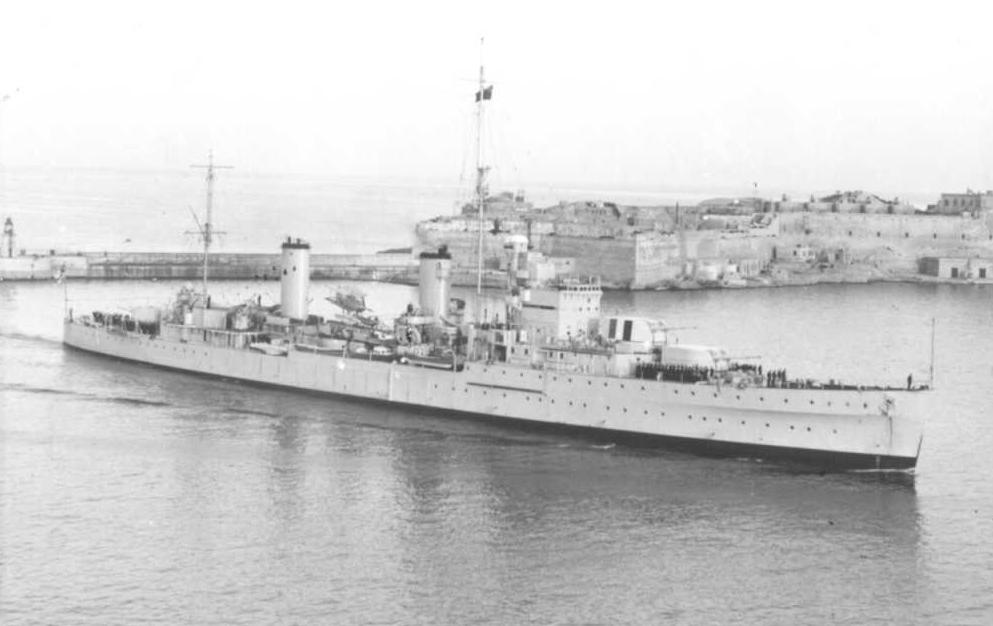
Late on the 8th,
heavy cruisers YORK, DEVONSHIRE,
BERWICK and light cruiser GLASGOW, soon to be joined by
French light cruiser
EMILE BERTIN and her destroyers, were ordered to join the
2nd Cruiser
Squadron at 0500/9th in 59-30N, 2-30E and sweep up the
middle of the North
Sea towards Adm Forbes' Main Force. The Eighteenth Cruiser
Squadron, further
north, was also ordered to sweep north towards Forbes.
Late on the 9th
light cruisers ARETHUSA (above - Navy Photos/Mark
Teadham) GALATEA, EMILE BERTIN,
and French destroyers MAILLE BREZE and TARTU were ordered
to
pin down German ships at Bergen and Stavanger and prevent
their reinforcement. This patrol was terminated at
0400/10th. By the next
evening, the Admiralty ruled interference with enemy
communications in the
southern areas must be left mainly to submarines,
aircraft, mining, and aided by
intermittent sweeps when forces allow.
Admiral Forbes in
battleship RODNEY with battleship VALIANT, light cruiser
SHEFFIELD, destroyers SOMALI, KELVIN, KASHMIR, JUPITER,
MASHONA and MATABELE turned south on receipt of
intelligence of ships in the Skagerrak and Kattegat to
join light cruisers MANCHESTER and SOUTHAMPTON
which were unsupported off Norway's southern coast.
(Note: It is important to note here
that the Germans had broken the British Fleet Code,
which enabled the Germans to avoid nearly all British
ship movements on their way to the Norwegian
ports. That is why very few intercepts were made
until after the German ships reached their
destinations.)
_____
NORWEGIAN
NAVAL FORCES
As the German
Oslo Group neared its destination late on the 8th, the
Norwegian Naval Forces
in the area were the old decommissioned coastal defense
ships HARALD
HAARFAGRE and TORDENSKJOLD, minelayer OLAV TRYGGVASON
which was at Horten for
repairs, fishery protection vessel FRIDTJOF NANSEN, 355
ton minelayers
GLOMMEN and LAUGEN at Melsomvik, 254 ton minelayers VIDAR
and NOR, 254 ton
minelayer BRAGE laid up at Melsomvik, minesweepers HAUK,
FALK, HVAS, KJAEK at
Tonsberg, and minesweepers OTRA and RAUMA at Horten. Old
Norwegian submarines
A.2, A.3 and A.4 of the 1st Submarine Division were
berthed at Horten and
submarine B.4 was refitting at Horten.
_____
START
OF NARVIK OPERATIONS
In the late
evening of the 8th, the German Narvik Group reached the
entrance to Vestfjord
and as the destroyers entered Narvik fjord for
Narvik, battlecruisers GNEISENAU
and SCHARNHORST turned out to sea to draw the main part of
the Home
Fleet away from the Norwegian coast.
Late on the 8th,
the Admiralty finally awoke to the true nature of the
German naval
activity around the Norwegian coast and decided that
Narvik was threatened. Battlecruiser
REPULSE, light cruiser PENELOPE, destroyers BEDOUIN,
KIMBERLEY, PUNJABI and ESKIMO, which had been detached to
assist destroyer GLOWWORM, were sent north
at 1956/8th to join the RENOWN force off Vestfjord.
Destroyer HOSTILE joined
the REPULSE force during the night and all arrived off
Vestfjord at 1130/9th.
_____
ALLIED
SUBMARINE OPERATIONS
Submarine SEAL
was involved in a collision with Estonian steamer OTTO
(1954grt) northwest of
Egersund. Only minor damage was sustained with the
pressure hull leaking
slightly. SEAL was able to continue patrol, reconnoitering
Stavangersfjord and acting as a beacon ship for the
Stavanger bombardment on
the 16th before returning to Rosyth on the 19th. SEAL went
on to
Blyth arriving on the
20th and was transferred to the 6th Submarine Flotilla for
minelaying mission
FD.7.
Polish submarine
ORZEL intercepted German transport RIO
DE JANIERO (5261grt)
off Lillesand in 58‑07. 8N, 8‑29. 4E at 1110. After
ordering the
crew and troops aboard into lifeboats, ORZEL fired one
torpedo at 1145 and
another torpedo at 1155. The transport was sunk. Norwegian
destroyers ODIN
and GYLLER and fishing boats picked up the RIO DE JANIERO
personnel. It was learned from the troops aboard the
German ship that they
were en route to protect the port of Bergen. However, no
heed was paid this report, either by the British or the
Norwegians.
Submarine
TRIDENT on patrol in the Northern Skagerrak at 1215
stopped
German tanker POSIDONIA (8036grt) on her maiden voyage off
Rauer in 58‑54N,
10‑21E. The crew scuttled the tanker as they abandoned
ship. TRIDENT
finished off POSIDONIA with torpedoes at 1320 near
Stavern. POSIDONIA
was salvaged in June and renamed STEDINGEN.
At 1800,
submarine TRITON sighted the German Oslo Group and
unsuccessfully attacked it
off the Skaw. She was able to fire ten torpedoes
between 1758 and 1906 at heavy cruiser LUTZOW but missed.
TRITON
was then heavily counterattacked by German torpedo boat
ALBATROS.
Submarine
SUNFISH also contacted the Oslo Force, but was unable to
reach a position to
fire torpedoes.
Scapa Flow was bombed by
the 20 He.111's of KG.26, but as the entire Fleet was
already at sea, no damage was
done.
_____
German armed
merchant cruiser ORION, breaking out during these
operations, first
encountered a merchant ship in the North Sea escorted by
an allied destroyer and later
minelayer TEVIOTBANK and her four destroyers, but was able
to proceed
undetected.
_____
French
destroyers TARTAR and MAILLE BREZE arrived at Scapa Flow
at 0900, and escorted by destroyer ENCOUNTER to the oilers
and buoys. FOUDROYANT (Capitaine de Corvette Paul
Fontaine), BRESTOIS (Capitaine de
Fregatte J. L. C. Kraft), and BOULONNAIS (Capitaine de
Corvette J. C. F.
Champion) arrived at 1300 and again led in by
ENCOUNTER to the oilers and buoys.
_____
Destroyer KEITH
departed Dover at 1000 for Dunkirk carrying Vice
Admiral B. H. Ramsay CB, MVO. Ramsay was en route for a
conference with
Amiral Nord regarding the possibility of French trawlers
taking over North
Goodwins Patrol and French trawlers cooperating with
British trawlers in
anti-submarine operations in the Straits of Dover. Admiral
Ramsay and
destroyer KEITH arrived back at Dover at 1800.
_____
Convoy MT.47
departed Methil, escorted by destroyer WOLSEY, sloop
AUCKLAND, and anti-submarine
trawlers of the 19th Anti-Submarine Group, and arrived the
next day.
_____
Greek steamer
OKEANIA
(4843grt) was sunk in 51‑18N, 02‑04E on a mine (Seekrieg -
laid by
Schiff 11), with the Chief Engineer missing. Destroyer
BOADICEA on
North Goodwin Patrol and minesweeper HUSSAR proceeded to
assist, with
BOADICEA picking up twenty nine survivors and Dutch
steamer
BEVERLAND the remainder.
Tuesday,
9
April
NORWEGIAN CAMPAIGN
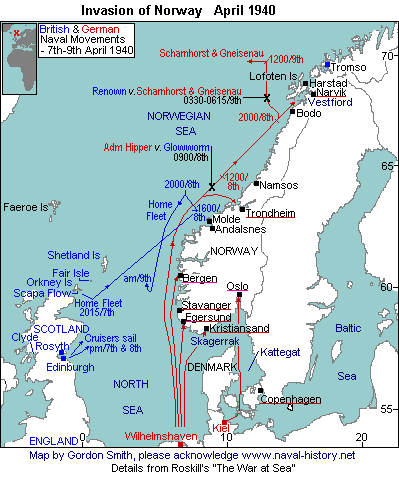
GERMAN
OSLO GROUP
Just after midnight,
Norwegian
submarine A.2 attempted to attack the German Oslo Group as
it entered
Oslofjord off Bolaerne, but was damaged in the
counterattack by motor
minesweeper R.23 and forced to the surface. A.2 was able
to escape, but she
surrendered at Teie on the 13th. Norwegian patrol boat POL
III
(trawler,
214grt) then encountered the Oslo Group. She challenged
the German ships and
getting no reply opened fire with her single gun. POL III
was soon
overcome and sunk by German torpedo boat ALBATROS with the
loss of eighteen crew.
Early on the
9th, motor minesweepers R.20 and R.24 landed troops at
Rauoy, and R.22 and
R.23 at Bolaerne. However, when R.17 and R.21 attempted to
landed troops at Horten, Norwegian minelayer OLAV
TRYGVASSON and minesweeper
RAUMA sank R.17 and damaged torpedo boat ALBATROS
and motor minesweeper R.21,
despite covering gunfire from ALBATROS and KONDOR.
Early on the 9th, in the
Drobak Narrows, German heavy
cruiser BLUCHER was sunk by eight and eleven inch
gunfire from the
fortifications at Drobak and Kaholm and two torpedoes from
the Kaholm
fortification. She was struck by the first eleven inch
shell at 0520 and two
torpedoes at 0521. At 0732, she rolled over and sank with
Kapt. z. S. H.
Woldag, thirty eight officers, and 985 ratings lost. Heavy
cruiser LUTZOW was
struck by three eleven inch shells and
light cruiser EMDEN was hit but not
seriously. With this damage, the German force retired
temporarily. Oslo fell to ground
forces brought there by aircraft and the Oslo Naval Group
entered Oslo midday on the 10th. EMDEN and the R-boat
Flotilla remained at Oslo for six weeks
for anti-aircraft defense and garrison duties. They
returned to Germany on 21 May.
With
the fall of Oslo, the Germans gained possession of two
unnamed Norwegian destroyers
building at Horten, SLEIPNER class destroyers TOR
outfitting at Fredrikstad, BALDER outfitting at
Horten, minelayer OLAV TRYGVASSON, and submarines
A 3, A 4 and B 4.
The destroyers under constrction were never completed
during the war
due to continuing acts of sabotage. TOR and BALDER had
been scuttled,
but the Germans were able to salve them and recommission
them on 13
June and 26 July, respectively. OLAV TRYGVASSON was
commissioned on the
28th as ALBATROS, and later in 1941 renamed BRUMMER.
Submarines
A.3 and A.4 were scuttled by German forces on the 16th at
Sauholmsundet
near Tonsberg, while B 4, which surrendered at Filtvedt on
the 10th,
was considered for use by the German,s but due to her poor
condition
was never commissioned.
Norwegian minesweepers RAUMA
(370grt), HAUK
(58grt) and auxiliary patrol boats HVAL
III
(246grt) and BETA
(168grt)
surrendered at Horten on the 9th. Minesweeper OTRA
(370grt) was seized at Filtvedt on the 10th. Minesweeper HVAS
(58grt) was seized at Stavern on the
12th. Auxiliary patrol vessels ALPHA (235grt) and
FURU (85grt) surrendered at
Halvorshamn on the 12th. Minesweepers FALK
(58grt). KJAEK (58grt) and
auxiliary patrol vessels FARM
(424grt), SKUDD
I (247grt), SKUDD II (247grt), OTER I
(251grt), HVAL II (224grt), RAMOEN
(299grt), SAETRE (172grt) and SARPEN
(187grt) surrendered at Tonsberg on the
13th. Minelayer BRAGE (236grt) and auxiliary
patrol vessel TREFF (204grt)
surrendered at Melsomvik on the 14th. Whale catchers SAIMA
(217grt)
and SOUSA (217grt) laid up at Tonsberg were seized
on the 9th.
Oslo was supplied by small
tankers EUROLAND (869grt) and SENATOR (845grt) which had
departed Hamburg on the 6th and
cargo ships ANTARES (2593grt), IONIA (3102grt),
ITAURI (6838grt), MUANSA (5472grt) and NEIDENFELS
(7838grt) which had departed Stettin at 0200/7th and
arrived as soon as Oslo was secured.
They
were followed two days later by eleven steamers carrying
the 196th Division.
These were ESPANA (7456grt), FRIEDENAU (5219grt), HAMM
(5874grt), HANAU (5892grt),
KELLERWALD (5032grt), ROSARIO (6079grt), TUCUMAN
(4621grt),
WANDSBEK (2388grt), WIGBERT (3648grt) and WOLFRAM
(3648grt) which departed Gotenhafen at 1600/8th for Oslo,
and steamer
SCHARHORN (2643grt) which departed Konigsberg at 1600/8th
for
Frederikstad.
Three days later, twelve
steamers (72,575grt) departed Hamburg carrying the
181st Infantry Division. In this group were tanker
FRIEDRICH BREME
(10,397grt) which was carrying fuel for aircraft based
near Oslo and steamer FLORIDA (6148grt).
Three
days after the third group, another convoy carrying the
214th Infantry
Division and rest of the 196th Infantry Division arrived
at Oslo. In addition,
independently-routed supply ships began to regularly
arrived at Oslo starting with MOLTKEFELS (7863grt),
UTLANDSHORN (2643grt) and URUNDI
(5791grt) on the 16th, LEUNA (6856grt) and BUENAS AIRES
(6097grt) on the 18th with Machine Gun Battalion 13, and
ENTRERIOS (5179grt), CAMPINAS (4541grt), CORDOBA (4611grt)
and SCHARHORN (2643grt) on the 22nd.
_____
GERMAN
U-BOAT OPERATIONS
German U-boats
operated off Norway in support of
Fleet operations under Operation HARTMUTH. Early on the
9th, they were
deployed as following. In Vestfjord were U.25, U.46, U.51
and U.64 which had departed Kiel on the 6th and
was en route. Off Trondheim were U.30 and
U.34. Off Bergen were five
submarines - U.9 and U.14 southwest of Bergen, U.56 due
west of Bergen, and U.60 and U.62 northwest of
Bergen. Off Stavanger were U.1 and
U.4, with U.1 off the actual harbour entrance and U.4 off
the outer
channel in a position to protect Haugesand as well.
Northeast of Lerwick, Shetlands
were U.48, U.49, U.52. U.50 was supposed to be
southeast of Lerwick, but had been
lost on a mine on the 6th in 54-15N, 5-06E with the entire
crew of forty
four dead. U.38 and U.47 were to the north of the
Shetlands. U.37 escorted armed
merchant cruiser ATLANTIS as far as the Denmark Strait
until being
detached on the 5th, after which she arrived off the
Shetlands and joined this
group.
East of the Pentland Firth
were U.13 and
U.57 with U.58 and U.59 to the west of Pentland Firth. Off
Stavanger and the Naze
were U.2, U.5, U.6 and later U.3. U.2 was west, southwest
of Egersund,U 5 was
west, southwest of Lindesnes,and U.6 was
southeast of Lindesnes. On arrival, U.3 was stationed
west,
northwest of Lindesnes. U.2 was forced to return to
Wilhelmshaven on the 12th
with hydroplane defects. The submarine arrived on the 15th
for repairs. Southeast
of the Shetlands were U.7, U.10 and U.19. U.7 was
southeast of Sumburgh Head,
with U.10 and U.19 east of Fair Island. At the east
end of the English Channel off Rotterdam and Antwerp were
U.17,
U.23, U.24 and U.61. The submarine group northeast of the
Shetlands was
dispersed on the 11th with U.50 and U.52 redeployed
off Trondheim and U.38, U.47,
U.48 and U.49 in Vaagsfjord. U.50, however, had already
been lost on a mine on
the 6th before her order for redeployment was sent. The
submarine group at
the east end of the English Channel was redeployed
on the 13th with U.17, U.23 and U.24 were ordered to
patrol off Bergen and U.61 off Trondheim.
_____
BATTLECRUISER
RENOWN'S ENGAGEMENT WITH SCHARNHORST and GNEISENAU
At
0337/9th, Battlecruiser RENOWN with destroyers GREYHOUND,
ICARUS,
IVANHOE, ESK, IMPULSIVE, HARDY, HUNTER, HAVOCK and HOTSPUR
encountered
German battleships GNEISENAU and SCHARNHORST and an action
ensued in
67‑22N, 09‑42E. RENOWN hit GNEISENAU's main armament
control system
putting it out of order and forcing the German ships to
retire. RENOWN
began to pursue the German ships. HARDY and HUNTER were
able to keep up
with RENOWN for a time in the heavy weather, but the
others fell
behind. At 0658 the destroyers were ordered to patrol the
entrance to
Vestfjord. RENOWN scored two more hits on GNEISENAU, one
of them
crippled GNEISENAU's forward turret, opening it directly
to the sea.
RENOWN received two hits in return. The one hit passing
through the
extreme stern without exploding and the second perforating
the
foremast, severing all internal cables, but also not
exploding. The
searchlights sustained minor damage by splinters. Lt Cdr
M.J. Evans was
the only crewman wounded. In the high speed retirement,
both
SCHARNHORST and GNEISENAU sustained weather damage in the
form of
flooding their forward turrets; GNEISENAU's damage being
much more
severe because of the shell damage to her gun house from
RENOWN's hit.
Three hours after the action began, the German battleships
were able to
outdistance RENOWN which returned to her patrol off
Vestfjord.
_____
Very early on
the 9th, Norwegian destroyer DRAUG at Haugesand captured
German supply ship MAIN (7624grt)
carrying mines to Trondheim. Later that
morning, German aircraft bombed and badly damaged MAIN.
Destroyer
DRAUG was forced to scuttle MAIN
after taking
aboard her crew of sixty seven. Destroyers MATABELE and
SIKH were ordered to
join DRAUG and escort her towards Sullom Voe, where she
arrived at 1700/10th.
The destroyers then rejoined Adm Forbes' Main Force. At
2000/10th, French destroyer
BRESTOIS departed Sullom Voe for Kirkwall with the 65
German prisoners brought there by DRAUG, and then
went on to Scapa Flow. French
destroyer BOULONNAIS escorted DRAUG directly to Scapa
Flow.
_____
Destroyers
ESCORT, JAVELIN, JANUS, JUNO and ECLIPSE departed
Scapa
Flow at 2130 escorting battleship WARSPITE. Aircraft
carrier
FURIOUS with destroyers ASHANTI,
MAORI,
DELIGHT and FORTUNE departed the Clyde at 0001 on the
9th. Aircraft carrier FURIOUS flew on nine Swordfish
aircraft of the 816
Squadron and nine Swordfish of 818 Squadron. The
Skuas of the 801
Squadron were not embarked. DELIGHT suffered weather
damage and was
forced to return to Greenock. The WARSPITE and FURIOUS
groups proceeded to a
rendezvous ten miles north of Muckle Flugga where they met
at 0500/10th. Together, the ships proceeded to join
the Commander in Chief Home Fleet on course 115°, 16
knots, in 61-24N, 2W at 0700/10th.
_____
GERMAN NARVIK GROUP
Norwegian naval
forces at Narvik were coastal defense ships NORGE and
EIDSVOLD at Narvik,
submarines B.1 and B.3 of the 3rd Submarine Division were
at Liland near
Narvik. The following merchant ships were at Narvik early
on the 9th -
Norwegian steamers CATE B (4285grt), ELRID (1712grt),
HAALEGG (1758grt) and
SAPHIR (4306grt), Dutch steamer BERNISSE (951grt), Swedish
steamers BODEN
(4264grt), OXELOSUND (5613grt) and STRASSA (5603grt),
British steamers BLYTHMOOR
(6582grt), MERSINGTON COURT (5141grt), NORTH CORNWALL
(4304grt), RIVERTON
(5378grt) and ROMANBY (4887grt), German steamers AACHEN
(6388grt), ALTONA
(5398grt), BOCKENHEIM (4902grt), HEIN
HOYER(5386grt),MARTHA HENRICH FISSER
(4879grt), NEUENFELS (8096grt), ODIN (5806grt), JAN WELLEM
(11,776grt),LIPPE
(7849GRT), FRIELINGHAUS (4339grt) and PLANET
(5881grt), and Swedish tugs DIANA (213grt) and STYRBJORN
(167grt).
The German
Narvik Group, less GIESE whose hull was holed in heavy
water and had fallen
behind, entered Ofotfjord at 0410 without opposition. The
force
entered Ofotfjord and encountered Norwegian fishery
protection vessels
MICHAEL SARS (207grt) and SENJA (243grt). They ordered the
Norwegian guard
ships to turn about and return to Narvik. German destroyer
ROEDER was
detached to patrol off Baroy to await the arrival of
destroyer GIESE. She captured
Norwegian auxiliary patrol boat KELT (376grt) while on
this patrol. At the Ramnes Narrows, German
destroyer flotilla commander Bonte detached destroyers
LUDEMAN and SCHMIDT to land
troops and capture the Narvik fortifications which prove
to be nonexistent. Abreast
of Herjansfjord, destroyers ZENKER, KUNNE and KOELLNER
were detached to go up
the fjord to Elvegaard where the Norwegian regimental
depot for the area was
located. The depot was captured without resistance.
Destroyers HEIDKAMP
(Pennant
Bonte), ARNIM and THIELE continued on to the harbour of
Narvik. German steamer
BOCKENHEIM (4902grt), believing the approaching
warships to be British, ran
aground and set herself afire. These destroyers
encountered Norwegian coastal defense ship EIDSVOLD
which HEIDKAMP sank after a perfunctory request for
free passage. EIDSVOLD sank taking with her 177 officers
and ratings. Only
eight survivors were rescued. Destroyer ARNIM was already
alongside the wharf
when coastal defense ship NORGE opened fire on her, but
ARNIM was able to
sink NORGE without damage to herself. NORGE sank
with 104 officers and
ratings lost and 97 survivors, one later dying of wounds.
Norwegian submarine
B.1 scuttled herself at Liland in Ofotfjord after
an unsuccessful attempt to
get to sea. Submarine B.3 was able to escape and
reached safety in a fjord
further north on the Norwegian coast.
_____
GERMAN EGERSUND GROUP
The cable
station at Egersund and protecting torpedo boat SKARV were
taken by surprise
by German minesweepers M.1, M2, M.9 and M.13. Both fell
into German hands with
no resistance. On the 11th, submarine CLYDE was ordered to
investigate the landing of troops at Egersund.
_____
GERMAN KRISTANSAND GROUP
Norwegian naval
forces at Kristiansand were composed of SLEIPNER class
destroyers ODIN and
GYLLER, submarines B.2 and B.5, refitting torpedo boat
KJELL, which was under
repair, old torpedo boats LYN, BLINK, which was under
repair, and KVIK. Norwegian
destroyer SLEIPNER of the 2nd Destroyer Division based at
Bergen was at Kristiansand. German torpedo
boat GREIF of the Kristiansand force was
detached to land troops at Arendal. Although landings were
delayed by fog
until 0900, Arendal fell without difficulty to German
troops. The German
Kristiansand force entering harbour was forced to retire
twice under
bombardment from shore batteries at Odderoy. Later in the
morning, a message
in Norwegian code was sent to the Norwegian commander
stating that French
destroyers were coming to his aid. Expecting these, light
cruiser KARLSRUHE and torpedo
boats LUCHS and SEEADLER were allowed to enter the port by
the defending
Norwegian forces and the town was forced to surrender by
1700/9th. The
Norwegian ships surrendered at naval station at Marvika on
the 11th.
Destroyers ODIN and GYLLER, submarines B.2
and B.5, torpedo boat
KJELL, old
torpedo boats LYN (38grt), BLINK (38grt)
and KVIK (38grt), auxiliary patrol
vessels W. BARENTS (205grt), FIRERN
(217grt), LYNGDAL (149grt), HVAL IV
(248grt), HVAL VI (248grt) and HVAL
VII
(247grt)
surrendered at Marvika.
The two Norwegian
destroyers were taken over on the 11th by the German
Navy and commissioned on the 25th 1940 as LOWE (former
GYLLER) and
PANTHER (former ODIN) for duty in the 7th Torpedo Boat
Flotilla. The
7th Torpedo Boat Flotilla was later also composed of TIGER
(former TOR
which had been scuttled at Horten), commissioned on 13
June 1940 and LEOPARD (former BALDER also taken at
Horten), commissioned on 26 July 1940. In December
1940, the 7th Torpedo Boat Flotilla command was terminated
and the former
Norwegian destroyers were transferred to the 27th
Submarine Hunting (UJ)
Flotilla. Submarine B.5 was
commissioned at Kristiansand on 20 November
1940 as UC.1, and torpedo boat KJEL at Kristiansand
on the 19th 1940 as TIGER and renamed KT.1 in June 1940.
Torpedo
boat TEIST, which was at Farsund, when the attack
took place, scuttled
herself near Farsund on the 14th. Old torpedo boats JO
(55grt), which had
been at Arendal, GRIB (55grt), which had been at
Risor, and
RAVN
(55grt), which
had been at Langesund, were scuttled at Lyngor on the
17th. In addition, torpedo boats ORN
(55grt) and LOM (55grt) of this division were
repairing at Horten and
surrendered there on the 9th. Swedish steamer ALBERT
(1745grt) was seized by
German forces at Kristiansand, and renamed DORA
CHRISTOPHERSON for German use.
_____
German steamer
SEATTLE (7369grt), which had departed Curacao on
5/6 March
and called at Tromso on 31 March, arrived off Kristiansand
as the German
force arrived. She was sunk by gunfire from Norwegian
destroyer GYLLER. (Seekrieg
- destroyer Sleipner)
_____
Supplies for the
Kristiansand and Arendal German troops were embarked on
German steamers
AUGUST LEONHARDT (2593grt), which was lost at sea
en route, KRETA (2359grt),
which arrived three days late, WESTSEE (5911grt) and
WIEGAND (5869grt) which had
all departed Stettin at 1700/6th.
_____
GERMAN BERGEN GROUP
The Norwegian
naval vessels at Bergen were torpedo boats STORM and SAEL,
minelayers TYR
(281grt) at Klokkarvik, VALE at Littlebergen, ULLER at
Bergen and GOR at Herdia
of the 2nd Minelayer Division, plus armed auxiliaries HAUS
(135grt),
LINDAAS (138grt), ALVERSUND (178grt), MANGER (153grt) and
OYGAR (128grt). The
1st Destroyer Division was based at Bergen, with GARM at
Herdla, north of Bergen, TROLL at
Maloy, and DRAUG at Haugesand. The 2nd Destroyer
Division was also based at Bergen, with AEGER at
Stavanger and SLEIPNER at Kristiansund. Old torpedo boats
DJERV and DRISTIG were at Littlebergen.
The 1st Torpedo Boat Division was based at Bergen, with
SNOGG was at
Floro and STEGG at Skudesneshavn. The 4th Torpedo Boat
Division was based at at Bergen, with STORM at
Hummelsund, BRAND at Bergen, and SAEL at
Brandasund. The 5th Torpedo Boat Division was originally
based at Trondheim, but was in the
Bergen area with SKREI at Hestvika on
Hita (scuttled 8 May at Aspoy), SILD at
Kristiansand (scuttled 5 May at Svanholmen) while SAKS
was under repair at Trondheim and surrendered
on the 13th.
The German Bergen Group
arrived off Bergen and the
cruisers identified themselves as HMS CAIRO and HMS
CALCUTTA and KARL PETERS
identified herself as HMS HALCYON which were regular
callers at Bergen since being
assigned to the ON/HN convoy escorts. As such, German
light cruisers KOLN and KONIGSBERG were allowed to
enter the fjord, but the shore batteries at Kvarven awoke
to the deception
and put three eight inch shells into KONIGSBERG and one
into
training ship BREMSE. On KONIGSBERG sixteen crew
were killed and thirty one wounded. Norwegian minelayer
TYR hurriedly dropped
eight mines between Sotra and Leroy and withdrew
undetected at the mouth of
the fjord. Norwegian torpedo boat STORM torpedoed the
leading German torpedo
boat, but the torpedo failed to explode. Bergen
surrendered
before dawn on the 9th. All the defending Norwegian naval
vessels were able
to escape into nearby Hardangersfjord. The fortifications
at Sandviken fired
on light cruiser KOLN at anchor in the harbour, but when
KOLN returned fire,
the fort ceased firing. By 0930, both Kvarven and
Sandviken were in German
hands.
The following vessels were
seized by German forces at Bergen and mostly renamed for
German service. Swedish merchant ship GALLIA
(1419grt), renamed
DEIME. Swedish steamer FAVERVIK (1912grt), renamed
TURKHEIM. Swedish steamer MONARK
(1786grt) was lost when the German
prize crew attempted to sail her back to Germany in early
May. Finnish
steamer ANTON H. (1436grt), renamed
ADMIRAL KARL HERING. Finnish steamer USKO
(1876grt) , renamed
DIETRICK OLDENDORF. Estonian steamer KADLI
(1818grt), renamed
HUMMEL. Estonian steamer ARCTURUS (1682grt), whose
crew was
returned to Tallinn, via Stockholm. Estonian
steamer AKSI (844grt), renamed STRASSBURG. Danish
steamer GERDA (1151grt) had
arrived at Bergen on the 4th, was later ordered to
Stavanger, and en route, struck a mine on 8 May off
Flesland and drifted ashore. Panamanian steamer
ANGLO (2978grt) renamed
SEEFAHRER.
Supplies for the
German Bergen force were embarked on tanker BELT (322grt),
which departed
Brunsbuttel on the 9th, steamers CURITYBA (4969grt), MARIE
LEONHARDT
(2594grt), and RIO DE JANIERO (5261grt) which departed
Stettin at 0400/6th.
However, RIO
DE JANIERO was lost en route and CURITYBA was
considerably delayed. On the 7th, four miles north of
Helsingborg, she ran
aground, two tugs and one anti-submarine patrol boat
arrived to assist and
CURITYBA was refloated on the 8th to continue her voyage.
_____
A RAF Coastal
Command Blenheim of 254 Squadron, carrying observer Lt Cdr
G. Hare RN, of 712
Squadron in light cruiser SHEFFIELD, sighted the
German warships at Bergen during the
morning. At 1900, twelve Hampden bombers of 50 Squadron,
six Wellington
bombers of 9 Squadron, and six Wellington bombers of 115
Squadron of Bomber
Command attacked light cruisers KOLN, KONIGSBERG and
training ship BREMSE
at anchor at Bergen but did not score any hits. During the
evening of the 9th,
KOLN with torpedo boats WOLF and LEOPARD was preparing to
leave Bergen, KONIGSBERG was unfit for sea and left behind
for
repairs. KOLN put to sea at
2100 with the two torpedo boats and followed the Leads
south, anchoring at
Maurangersfjord until the afternoon of the 10th before
continuing. Off the Elbe at 0545/11th,
they were joined by German destroyers SCHOEMANN and
BEITZEN which escorted
them to Wilhelmshaven, arriving at
1700 that evening.
_____
GERMAN TRONDHEIM GROUP
The primary
Norwegian naval unit at Trondheim was minelayer
FROYA, which was en route from the Kirkenes to Horten. On
the 9th, she was in
Skjornfjord in Trondheimsfjord. Also at Trondheim was the
14th
Patrol Boat Division with auxiliary patrol boats HEILHORN
(192grt) at Beiarn
and STENKJAER (158grt) and FOSEN (273grt) at Agdenes. The
two patrol boats at
Agdenes surrendered at Hasselvika on the 9th. Finally,
patrol boat NAUMA (219grt) of this
division was under repair at Trondheim and surrendered
on the 13th. The Trondheim Group entered Trondheimsfjord
without
firing a shot. Destroyers JACOBI, RIEDEL, HEINEMANN were
detached near the
fortifications of Brettingen and Hysnes with landing
parties to neutralize
the forts, while heavy cruiser ADMIRAL HIPPER and
destroyer ECKHOLDT continued
on to Trondheim.
Cruiser
ADMIRAL HIPPER had already passed the fortifications when
the guns at
Hysnes opened fire. Destroyer RIEDEL getting underway
rapidly,
accidentally ran aground doing considerable damage to her
hull. Gunfire
from ADMIRAL HIPPER sent up clouds and smoke and dust
spoiling the aim
of the fort's gunners. RIEDEL was able to get herself off
only by the
crew all going aft. The destroyer was then beached in
Strommen Bay for repairs
until 20 April. ADMIRAL HIPPER and destroyer ECKHOLDT
anchored
in Trondheim harbour at 0525
and the town surrendered without a shot. Norwegian
minelayer FROYA attempted
to escape from Trondheimsfjord, but was damaged by German
coastal artillery
and forced aground where she was scuttled by her crew on
the 13th (Seekrieg -
sunk by U.34 in Drontheim Fjord). Finnish
steamer EMMI (1592grt) was seized by German forces
at Trondheim and renamed
SCHIRMECK for German service.
The Trondheim
supply ships, tanker MOONSUND (321grt), had departed
Brunsbuttel on the 9th,
steamers MAIN
(7624grt) and SAO PAULO (4977grt) were
lost en route; SAO PAULO late on the 9th at
Brantholm in 60‑30N, 05‑10E.
The fourth supply ship, steamer LEVANTE (4770grt) did not
arrive until 12 April.
_____
Just after dark
on the 10th, heavy cruiser ADMIRAL HIPPER left Trondheim,
bombarding the
fortifications once as she left the fjord. She took
destroyer ECKHOLDT with
her, but in heavy seas, the destroyer was forced to return
to Trondheim. The other
three German destroyers were immobile. Destroyer RIEDEL,
which had run
aground, and HEINEMANN, which had defects, were cripples
and JACOBI was too low
on fuel to even attempt the return trip. The non arrival
of tanker SKAGERRAK (6044grt),
which was delayed at Kopervik, and the loss of supply ship
SAO PAULO (4977grt),
which was mined near Bergen, was greatly affecting German
destroyer activity. The fuel supply was so acute that
ADMIRAL HIPPER had to return without refuelling and
arrived back in Germany
with only 123 tons of fuel (two and a half hours steaming)
remaining in her
bunkers.
_____
By mid-morning
on the 9th, reinforcements had reached Admiral Forbes in
the form of heavy
cruisers DEVONSHIRE, BERWICK and YORK of the 1st
Cruiser Squadron, light cruisers ARETHUSA and GALATEA of
the 2nd Cruiser
Squadron, GLASGOW, SOUTHAMPTON and MANCHESTER of the
18th Cruiser Squadron,
French light cruiser EMILE BERTIN, destroyers ELECTRA,
CODRINGTON, GRIFFIN,
ESCAPADE, GURKHA, SIKH, AFRIDI, MOHAWK, ZULU and COSSACK,
Polish destroyers
GROM, BURZA and BLYSKAWICA and French large destroyers
MAILLE BREZE and TARTU. At
0400, destroyer KELVIN ran into KASHMIR's stern in 60‑28N,
2‑25E. KASHMIR's stern was badly damaged and Temporary
Surgeon Lt J. N. Haggar RNVR, of KASHMIR, killed in
his bunk. Destroyer COSSACK was ordered to tow KASHMIR to
Lerwick
escorted by destroyers ZULU and the damaged KELVIN.
At 1415, destroyer ZULU
attacked U.19 north of the Orkneys after the submarine
surfaced near the British ships, but she escaped with no
more than light damage. The
British ships arrived safely at Lerwick on the 9th.
Destroyers COSSACK and
ZULU immediately departed after refuelling on the 10th to
rejoin the British
forces off Norway. French
destroyers BRESTOIS and FOUDROYANT departed Scapa Flow at
1325/12th
for Lerwick. On the 12th, destroyers KELVIN, proceeding
stern first, and KASHMIR departed Lerwick
for the Tyne, and were met at sea by the French
destroyers. They all safely arrived on the 13th at 2030.
KELVIN
arrived at Scapa Flow after repairs on 28 May and KASHMIR
returned to
service on 13 June.
_____
Destroyers JANUS
and ECLIPSE carried out six depth charge attacks at 1355
on a submarine
contact in 59‑01N, 2‑24W. This contact was later found to
be a
wreck.
_____
Destroyers
HYPERION and HERO arrived at Sullom Voe to refuel at 1430.
_____
Convoy HN.25 had
departed Bergen on the 7th, but
was recalled, and on the morning of the 9th was waiting in
a fjord
near Hovden, north of Bergen, when word was
received that Bergen had fallen to
German troops. When German tanker SKAGERRAK (6044grt)
arrived at Hovden at noon on the 9th en
route to Trondheim, Captain J. S.
Pinkney, acting convoy commodore and Master of steamer
FYLINGDALE (3918grt)
left with the convoy at 1400. Convoy HN.25 was composed of
twelve British,
nine Norwegian, eight Swedish, five Danish, two Finnish
and three Estonian
ships. It was formed into four columns with steamers
FYLINGDALE
(3918grt), GLEN TILT (871grt), BRIGHTON (5359grt) and LEO
(1140grt) as column leaders. In this convoy were British
steamers NYANZA
(4974grt) and NORTH DEVON
(3658grt) which were in fjord after arriving from the
aborted ON.25
convoy. NYANZA was the last steamer to leave Hovden.
Destroyer
ZULU and Polish destroyers GROM, BURZA and BLYSKAWICA were
ordered to
join convoy HN.25 and escort it into the Firth of Forth,
but ZULU was
replaced by destroyer TARTAR before joining the convoy. At
1500/9th,
the allied destroyers joined convoy HN.25, and at
1700/11th,
TARTAR attacked a submarine contact, which brought
up air and
oil, but no submarine was lost at that time. The last
Norwegian convoy
arrived safely at Methil at 1300/12th.
_____
At Boknfjord,
near Stavanger, Norwegian
destroyer AEGER sank German steamer RODA
(6780grt), carrying anti-aircraft guns. RODA, which had
departed Hamburg on the 3rd, was
bringing these guns and other supplies to two battalions
of German
paratroopers which had captured Sola airfield. Later on
the 9th, AEGER was sunk by German Ju.88 aircraft
of KG.4, already based at Sola on the 9th.
Seven crew were killed, one fatally wounded, and one
severely wounded.
Greek steamer
SPYRIDON (3527grt) arrived at Stavanger on the 9th
for
repairs, seized by German forces and renamed EKENES
for German
service.
_____
U.56 at 0920
sighted Battleship RODNEY and VALIANT southwest of
Stadlandet steering south
and radioed this information to the German command.
_____
At
1130, Admiral Forbes dispatched light cruisers
SOUTHAMPTON, MANCHESTER,
SHEFFIELD and GLASGOW of the 18th Cruiser Squadron with
destroyers
GURKHA, SIKH, MOHAWK, MATABELE, MASHONA, SOMALI and AFRIDI
for a raid
on Bergen where the damaged German ships KONIGSBERG and
BREMSE and
undamaged cruiser KOLN were located. At 1400, the
Admiralty cancelled
the operation and ordered the force to set course to
return to the Main
Fleet which had turned north to open the distance between
themselves
and German land based aircraft. As the Bergen raiding
force arrived
back at the Main Fleet, the Luftwaffe, which was alerted
by U.56's
report arrived on the scene with 47 Ju.88 bombers from
KG.30 and 41
He.111 bombers from KG.25, southwest of Bergen. German
attacks on the
British fleet continued from 1430 to 1730, and four
JU.88's were
downed.
Destroyer GURKHA,
which had reduced speed to improve her gunnery in heavy
seas, was fatally
damaged by near misses aft in these attacks 100 miles
southwest of Bergen. Lt M.F. J.
Ferguson, Lt D. O. Smith, Lt Cdr (E) I. C. Howden,
Probationary S/Lt N. C. J.
S. Hutchings RNVR, Temporary Surgeon Lt D. N. B. Morgan
RNVR, ten ratings
were lost with GURKHA, which was left behind in a sinking
condition as the Main Fleet continued on under heavy
bombing attacks (Seekrieg
- sunk by He.111's of KG.26).
Light cruiser AURORA, en route from Scapa Flow
to join Adm Forbes, came upon the sinking GURKHA,
and fought off
five air assaults while picking up 194 survivors and
attempting to tow
the damaged ship. Destroyer MASHONA picked up five
survivors and one
dead rating. GURKHA sank four and a half hours after
receiving her
fatal damage, and her survivors taken directly to Scapa
Flow.
Battleship
RODNEY was struck by a 500 kilogram bomb which failed to
penetrate the armour
belt and caused only injuries to Paymaster Midshipman W.
R. H. Lapper,
Commissioned Gunner F. G. Roper, Midshipman J. C. S.
Wright, and seven ratings. Attacks
on heavy cruiser DEVONSHIRE caused some splinter damage
from near
misses. Light cruisers SOUTHAMPTON and GLASGOW were
damaged by near misses. SOUTHAMPTON's damage was
minor and no time was spent out of service. GLASGOW's
damage from
two near misses took 'A' turret out of action for a short
time and the ship's
speed was reduced for about thirty minutes. Damage to
GLASGOW was repaired in
two days while continuing patrol at sea. Two ratings were
killed and five
ratings, one dying of wounds, were wounded in GLASGOW.
Light cruiser
ARETHUSA and French destroyers TARTU and MAILLE
BREZE were near missed by bombs, but not damaged. Among
the German claims for
these attacks was the sinking of the French heavy cruiser
FOCH. In later
communiques, this claim was changed to light cruiser EMILE
BERTIN which
was present, but undamaged.
_____
At Narvik, steamers BLYTHMOOR
(6582grt),
MERSINGTON
COURT (5141grt),
NORTH CORNWALL (4304grt),
ROMANBY (4887grt) and RIVERTON (5378grt)
were seized by German forces and their
crews taken prisoner and placed aboard German tanker JAN
WELLEM (11,776grt). A
working party from the German steamer LIPPE (7849grt)
removed the deck guns from
the captured steamers for coastal defense of the German
positions.
_____
At Trondheim, steamer THISTLEBRAE
(4747grt) in drydock for a 4 April collision at Trondheim,
was seized
by German forces, renamed ALTKIRCH for German
service, and later
renamed INSTER. Her thirty three man crew was made
prisoners of war. American steamer MORMACSEA (4996grt) was
also at Trondheim. However, her
captain would not allow German guards aboard the ship.
Finally, on the 14th,
MORMACSEA was allowed to sail with a hidden cargo of four
and a half million
dollars in Swedish gold bullion for transport to the
United States for
safekeeping.
_____
ALLIED
SUBMARINE OPERATIONS
At 1324/9th, the
Admiralty gave Vice Admiral Horton permission for his
submarines to
sink without warning any German merchant ship in the
Skagerrak, the Kattegat and Heligoland
Bight.
At 1700,
submarine SUNFISH sank German steamer AMASIS
(7129grt) with two torpedoes
northeast of the Skaw off Goteborg in 58‑13N,
11‑13E.
Submarine UNITY
in the Heligoland Bight reported that she had been depth
charged by a
merchant ship.
Submarine TRUANT
off Kristiansand at 1856 sighted
the German light cruiser KARLSRUHE and torpedo
boats LUCHS, SEEADLER, GREIF as they left harbour that
evening on their
voyage back to Germany. Submarine
TRUANT fired ten torpedoes at the German cruiser, one of
which wrecked her
stern and put her engines out of commission. Slowly
settling and without
means to contain the flooding, KARLSRUHE
was abandoned and her crew were aboard the torpedo boats.
Torpedo boat
GREIF administered the coup de grace at 2250 in
57-56N, 8-14E.
TRUANT was able to escape with only minor damage, despite
a determined
effort by the torpedo boats and motor torpedo boats in a
five hour
submarine hunt. She returned to Rosyth on the 12th to make
good damage
and defects.
_____
German steamer
KRETA (2359grt) reported that she was under attack by a
submarine near
Faerder Lightship in the Skagerrak. Later overdue
at Kristiansand, she was presumed
lost but she arrived on the 12th unharmed.
_____
At 1815/9th,
U.49 sighted Forbes' Main Fleet steering north of the
Norwegian coast
northwest of Bergen.
_____
Late on the 9th,
Admiral Forbes ordered all his light cruisers and most of
his destroyers to
return to Scapa Flow or Sullom Voe for refuelling. The
last
units arrived about noon on the 11th. At
1530/10th, light cruisers SHEFFIELD, GLASGOW, MANCHESTER,
SOUTHAMPTON and
destroyers AFRIDI, SOMALI (D.6), CODRINGTON (D.1), MOHAWK,
MASHONA, JUPITER,
BRAZEN, ESCAPADE and ELECTRA arrived at Sullom Voe foe
refuelling. Light
cruisers BIRMINGHAM refuelled at Scapa Flow, AURORA
at Rosyth., and GALATEA
and ARETHUSA refuelled, all on the 11th. French large
destroyers TARTU and MAILLE
BREZE arrived at Scapa Flow with the British cruiser force
at
1900/10th.
_____
During the
evening of 9 April, German destroyer FRIEDRICH ECKHOLDT
penetrated Trondheimsfjord
as far as the neighbourhood of Inderoy where
Trondheimsfjord branches into
the smaller Beitstadfjord. German destroyer PAUL JACOBI,
after refuelling
from damaged destroyer THEODOR RIEDEL, joined FRIEDRICH
ECKHOLDT on the
morning of 10 April. However, heavy ice in the fjord
prevented the destroyers
from progressing beyond Inderoy.
_____
German naval
auxiliary Schiff 111 (lumbership JUPITER, 2152grt) arrived
at Bergen with a cargo of
mines to mine the harbour.
_____
At 0600,
destroyers FAULKNOR (D.8), FOXHOUND and FORESTER arrived
at Scapa Flow from the Clyde, then
departed at 1500 to rendezvous with the Commander
in Chief Home Fleet.
_____
Destroyer
GRENADE arrived at Scapa Flow at 1230 to
refuel.
_____
Destroyers
GRENADE and ENCOUNTER departed Scapa Flow at 1600 with
oiler BRITISH LADY (6098grt) for Vestfjord arriving at
1700/12th.
_____
French large
destroyer CHEVALIER PAUL arrived at Scapa Flow at 0830 and
was
led into harbour by destroyer ENCOUNTER.
_____
French
destroyers BRESTOIS and BOULONNAIS departed Scapa Flow
with British
tanker ALDERSDALE, arriving at Sullom Voe at 1300/10th.
_____
Off Vestfjord
late on the 9th were Minelaying destroyers ESK, IVANHOE,
ICARUS, HARDY,
HOTSPUR, HUNTER, HAVOCK and GREYHOUND. Destroyer IMPULSIVE
with a damaged
paravane boom was sent to Scapa Flow arriving at
0445/11th. Battlecruiser RENOWN, reinforced by
battlecruiser REPULSE, light
cruiser PENELOPE, and destroyers ESKIMO, KIMBERLEY,
PUNJABI,
BEDOUIN and HOSTILE which had arrived off Vestfjord at
1130/9th were out to
seaward of Vestfjord on patrol.
_____
On orders from
the Admiralty, the destroyers of the 2nd Destroyer
Flotilla, HARDY (Captain
B. A. W. Warburton-Lee, D 2), HOTSPUR, HAVOCK and HUNTER
proceeded up Vestfjord
on Operation TN towards Narvik leaving the destroyers of
the 20th Destroyer
Flotilla to patrol the minefield. Destroyer HOSTILE with
the battlecruisers
at sea was detached and joined the 2nd Flotilla off
Tranoy. At 2022 on the
9th, U.51 sighted the five Destroyers of the 2nd Destroyer
Flotilla in
Vestfjord steering westbound, apparently leaving the
fjord. However, this
westward movement was only to adjust the destroyers'
arrival time off Narvik
allowing them to arrive off that port at dawn.
_____
German supply
ship ALSTER (8514grt) and tanker KATTEGAT (6031grt),
which had been delayed at Kopervik over the night of 5/6
April, were in the
Bodo area. KATTEGAT
was sunk late
on the 9th by Norwegian patrol boat NORDKAPP off Neverdal
in Tannholmford,
south of Bodo. ALSTER was stopped on the 8th by
Norwegian
patrol vessel SYRIAN (298grt) and sent into Bodo, but was
captured by
destroyer ICARUS on the 11th. Also at Bodo was Norwegian
auxiliary patrol
vessel SVALBARD 2 (270grt).
_____
Norwegian
fishery protection vessels FRIDTJOF NANSEN and HEIMDAL
were stationed at
Honningsvaag and Tromso, respectively, on this date.
Escort vessel WINCHESTER
completed
conversion at Portsmouth. Following
working up at Portland, she joined
Convoy C operating from Rosyth.
_____
Leading Airman
H. E. Cook was killed when his RAF Battle of 1 SFTS
Netheravon crashed near
Collingbourne Kingston, Wilts. Passenger AC 2/c W. I.
Hammond was also
killed.
_____
Petty
Officer W. E. Chinn and Naval Airman T. G. L. Burgess were
killed when their
Skua of 803 Squadron from Hatston crashed on convoy duty.
_____
Swedish fishing
vessel DAGNY (47grt) was sunk on a mine north of
Hantsholm. Six crew were lost.
_____
Swedish steamer
FRAMNAS (721grt) was seized near Kopervik, renamed
BURGEN and used as a German meteorological ship.
_____
Convoy OA.126
departed Southend escorted by destroyer WINDSOR from the
9th to 10th, and dispersed on the 12th.
_____
Convoy OB.126
departed Liverpool escorted by sloop LEITH from the 9th to
12th,
when she detached to convoy SL.26. Destroyer VENETIA and
anti-submarine trawler YORK CITY joined the escort on the
9th and 10th.
The convoy was dispersed on the 13th.
_____
Convoy BC.32
of four steamers, including BARON KINNARID, JOHN HOLT
(Commodore) and PIZARRO
departed the Loire escorted by destroyer MONTROSE,
and arrived in the
Bristol Channel on the
11th.
_____
Convoy FN.141
departed Southend, escorted by destroyer VALOROUS and
sloop LOWESTOFT, and arrived in the Tyne on the 11th.
_____
Convoy FS.141
departed the Tyne, escorted by sloops FLEETWOOD and
AUCKLAND, and arrived at Southend on the 11th.
_____
French
battleships DUNKERQUE and STRASBOURG with light
cruisers GLOIRE, MONTCALM and destroyers MOGADOR,
L'INDOMPTABLE,
L'TRIOMPHANT and LE MALIN departed Oran for Brest,
arriving on
the 12th. Destroyer TERRIBLE which had come with this
group from Brest departed Oran on the 11th,
escorting armed merchant cruiser COLOMBIE, and arrived at
Brest on the 15th.
_____
Destroyer
VIDETTE was taken in hand for refitting at Gibraltar.
_____
Submarine
PANDORA departed Hong Kong on this date, Singapore on the
14th,
Colombo on the 21st,
Aden on the 29th, and was at Suez on 3 and 4 May.
She arrived at Alexandria on the 5th for
operations with the Home Fleet.
Wednesday,
10 April
NORWEGIAN CAMPAIGN
ALLIED
SUBMARINE OPERATIONS
At 1604/9th in
59-00N, 05-10E, submarine THISTLE fired six torpedoes at
U.4 which submerged
in time to evade the torpedoes. THISTLE received orders to
dive
into Stavanger harbour and
attack merchant ships there, but when she reported her
encounter with the
German submarine, was instructed to remain in the area for
another chance
at the submarine. THISTLE with only two torpedo warheads
remaining
was then to return to Rosyth. At 0113/10th, U.4 torpedoed
and sank THISTLE, which was recharging her
batteries on the surface, northwest of Stavanger off
Skudesnes in 59.00N, 05.00E. Lt
Cdr W. F. Hanselfoot, Lt K. J. Harper, Lt L. A. Jones, Lt
R. P. N. Ennor RNR, Warrant
Engineer G. A. Bowen, and the entire crew of forty eight
ratings were lost.
Submarine TARPON
(Lt Cdr H. J. Caldwell), which was on her first patrol and
working up,
encountered by German Schiff 40 (trawler ARTHUR DUNCKER -
278grt) in 56‑43.
5N, 06‑20. 33E in the North Sea. At 0620,
TARPON fired two torpedoes at the German ship which was
outfitted
as a Q ship, but in the counterattack, was lost to depth
charges. Lt Cdr Caldwell,
Lt Cdr C. B. L. Wren RNR (Ret), Lt L. H.
Kettle, S/Lt H. D. A. Weatherall, Warrant Engineer R. W.
Sherry, and forty eight
ratings were lost.
At 1150,
submarine SUNFISH fired one torpedo at German steamer
HANAU (5892grt) three
miles off Masekar Light, Sweden.
At 1520,
submarine SUNFISH fired two torpedoes at a German steamer
off Masekar Light. The
attack was observed by a trawler of the German 7th VP
Flotilla.
At 1626/10th,
submarine TRITON in the Kattegat in 57-50N,
11-23E sighted the 2nd German Transport Convoy. Submarine
TRITON fired six
torpedoes and sank steamers FRIEDENAU (5219grt),
WIGBERT (3648grt) and
auxiliary patrol boat Vp.1507 (trawler RAU VI,
354grt). Nine hundred German
soldiers of the 340th and 345th Infantry Regiments of the
196th Division were
drowned on the two German transports. TRITON
escaped the counter attack without severe damage.
At 1822, Polish
submarine ORZEL fired two torpedoes at German trawler VP
705 (German trawler
CARSTEN - 258grt) off Larvik in the Skagerrak.
At 1845, submarine TRIDENT
fired two torpedoes at German steamer WANDSBEK (2388grt)
in
58-38N, 10-32E.
At 2000,
submarine SUNFISH hit German steamer ANTARES
(2598grt) with one torpedo off
Skagen in 58‑11N, 11‑17E, near Lysekill, Sweden, and she
sank by the stern at 2230.
Submarine
SPEARFISH was under attack by anti-submarine trawlers of
the 11th UJ.Flotilla
east, southeast of Kristiansand from 1730 to
1840 and again at 2000.
_____
German heavy
cruiser LUTZOW left Oslo in the early
afternoon of the 19th at 1440 as she was required back at
Kiel to prepare for
a raid into the Atlantic. As there were no fast escorts in
the
Oslo Force, it was decided that LUTZOW's speed and
darkness would be
sufficient protection. Intelligence reports of the
presence and sinkings by
submarines TRITON and SUNFISH caused LUTZOW to take a
course to the west of
these submarines' patrol areas. Ten miles north of the
Skaw at 0029/11th,
LUTZOW entered submarine SPEARFISH's patrol area.
Submarine SPEARFISH
sighted and fired six torpedoes at the German cruiser at
0033. She was able
to strike LUTZOW with one torpedo, wrecking her propellers
and rudder. Some
1300 tons of water flooded into LUTZOW. Not knowing LUTZOW
was unescorted,
SPEARFISH made off. Captain Thiele of the LUTZOW
considered running his ship
aground near Laeso Island, but word that
auxiliary minesweepers of the 19th Flotilla and auxiliary
submarine chasers
of the 17th UJ Flotilla along with two German and Danish
tug GARM coming to
his aid held him off. At 0900/11th, four torpedo boats,
including torpedo
boats LUCHS, SEEADLER, GREIF, four escort ships, including
auxiliary
minesweepers M.1907 (trawler HEINRICH BAUMGARTEN, 467grt)
and M.1908 (trawler
YORCK, 470grt), the tugs arrived and six hundred men were
taken off LUTZOW
and taken to Frederikshavn. LUTZOW was towed back to Kiel
arriving late
on the 13th.
_____
Light cruiser MANCHESTER,
returning to Scapa Flow for refuelling,
reported running over a submerging German submarine in the
North Sea at 0057.
_____
Destroyers
HESPERUS and HAVANT departed Scapa Flow at 1430 to
search for a German submarine reported by aircraft in
58‑37N, 1‑54W.
_____
Light cruiser
BIRMINGHAM,returning to Scapa Flow for refuelling,
sighted a submarine in 59‑28N, 3‑23W, but no damage was
done to
either ship. Destroyers HESPERUS and HAVANT were sent at
1700 to the area to
search for the submarine. After this patrol, the
destroyers patrolled north
of the Shetlands.
_____
U.37 sank
Swedish steamer SVEABORG (9076grt) in 62‑52N,
07‑34W, with the loss of five crew. Norwegian steamer TOSCA
(5128grt) received SVEABORG's distress signal, arrived on
the scene to
rescue survivors, and was then herself sunk by U.37, in
62‑52N, 07‑34W.
Two crew were lost, and the survivors from both ships
rescued by armed
boarding vessel NORTHERN CHIEF (655grt).
_____
Swedish fishing
vessel INES (48grt) was sunk on a mine northwest
of Hantsholm, with the loss of her crew of
six.
_____
U.49 sighted two
British cruisers west of Stadlandet at 0159.
_____
FIRST BATTLE OF NARVIK
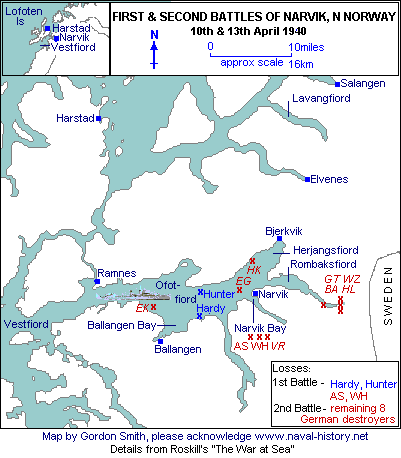
Early on the
10th, German destroyer DIETHER VON ROEDER (VR - see
map) was supposed to be on patrol across the mouth
of Ofotfjord, but the approaches were unguarded. ROEDER
was supposed to
remain on patrol until relieved by HANS LUDEMANN (HL), but
in ROEDER's diary there was the
entry "Am relieving SCHMIDT from 0300 as anti-submarine
patrol until
dawn." ROEDER left her patrol area across Ofotofjord and
turned towards
Narvik with the British 2nd Destroyer Flotilla less than a
mile behind in
heavy snow and mist. ROEDER anchored at Narvik at 0420.
German
refuelling was far behind schedule. While tanker JAN
WELLEM (11,776grt) had
arrived on schedule, the second tanker,
KATTEGAT
(6031grt) was
sunk late on the 9th before reaching Narvik. LUDEMANN and
HERMANN KUNNE (HK) were alongside the converted whaler JAN
WELLEM when the British attack
began at 0430.
Destroyer HARDY went in
first into the harbour and fired seven
torpedoes. One exploded in the after magazine of destroyer
WILHELM HEIDKAMP (WH) blowing
off her stern; eighty one crew members including Commodore
Bonte were killed.
Finally, on the 11th at 0600, as a result of culminating
damage, HEIDKAMP
capsized and sank. Other torpedoes from HARDY struck
merchant ships in the
harbour. As destroyer HARDY withdrew, destroyers HUNTER
and HAVOCK entered
the harbour firing torpedoes. Torpedoes from HAVOCK struck
ANTON SCHMITT (AS) , seriously
damaging her. Destroyer KUNNE, getting underway from
alongside the tanker,
was near SCHMITT when the torpedoes hit and sustained
damage to her engines
from the concussion. SCHMITT, rolling over,
settled onto KUNNE immobilising
her for forty minutes. Sixty three crew were killed on the
destroyer SCHMITT.
German destroyer LUDEMAN had a gun knocked out from
shellfire and a fire
which necessitated flooding of her after magazine. Two
crew were killed on
the destroyer LUDEMAN.
Destroyers HOSTILE and
HOTSPUR had been detailed to
neutralize nonexistent coastal batteries on the north
shore of Narvik. Upon finding
no batteries, the destroyers entered the harbour fight.
Destroyer HOTSPUR
fired torpedoes at numerous merchant ships in the harbour
and HOSTILE went
into a gun action with German destroyer ROEDER damaging
her so severely that
the German captain ordered his ship abandoned. As the
destroyers withdrew,
destroyers HOSTILE and HOTSPUR laid a smoke screen and
HOSTILE fired her
torpedoes against merchant ships in the harbour. The 2nd
Destroyer Flotilla
then began its withdrawal out of the fjord. During this
battle, British
steamer BLYTHMOOR (6582grt), Norwegian steamers SAPHIR
(4306grt) and ELRID
(1712grt), Swedish steamers STRASSA (5602grt) and
BODEN (4265grt), German
steamers FRIELINGHAUS (4339grt), HEIN HOYER
(5836grt), NEUENFELS (8096grt),
MARTHA HEINDRIK FISSER (4879grt), AACHEN
(6388grt), ALTONA
(5398grt) were lost to British torpedoes and British and
German
gunfire. Six of crew of the BLYTHMOOR were lost. Thirty
crew were
interned in Sweden. Seven of the
British steamer crew were picked up by HM ships and
returned to England. The entire
crew of Norwegian steamer ELRID was rescued. The wreck of
ELRID was sunk on 5
May. The wreck of Swedish steamer STRASSA was sunk on 11
May by an internal
explosion.
German destroyers WOLFGANG
ZENKER (WK), ERICH GIESE (EG), and ERICH KOELLNER (EK) in
Herjansfjord, waiting
to refuel, got the alarm of the British intrusion at 0515
and got underway at
0530. They chased the British ships up the fjord and
theywere
on the verge of escaping as the German destroyers did not
have fuel to
continue the chase further. However, German destroyers
GEORG THIELE (GT) and BERND VON ARNIM (BA),
getting underway from Ballengenfjord at 0540, contacted
the British force and
attacked. In the ensuing fray, THIELE had two guns knocked
out, a magazine
flooded, was set afire and ARNIM was hit five times and
had a boiler room
flooded. Destroyers ZENKER, KOELLNER and GIESE expended
more than half of their
ammunition. Fifteen crew were killed and twenty three
wounded on destroyer
THIELE. Two crew was killed on destroyer ARNIM.
In the exchange, destroyer
HARDY was badly damaged and was run aground near
Virek to prevent sinking.
Captain B. A. W. Warburton-Lee, Lt E. K. U. Clark, MVO, Lt
C. P. W. Cross,
sixteen ratings were killed. The surviving crew went
ashore. Lt Cdr R. C.
Gordon-Smith, Paymaster Lt G. H. Stanning, Temporary
Surgeon A. P. B. Waind
RNVR, six ratings were seriously wounded. Gordon-Smith
died of wounds on 17 July 1940. Three other ratings were
less seriously
wounded. Waind, left in a local hospital, was later
captured by the Germans.
He was repatriated in 1944. Destroyer HUNTER was also
badly damaged. As she
lost speed, she swerved into the path of destroyer HOTSPUR
which was unable
to avoid ramming her. In this condition, HUNTER
was sunk and HOTSPUR was
badly damaged by German gunfire. Lt Cdr L. de Villiers, Lt
K. B. P. Pearson,
Lt H. R. M.Maidlow, Probationary S/Lt P. N. Lancaster
RNVR, Probationary
Temporary Surgeon Lt H. G. Evans RNVR, ninety eight
ratings were lost with
HUNTER. Forty six survivors, including Lt H. A.
Stuart-Menteth, Lt (E) A. G.
Reid, Acting Gunner (T) J. H. Coombe, were picked up by
German destroyers
ZENKER, KOELLNER, GIESE. They were put ashore on the 13th
from destroyer
GIESE where they had been held. Stuart-Menteth and thirty
seven ratings were
later able to escape to Sweden. Lt Reid and
eight ratings remained prisoners of war through the end of
the war. Gunner
Coombe died of wounds on the 23rd and four ratings also
died of wounds and
exposure.
Destroyers HOSTILE and
HAVOCK escaped without serious damage, but
HOTSPUR suffered thirteen ratings and the NAAFI manager
killed, with three
other ratings dying of wounds, S/Lt L. J. Tillie and ten
ratings wounded. Retiring
up the Fjord, destroyers HOTSPUR, HAVOCK, HOSTILE
encountered the German
supply ship RAUENFELS (8460grt) carrying the Narvik
force's ammunition
supplies. Destroyers HAVOCK and HOSTILE hit RAUENFELS
several times with
gunfire and a fire was started that soon detonated the
ammunition and
destroyed RAUENFELS. Destroyer HAVOCK picked up the
Captain and eighteen crew
from one boat from the German steamer. The two other boats
rowed ashore and
were captured by Norwegian forces. Destroyer HAVOCK
sustained some hull
damage from the concussion, but the German forces at
Narvik now had no
reserve ammunition which was sorely needed.
Light cruiser PENELOPE and
destroyers BEDOUIN, ESKIMO, PUNJABI, KIMBERLEY hastened
into
Vestfjord to guard the retirement of destroyers HOSTILE,
HAVOCK, HOTSPUR. On
meeting the retiring the 2nd Flotilla, PENELOPE, BEDOUIN,
ESKIMO, PUNJABI, KIMBERLEY, HAVOCK
returned to support the 20th Destroyer Flotilla guarding
the Vestfjord
minefields. Damaged destroyer HOTSPUR arrived at Skelfjord
at 1640 escorted
by destroyer HOSTILE. Destroyer HOTSPUR departed Skelfjord
during the
forenoon of 20 April and arrived at Scapa Flow at
2200/23rd. Destroyer
HOTSPUR departed Scapa Flow at 2030/26th in the company of
damaged
anti-aircraft cruiser CURACOA for Chatham, arriving on 1
May, for repairs completed in mid July 1940.
German destroyers GIESE
and ZENKER were refuelled by early afternoon, but
KOELLNER would not be ready until midnight. Destroyer
ROEDER
was so badly damaged that she could not leave the pier, so
she was assigned
in an immobile harbour defence role. The other four
surviving German
destroyers at Narvik required much work before they would
be fully combatant
units again; two days would be required to make the ships
merely fit to go to
sea.
_____
LIGHT
CRUISER KONIGSBERG BOMBED AND SUNK
Early on the
10th, five Fleet Air Arm Skuas from 800 Squadron (Captain
R. T. Partridge,
RM; Petty Officer Airman H. A. Monk, Petty Officer Airman
Jack Hadley, Lt E.
W. T. Taylour, Lt J. A. Rooper) and eleven from 803
Squadron (Lt W. P. Lucy;
Captain E. D. MacIver, RM, Lt A. B. F. Harris, Lt H. E. R.
Torin, Lt L. A.
Harris, Lt W. C. A. Church, Lt B. J. Smeeton, Lt C. H.
Filmer, Acting Petty
Officer Airman T. F. Riddler, Lt K. V. V. Spurway, Acting
Petty Officer Airman
J. A. Gardner) from Hatston, attacked the German light
cruiser KONIGSBERG at
Bergen sinking her with three direct hits and two near
misses. Captain
Partridge and Lt E. W. T. Taylour of the 800 Squadron, Lt
C. H. Filmer, Lt A.
B. Fraser-Harris, Lt E. D. Mciver, RM, of the 803 Squadron
made damaging
attacks. One Skua of the 803 Squadron with Acting Lt B. J.
Smeeton and
Midshipman (A) F. Watkinson was lost. Eleven crew were
killed in the cruiser.
The Germans were later able to refloat KONIGSBERG in 1942,
but
the cruiser capsized on 29 July 1944. The cruiser
was stripped for equipment and scrapped after the war.
_____
On the 10th,
German torpedo boat ALBATROS after damage by
gunfire was ran aground in Oslofjord at Bolarne. Her
damaged was found to be beyond repair, and she was
abandoned, towed into deep water and sunk.
_____
Admiral Forbes'
Main Fleet was reinforced at about 0800 by the arrival of
battleship WARSPITE
with destroyers ESCORT, ECLIPSE, JANUS, JUNO, JAVELIN from
Scapa Flow and aircraft carrier FURIOUS with destroyers
ASHANTI, MAORI,
FORTUNE from the Clyde.
_____
Light cruiser
AURORA arrived in Scapa Flow with destroyer
GURKHA survivors during another air raid by German
bombers. Light cruisers SHEFFIELD and GLASGOW were in
harbour
refuelling. As on the 8th, the raid, which took place
between 2102 and 2148,
caused no damage.
_____
At 1525, off
Varoy in 67‑33. 5N, 12‑47. 5E, destroyer GREYHOUND
escorting
destroyer HAVOCK attacked U.64 without success. GREYHOUND
dropped
one pattern of depth charges and the submarine was
presumed sunk or badly
damaged, but no damage was done.
_____
Destroyer
FEARLESS arrived at Sullom Voe at 0630 to refuel.
_____
Mid-morning on
the 10th, the aircraft carrier FURIOUS was being
considered for an air strike
on Bergen, but the decision was made to leave Bergen to
the Fleet Air Arm and
the Royal Air Force and the FURIOUS would launch her
planes against ships at
Trondheim. Admiral Forbes now had with him battleships
RODNEY, VALIANT,
WARSPITE, carrier FURIOUS, heavy cruisers DEVONSHIRE,
BERWICK, YORK, destroyers
ASHANTI, COSSACK, ZULU, MAORI, ECLIPSE, ESCORT, ISIS,
ILEX, IMOGEN,
INGLEFIELD, JANUS, JAVELIN, JUNO, FORESTER,
FOXHOUND, FAULKNOR.
_____
Destroyers HERO
and HYPERION left Sullom Voe at 0300 after refuelling on
the 10th and joined
Forbes at sea. North, northeast of the Shetlands at 1007,
HERO
attacked a submarine contact which was later throught to
have been U.50 on
her second war patrol. However, the target was not a
submarine and U.50 had
already been lost.
_____
With this force,
Forbes steered north to a position where FURIOUS could fly
off her aircraft
against Trondheim on the 11th and
cover the movement of convoy HN.25 to Rosyth.
_____
German steamer
MUANSA (5472grt) was lost on a mine near Oslofjord.
_____
Just after dark
on the 10th, German heavy cruiser ADMIRAL HIPPER and
destroyer FRIEDRICH
ECKHOLDT left Trondheimsfjord but in heavy seas, ECKHOLDT
had to turn back
and make her way back to Trondheim. Due to the non
arrival of German tanker SKAGERRAK (6044grt),
ADMIRAL HIPPER was forced to return to Germany without
refuelling and she would ultimately arrive at
Wilhelmshaven with 123 tons
of fuel remaining in her bunkers. German battleships
GNEISENAU and
SCHARNHORST had been patrolling in the Arctic waiting to
escort the Narvik
group back to Germany, but the damage done to the
destroyer force by the British 2nd Destroyer Flotilla
precluded the necessity of a escort at this
time. Battleships GNEISENAU and SCHARNHORST refuelled from
their supply ship
NORDMARK (10,845grt) and later rendezvoused with German
heavy cruiser ADMIRAL
HIPPER at 0830/12th.
The German force was
sighted off Egersund at 0721 on the
12th by a British Hudson of 224 Squadron, but contact was
lost at 0925. Seven Blenheims of 224 and twelve of 233
Squadrons of Coastal Command were airborne
searching in the area. Thirty six Wellington of 9 (nine
aircraft), 37 and 75
(eleven aircraft), 38 and 149 Squadrons (twelve aircraft)
and twenty four
Hampton bombers of 44 (seven aircraft), 50 (five
aircraft), 61, 144 Squadrons
of Bomber Command aircraft attempted to attack but none
contacted the German
force due to snow, sleet, low visibility. The twelve
Hamptons of 61 and 144
Squadron turned back due to being unable to locate the
target. Four Hamptons
of 50 Squadron and two of 44 Squadron, one Wellington
bomber from 9,
one from 38 Squadron, two from 149 Squadrons, one Hudson
from 233 Squadron
were lost to air attacks. At 1000/12 April, the German
force was joined by
German destroyers BEITZEN and SCHOEMANN and all arrived at
Wilhelmshaven during the
evening of 12 April.
_____
The evening of
10 April, destroyers BEDOUIN and ESKIMO were south of
Tjeldoy. Destroyers
PUNJABI and KIMBERLEY were northeast
of Tranoy. Light cruiser PENELOPE was off Tranoy Light.
Destroyers GREYHOUND
and HAVOCK were submarine hunting off Rost. Destroyers ESK
(D.20), ICARUS,
IVANHOE were patrolling in Vestjord with battlecruisers
REPULSE and RENOWN
out to seaward. Destroyers HOSTILE and HOTSPUR were
anchored at Skelfjord.
_____
On
the night of 10 April, destroyers BEDOUIN and ESKIMO on
patrol at Baroy
were attacked by U.25, which fired torpedoes at BEDOUIN,
but they
prematurely exploded. BEDOUIN was undamaged and continued
patrol,
thinking the explosions were detonations of a radio
controlled
minefield.
_____
On the night of
10 April, Captain Erich Bey, senior surviving officer of
the Narvik Destroyer
Group, took his only operational destroyers, GIESE and
ZENKER, to sea in an
attempt to break out. However, they soon encountered near
Tranoy Light
cruiser PENELOPE and destroyers PUNJABI and KIMBERLEY and
were forced
to return to Narvik, undetected.
_____
German minelayer
HANSESTADT DANZIG landed troops at Roenne to occupy the
island of Bornholm.
Minesweeper
HALCYON arrived at Dover at 1045 to join
the 6th Mine Sweeping Flotilla.
_____
Minesweeper LEDA
departed Dover at 1437 to
rejoin the 5th Mine Sweeping Flotilla in the Humber.
_____
Tug
FAIRPLAY and two lighters grounded at 1900 on the
Goodwins. The vessels were
refloated at 0830/11th by tug LADY BRASSEY. The lighters
were
undamaged. Tug FAIRPLAY proceeded to Ramsgate for
inspection.
_____
Convoy OA.127
departed Southend escorted by destroyer WHITEHALL from 10
to 12 April.
Destroyer WILD SWAN joined on the 12th and remained with
the convoy until
dispersal on the 13th.
_____
Convoy OB.127
departed Liverpool escorted by destroyers VERSATILE from
10
to 11 April and VANQUISHER from 10 to 13 April. Destroyer
VANQUISHER was
detached to convoy HX.32 on the 13th. The convoy dispersed
on the 14th.
_____
Convoy OG.25 was
formed from convoys OA.125G, which departed Southend,
escorted by destroyers
WAKEFUL and BROKE from 8 to 10 April, OB.125G, which
departed Liverpool on the 8th,
escorted by destroyer VERITY. The convoy was escorted by
destroyers WAKEFUL,
BROKE, VERITY from 10 April. On the 10th, WAKEFUL was
detached to convoy
HG.25 as was destroyer BROKE on the 11th. Destroyer VERITY
was detached on
the 11th. French destroyer CHACAL escorted the convoy from
11 to 14 April.
French torpedo boat BATAILLEUSE escorted the convoy from
11 to 16 April. Destroyer
VORTIGERN escorted the convoy from 14 to 16 April when the
convoy arrived at Gibraltar.
_____
Convoy FN.142
departed Southend, escorted by destroyer VIMIERIA and
sloop BLACK SWAN. The
convoy arrived in the Tyne on the 12th.
_____
Convoy MT.48
departed Methil, escorted by destroyers WHITLEY and
WESTMINSTER, sloop LONDONDERRY, anti-submarine
trawlers of the 1ST Anti-Submarine Group. The convoy
arrived in the Tyne, later that
day.
_____
Convoy FS.142
departed the Tyne, escorted destroyers WHITLEY and
WESTMINSTER and sloop LONDONDERRY. The convoy
arrived at Southend on the 12th.
_____
Convoy HG.26F
departed Gibraltar with seventeen ships. The convoy was
escorted by destroyer VELOX from 10 to 13 April. French
destroyer LYNX and auxiliary
patrol vessel MINERVE escorted the convoy from 10 to 16
April. Sloop DEPTFORD
escorted the convoy from 16 to 19 April. The convoy
arrived at Liverpool on the 19th.
_____
Convoy HX.34
departed Halifax at 0800
escorted by Canadian destroyers OTTAWA, SAGUENAY,
RESTIGOUCHE,
which were detached on the 11th. At 1650, Canadian
destroyer OTTAWA returned to Halifax after colliding
with Canadian tug BANSURF (175grt). The ocean escort for
the convoy was
Battleship ROYAL SOVEREIGN, which was leaving the command
for duty with the
Mediterranean Fleet. The battleship was detached on the
20th. Destroyer OTTAWA was repaired at
Halifax completing on 13 June. Destroyers
WARWICK and WINDSOR escorted the convoy from 23 to 26
April, then the convoy
arrived at Liverpool.
_____
French
destroyers TRAMONTANE, TORNADE, TYPHON departed Toulon on
the 10th and
proceeded to Casablanca for escort
duties. Destroyer TYPHON arrived at Gibraltar on the 15th
after escorting convoy 87 KF, which departed Casablanca on
the 13th.
The destroyer departed for Casablanca on the 16th.
Thursday,
11 April
Aircraft carrier
FURIOUS launched nine torpedo bombers of 816 Squadron and
nine torpedo
bombers of 818 Squadron at 0400 against Trondheim and
German heavy cruiser
BLUCHER which was thought to be there. German destroyers
RIEDEL and HEINEMANN
and U.34 were the only targets found in port. Due to the
shallow waters of
the harbour, the torpedo attacks were ineffective and no
damage was done to
any of the German ships. U.48 contacted the British Main
Force off Trondheim. At about 1230,
U.48 fired torpedoes at either heavy cruisers DEVONSHIRE
or BERWICK and
two of the torpedoes missed and the third failed to
explode. The explosion of
one of the torpedoes was felt in both cruisers. During the
early afternoon of
11 April, destroyers ILEX and ISIS were detached on a
reconnaissance, ordered
on the 10th, made an independent approach to the mouth of
Trondheimsfjord.
ISIS searched Froy
Suls and South Frohavet and intended on searching Skjoen
and beyond with destroyer ILEX. At 1325, ISIS was fired
upon by
shore guns at Skjornfjord in 63-39N, 6-48E, which had
fallen to German troops
only a few hours before, returned fire. Although the
firing of the Norwegian
fortifications was wild and ineffective, their mere
presence weighted heavily
on later operations. The destroyers were ordered at 1331
to return to the
Main Force. At 1500 DEVONSHIRE and BERWICK
with destroyers INGLEFIELD, IMOGEN, ISIS, ILEX were
ordered to sweep north
from the Trondheim Leads to 66‑17N by 12 April. ISIS and
ILEX were
again detached. They were ordered to search Namsenfjord
and the approaches to
Namsos. The destroyers were instructed to rejoin the heavy
cruisers at 2100
in 64-38N, 10-10E. The destroyers found no shipping in
Namsenfjord and at
Namsos. INGLEFIELD and IMOGEN were sent to Indrelein.
The
destroyers entered and left at Buholmraasa in 64-26N,
10-30E. The destroyers
were also to meet the heavy cruisers at 2100. No shipping
was found in the
Inner Leads, Sves Skjervoer, Brands, Berfjorn, Skjora
Fjords. At 0500/12th,
ISIS and IMOGEN were detached off Kya Light in 64-28N,
10-13E to
attempt to get pilots at Rovik. DEVONSHIRE and BERWICK
with INGLEFIELD and ILEX worked north. ISIS rejoined at
1530/12th. She reported no German ships of troops between
Namsenfjord and
Aasvaerfjord. ISIS had spoken to
Norwegian fishery protection vessel NORDKAPP at Aluangen
in 66-03N, 12-35E.
She was informed that the Norwegians had sunk a German
tanker (the KATTEGAT). At 2030/12th,
DEVONSHIRE sighted Italian steamer VOLTA (1191grt). On the
12th, BERWICK's speed was reduced to twenty six knots
due to excessive vibration in the inner HP turbine. The
heavy cruisers
rejoined the Main Force at 0930/13th. The destroyers were
detached to
Skelfjord to refuel from tanker BRITISH LADY.
_____
Troopships FRANCONIA
(20,175grt) and SOBIESKI (11,030grt)
left Liverpool escorted by destroyers MACKAY and
WALPOLE. They arrived in the Clyde later that day
and WALPOLE returned to Liverpool.
_____
At 0055,
submarine TRIAD fired two torpedoes at German steamer
IONIA (3102grt) in
58-00N, 11-12E near Larvik at the mouth of Oslofjord. One
torpedo struck the
German steamer. The German steamer was taken in tow by an
auxiliary patrol
boat of the 7th Patrol Boat Flotilla and was towed towards
Stavern. IONIA
sank at
0705/11th in 58-30N, 10-35E.
_____
At 1648,
submarine SEALION, stationed in the Kattegat to intercept
German naval units
coming out from Kiel, fired two torpedoes at AUGUST
LEONHARDT (2593grt)
thirteen miles south of Anholt Island in 56‑30N, 11‑30E.
The
German steamer was struck by one torpedo and sank.
_____
At 2145,
submarine SEVERN fired two torpedoes at a German
merchantship of some 6000grt near Kristiansand.
Both torpedoes missed.
_____
Destroyers
SOMALI, MATABELE, MASHONA, AFRIDI, SIKH, MOHAWK,
CODRINGTON, BRAZEN, JUPITER,
ESCAPADE, ELECTRA, GRIFFIN and FEARLESS
completed refuelling at Sullom Voe early on the 11th. At
0400, SOMALI, MATABELE, MASHONA, AFRIDI, SIKH, MOHAWK,
ESCAPADE and ELECTRA departed Sullom Voe to embark
ammunition at Scapa Flow where they
arrived at 1300.
_____
Light cruisers
GLASGOW and SHEFFIELD with destroyers SOMALI (D.6),
MASHONA,
MATABELE, AFRIDI (D.4), SIKH, MOHAWK departed Scapa Flow
for operations
on the Norwegian coast. Sweeps of the Indreled were
carried out by
destroyers, but no contact was made.
_____
Destroyer
CODRINGTON departed Sullom Voe at 2300 and arrived at
Scapa Flow at 1200/12th.
_____
Destroyer
FORTUNE arrived at Kirkwall at 0530 with
Danish steamer KINA (9823grt). Destroyer FORTUNE continued
on to Scapa Flow.
_____
Submarine TAKU,
just completed, had been escorted from Portsmouth by
destroyer
FOXHOUND to the Clyde, arriving on the 5th for working up.
Submarine
TAKU was lent to the 2nd Submarine Flotilla and departed
the Clyde for Scapa Flow on the 11th
escorted by trawler NOTTS COUNTY (541grt) in
preparation of setting out on patrol.
_____
U.5 encountered
a Submarine west, southwest of Lindesnes.
_____
Submarine U.7 at
Marstein Island occupied the
Norwegian Light House. The submarine remained at Marstein
Island until 14 April.
_____
At about
0030/11th, reports from Norwegian sources indicated that a
German tanker and
also perhaps a warship were at Bodo. Light cruiser
PENELOPE and destroyers KIMBERLEY and ESKIMO in
Vestfjord were ordered to Bodo to attack the German ships.
At 1500, en route
to Bodo, light cruiser PENELOPE ran aground off Fleinver
near Bodo and was
badly damaged. PENELOPE was towed to Skelfjord by
destroyer ESKIMO and
destroyer KIMBERLEY continued on
alone. Light cruiser PENELOPE after emergency repairs at
Skelfjord and damage
from a near miss of a German air bombing on 10 May
departed under tow late on
10 May for the Clyde with the protection of anti-aircraft
cruisers CALCUTTA and COVENTRY. She safely
arrived on 16 May and was undergoing temporary repairs
until 2 July 1940. PENELOPE arrived at the Tyne on 26
August
and was under repair until 2 July 1941.
At Bodo,
destroyer KIMBERLEY found the
German steamer ALSTER (8514grt) which had been
captured that morning by
destroyer ICARUS in 67‑48N, 13‑15E. ALSTER had attempted
to
scuttle herself and had
detonated
one scuttling charge , but was not
seriously damaged. German steamer ALSTER was taken to
Skelfjord and renamed
EMPIRE ENDURANCE for British service. Earlier, late on the
9th, German tanker
KATTEGAT
(6031grt) had
been sunk by Norwegian patrol boat NORDKAPP at
Tannholmsfjord near Bodo.
_____
During German
bombing from 1540 to 1700, destroyer ECLIPSE of Forbes'
Main Force was bombed
and badly damaged at 1700 with a hit in the engine room
northwest of Trondheim
in 64‑48N, 07‑52E. Lt (E) L B Curgenven and two ratings
were killed .
One further rating died of wounds and two ratings were
wounded. ECLIPSE
was abandoned under heavy air attacks, but was later
reboarded by men
from destroyer ESCORT. She was taken in tow by ESCORT.
Heavy cruiser YORK was detached from the Commander in
Chief's Main Force to screen the retirement of ECLIPSE.
YORK took off the wounded and one hundred
crew from the destroyer. YORK soon relieved
ESCORT. Towed by YORK, ECLIPSE was only able to proceed at
five knots screened by destroyers ESCORT
and HYPERION.
At 2115 off Trondheim,
U.48 was able
to fire torpedoes at YORK, but the torpedoes all
prematured. ESCORT took over the tow
at 1200/13th in 64-10N, 4-43E. ESCORT slowly towed ECLIPSE
at only
one knot in poor weather towards Lerwick supported by
anti-air craft cruiser CAIRO. On 15 April,
YORK arrived in Scapa Flow.
At 0145/16th, the tow parted in 61-12N, 1-00E, but it was
soon regained
with HYPERION's aid. Later that day, ESCORT was relieved
by tug ST
MELLONS (860grt) which had left Lerwick at 0840/16th.
Destroyers FURY
and HESPERUS arrived with the tug and acted as destroyer
escort.
HYPERION and HESPERUS were detached and arrived at Sullom
Voe at
2100/16th for refuelling. After refuelling, HYPERION took
tanker
ALDERSDALE (8402grt) to Scapa Flow. HESPERUS returned to
ECLIPSE's escort. Light
cruisers SHEFFIELD and GLASGOW were involved in screening
the withdrawal of the damaged destroyer. ECLIPSE arrived
at Lerwick
1130/17th escorted by ESCORT and FURY. FURY was
immediately
detached to assist damaged heavy cruiser SUFFOLK. ECLIPSE
later proceeded to the Clyde arriving at
1800 on 7 May for repairs completed on 7
September 1940.
_____
At 1956/11th,
submarines were given permission to attack all ships
without warning within
ten miles of the Norwegian coast from Bergen south.
_____
Convoy NP 1,
composed of liners EMPRESS OF AUSTRALIA (19,665grt), REINA
DEL PACIFICO
(17,707grt), MONARCH OF BERMUDA (22,424grt), escorted by
repair ship
VINDICTIVE and destroyer AMAZON, departed the Clyde for
Narvik. Polish
troopships CHROBRY (11,442grt) and BATORY (14,287grt) with
destroyers
HIGHLANDER of the 9th Destroyer Flotilla, VANOC and
WHIRLWIND of the 11th
Destroyer Flotilla, VOLUNTEER and WITHERINGTON of the 15th
Destroyer Flotilla
and netlayer PROTECTOR left Greenock at 0145/10th and
arrived at Scapa Flow
at 0700/11th. These units departed Scapa Flow at 1300/12th
and joined NP 1 at sea. VINDICTIVE and destroyers ARDENT
and ACASTA arrived at Scapa Flow at 1300/12th. Destroyers
ACASTA and ARDENT had departed Plymouth on the 9th,
refuelled at Belfast, before
arriving at Scapa Flow for refuelling. On 13 April, light
cruisers
MANCHESTER and BIRMINGHAM, destroyers ACASTA, ARDENT,
CODRINGTON (SO of the
escort force) and repair ship VINDICTIVE which departed
Scapa Flow on the
12th and anti-aircraft cruiser CAIRO and destroyers
FEARLESS, BRAZEN, GRIFFIN
which departed Sullom Voe on the 12th, joined the convoy
for support.
_____
Light cruiser FIJI,
completing
construction at Clydebank, on trials at sea was escorted
by
destroyers WANDERER and WALKER on 11 to 13 April.
_____
While
maneuvering in Narvik harbour during the night of 11/12
April, German
destroyers ZENKER and KOELLNER ran aground. ZENKER damaged
her
propellers and was restricted to only twenty knots.
KOELLNER was so badly
damaged that she was unrepairable and the Germans intended
to moor her at
Tarstad in the same capacity as ROEDER - an immobile
defense battery - once
she was patched up enough to move.
_____
Norwegian
minelayer TYR laid sixteen mines near Vatlestraumen in the
southern
approaches to Bergen on the 9th. German
naval auxiliary Schiff 9 (trawler KOBLENZ, 437grt) and
auxiliary patrol boat Vp.105 (trawler CREMON, 268grt) were
sweeping mines in
this field on the 11th. Schiff 9 was lost in a
mining near Bergen on this
minefield. Auxiliary patrol boat Vp.105, going to
Schiff 9's assistance was
also sunk by a mine.
_____
Convoy MT.49
departed Methil, escorted by sloops PELICAN and WESTON and
anti-submarine
trawlers of the 19th Anti-Submarine Group. The convoy
arrived later that day
in the Tyne.
_____
Convoy FS.143
departed the Tyne, escorted by sloops PELICAN and WESTON.
The convoy arrived at Southend on the 13th.
_____
German
minelayers ROLAND, COBRA, PREUSSEN, KONIGIN LUISE laid two
mine barrages off
the Skagerrak from 11 to 13 April.
_____
French
battleship PROVENCE and heavy
cruisers DUQUESNE and COLBERT departed Dakar. They were
joined by destroyer TROMBE from Casablanca. On 16 April,
the battleship and the destroyer arrived at Oran. The
heavy
cruisers arrived at Toulon on the 17th.
_____
French destroyer
LE TERRIBLE departing Oran on the 11th
escorted armed merchant cruiser COLOMBIE from Algier and
destroyer ORAGE from
Oran escorted steamer PRESIDENT DOUMIER
from Marseille. Destroyer FORBIN departed Casablanca on
the 10th
escorting steamer DJENNE, arriving at Brest on the 13th.
AMC COLOMBIE
arrived at Brest on the 15th and
PRESIDENT DOUMIER on the 16th for Norwegian operations.
Friday,
12
April
Destroyers
HAVANT and HESPERUS were recalled from anti-submarine
hunting and arrived at Scapa Flow at 2200/11th. They
departed Scapa Flow at 2300/11th and arrived at Thorshavn
on
the 12th to inform the Governor of the Faroes Islands that
a garrison
of Royal Marines would be garrisoned there to forestall
German invasion. The
destroyers then went back out to sea to await the arrival
of heavy cruiser SUFFOLK. This garrison
movement was codenamed VALENTINE. Armed boarding vessels
NORTHERN FOAM and
NORTHERN SKY arrived at Thorshavn at 0700/13th.SUFFOLK,
which departed the Clyde on the 12th,
arrived early on the 13th and landed the 250 man Marine
detachment. The
operation was completed at 2200/13th. Following this duty,
SUFFOLK proceeded to
patrol off Vestfjord and HAVANT and HESPERUS arrived back
at Scapa Flow at 1030/14th. NORTHERN
SKY returned to Northern Patrol duties. NORTHERN
FOAM was left at Thorshavn to transport troops and to
escort Danish, Norwegian
and neutral shipping from the Faroes to Kirkwall. This
garrison
was relieved on 25 May by a force carried by steamer
ULSTER PRINCE (3791grt),
escorted by destroyers ARDENT and ACASTA.
_____
Light cruiser ENTERPRISE
departed Portsmouth for Scapa Flow and service off
Norway.
_____
Destroyer
IMPULSIVE's bow protection boom was removed by depot ship
WOOLWICH and was
carried on the deck of destroyer IMPULSIVE. Destroyer
IMPULSIVE, after
emergency repairs, departed Scapa Flow for Immingham
to repair her paravane boom.
_____
Submarine TRUANT
arrived at Rosyth after patrol.
_____
French
submarines ANTIOPE and AMAZONE arrived at Harwich after
their first patrols
in the 10th Submarine Flotilla. French submarine ANTIOPE
departed Harwich
later that day to return to patrol.
_____
Norwegian
torpedo boat STORM was run aground a total loss after
German air attack south
of Bergen at Bomlo.
_____
Destroyer FURY
arrived at Scapa Flow for duty after repairs at Newport.
Destroyer
NUBIAN arrived at Scapa Flow at 0600 for
duty after repairs in the Tyne.
_____
Submarine
SNAPPER on patrol in the Skagerrak at 0340
encountered the small German tanker MOONSUND
(321grt) near Larvik, south of
Oslofjord in 58-53N, 10-43E. SNAPPER fired two torpedoes
which missed. The submarine then chased the tanker for
seven miles before being able to stop it, took off the
crew and sank her with
gunfire.
_____
At 0415,
submarine SUNFISH fired a torpedo at a trawler, probably
either Schiff 35 or
Schiff 40, near Maseskar Light. The torpedo missed.
_____
Submarine
STERLET fired torpedoes at 2130 at a convoy of three
merchant ships and
escorts in 57-47N, 9-39E. The torpedoes missed.
_____
Tanker
BRITISH LADY (6098grt), escorted by destroyers GRENADE and
ENCOUNTER, which
departed Scapa Flow at 1600 on 9 April,arrived at
Skelfjord
at 1700 to replenish British ships in the Vestfjord area.
_____
Light cruiser
SOUTHAMPTON with destroyers ELECTRA and ESCAPADE departed
Scapa Flow at 1320 with
General Mackesy to command the Narvik ground forces en
route to Narvik on
convoy NP.1.
_____
Light cruiser
AURORA arrived at Rosyth on the 11th from Scapa Flow.
Light cruiser AURORA
departed Rosyth on the 12th with Lord Cord Orrery, Naval
Commander of the
Narvik Expedition.AURORA made the voyage, for the most
part, unescorted.
_____
Destroyers
NUBIAN and FORTUNE departed Scapa Flow at 1930 with
tanker WAR PINDARI for Skelfjord, but they were diverted
en route to
Lillesjona.
_____
Destroyer
PUNJABI in Vestfjord engaged a German Do.18 aircraft at
1906.
_____
Destroyers ASHANTI and
MAORI
arrived at Sullom Voe for refueling. Refuelling was
completed at 2030.
_____
Antisubmarine trawlers
NORTHERNSPRAY (SO), NORTHERN DAWN, NORTHERN GEM, NORTHERN
PRIDE, NORTHERN WAVE of the 12th
Antisubmarine Striking Force departed Aberdeen for
Skjelfjord.
_____
Six Skuas of 800 Squadron
(Captain R.T. Partridge RM, Acting Lt E.W.T. Taylour,
Petty Officer Airman J. Hadley, Lt E.G. Finch-Noyes, Lt
J.A. Rooper, Petty
Officer Airman H.A. Monk),six of 801 Squadron (Lt Cdr P.
Bramwell, Lt R.L.
Strange, Probationary Temporary S/Lt (A) B.F. Wigginton
RNVR, Lt (A) W. H.
Martyn, Probationary Temporary S/Lt (A) J.B. March RNVR,
Petty Officer Airman
H.C. Kimber, eight of 803 Squadron (Lt W.P. Lucy, Lt C.H.
Filmer, Lt H.E.R.
Torin, Lt L.A. Harris RM, Lt (A) W.C.A. Church, Lt K.V.V.
Spurway, Acting
Petty Officer T.F. Riddler, Petty Officer J.A. Gardner)
from Hatston attacked
Bergen. Several near misses were scored on merchant ships
and motor torpedo
boat S.24 was strafed by Lt Lucy's aircraft and sustained
three crew wounded.
A Skua of 803 Squadron forced landed in Korsfjord. Petty
Officer J.A. Gardner
and Naval Airman A. Todd were rescued and returned to
Hatston by air on the
27th.
_____
U.37
sank steamer STANCLIFFE
(4511grt) forty five miles northeast of Unst Island,
Shetlands. Twenty
two crew were lost. On 16 April, survivors arrived on the
north coast of Scotland in their
lifeboats.
_____
U.38
reported a destroyer and two merchant
ships in Vestfjord on a northeasterly course.
_____
German supply
ship LEVANTE (4770grt) arrived safely at Trondheim, three
days
behind schedule.
_____
Steamer
THORLAND (5208grt), which had been laid up since
1937, was seized by German
forces at Sandefjord.
_____
Early on the
12th, Admiral Forbes joined Battlecruisers RENOWN and
REPULSE off Vestfjord. The
plans for destroying German naval forces, believed to
include two light
cruisers, at Narvik was to be an attack by a battleship
heavily escorted by
destroyers in conjunction with an airstrike by aircraft
carrier FURIOUS
aircraft. Swordfish aircraft were launched against the
Narvik area by
aircraft carrier FURIOUS. 818 Squadron with nine aircraft
under Lt Cdr P.G.
Sydney-Turner reached Narvik, despite poor weather, but
was driven off by
anti-aircraft fire without causing any damage to the
German ships, except
slight splinter damage to destroyer GIESE. Three small
Norwegian craft, taken
over by the Germans were sunk and Dutch steamer BERNISSE
(951grt) was
scuttled during the attack. Two planes, piloted by
Sydney-Turner with Lt W.B.
Kellett, Petty Officer W.H. Dillnutt and S/Lt S.G.J.
Appleby with Leading
Airman E. Tapping, were shot down, but their crews were
picked up by
destroyers PUNJABI and GRENADE, respectively. 816 Squadron
with nine
Swordfish under Lt Cdr H.H. Gardner did not even reach
Narvik and did not
return to FURIOUS until after dark. An aircraft landing
from this group,
piloted by Lt M D Donati, plunged off the flightdeck of
the carrier.
Destroyer HERO picked up Donati and Leading Airman F.A.J.
Smith.
_____
At 2345,
destroyers FEARLESS, GRIFFIN, BRAZEN
departed Sullom Voe to rendezvous with the northbound
convoy, then screen
battleship VALIANT during her passage north.
_____
Battleship
RESOLUTION with destroyers ANTELOPE and WITCH arrived in
the Clyde from Plymouth in preparation
of going to Norway.
_____
Destroyer
BASILISK arrived at Dover to rejoin the
19th Destroyer Flotilla after repairs.
_____
Troopship ORION
(23,456grt) departed Southend escorted by destroyer
WHITLEY
for Leith.
_____
Convoy FN.143 departed
Southend, destroyer WOLSEY and sloop FLEETWOOD. The convoy
arrived at the Tyne on the 14th.
_____
Convoy FS.144 departed the
Tyne, escorted by sloops PELICAN and WESTON. The convoy
arrived at Southend on the 14th. Convoy FS.145 was
cancelled.
_____
German trawler
WILHELM REINHOLD (259grt) was seized by Norwegian
forces, but was sunk by German bombing before the end of
the month in the Skagerrak.
_____
Captured German
trawlers FRIESLAND,
NORDLAND, BLANKENBURG under British
control arrived at Aberdeen during the
night of 12/13 April. Later on 18 May, trawler NORDLAND
sailed for Glasgow for fitting out
and BLANKENBURG departed on 19 May for North Shields for
fitting out.
_____
Dutch coastal
steamer VELOCITAS (197grt) was lost on a mine in
51‑25N, 01‑50E. Three
crew were lost and two rescued by British steamer
MAVIS (935grt).
_____
French submarine
chaser C.107 was lost in a collision with French
steamer SHELSPRA (1951grt)
in the River Loire.
_____
Destroyers
DAINTY and DIAMOND arrived at Gibraltar, escorting
destroyer depot ship RESOURCE from Freetown.
_____
French steamer
MEXIQUE departed Marseilles and was
escorted by destroyer LE MARS from Gibraltar. The steamer
arrived at Brest on the 16th.
_____
En route to duty
in the Malaya Force, following conversion, Australian
armed merchant cruiser
WESTRALIA captured Norwegian steamer FERNLANE (4310grt)
north of Australia and sent her
under a prize crew to Singapore.
Saturday,
13
April
U.34
scuttled Norwegian minelayer FROYA
which had been run aground in Trondheimsfjord after severe
damage from German
coastal artillery on 9 April.
_____
Submarine CACHALOT
departed Portsmouth for the Tyne on the 10th. The
submarine arrived at Blyth on the 12th. CACHALOT departed
Blyth on the 13th en route to Immingham to embark mines.
The submarine was damaged in a collision with Italian
merchant ship BEPPE (4859grt) from convoy FN.43 near
Whitby. The merchant ship proceeded to Wallsend. CACHALOT
was able to proceed under her own power to the Tyne
arriving on the 14th.She was taken to Sheerness on the
27th escorted by destroyer WINCHESTER. Escorted by sloop
FOXGLOVE, she then was taken to Chatham, arriving on 1 May
for drydocking. Later, she went to Plymouth for permanent
repairs completed on 16 July. This accident removed
CACHALOT from minelaying mission FD.7. Submarine SEAL was
scheduled on completion of her current patrol to drydock
at Chatham. However, CACHALOT took over SEAL's drydocking
time and SEAL assumed the FD.7 duties.
_____
Destroyer TARTAR
and Polish destroyers GROM, BURZA, BLYSKAWICA arrived at
Scapa Flow at 0630 from
Rosyth.
_____
Destroyer
JUPITER arrived at Scapa Flow at 1100 from
Sullom Voe.
_____
Convoy NS.1 of steamers
LOMBARDY (3379grt) and LOCHEE (964grt) arrived at
Scapa
Flow at 0800 escorted by destroyers WOLVERINE and VANESSA.
After
refuelling, the destroyers proceeded to Devonport at 1200.
_____
SECOND BATTLE OF NARVIK
Early
on the
13th, destroyer ICARUS led the minesweeper sweep followed
by destroyers HERO,
FOXHOUND and FORESTER streaming minesweeps. These ships
swept for mines in
Vestfjord prior to battleship WARSPITE's entry into the
Fjord for Operation
DW. At 0730, the Narvik attack force was composed of
battleship
WARSPITE (Captain V.A.C. Crutchley, now flying the flag of
Vice Admiral
Whitworth) with destroyers FORESTER, FOXHOUND, HERO and
COSSACK joining
destroyers BEDOUIN, KIMBERLEY,
ESKIMO and PUNJABI, which formerly operated with light
cruiser PENELOPE
and destroyer minelayer ICARUS of the 20th Destroyer
Flotilla.
Destroyer IVANHOE of the 20th Destroyer Flotilla and
destroyer HOSTILE
of the 2nd Destroyer Flotilla, while not taking part in
the attack,
entered the fjord after the WARSPITE force on general
duties which
would include screening damaged ships and picking up
survivors. At
1040, U.48 was discovered by ESKIMO in Vestfjord.
Destroyers ESK,
IVANHOE, HOSTILE, HAVOCK were sent to hunt the submarine
and ESKIMO
continued with the WARSPITE group. The submarine was
attacked, but no
damage was done. WARSPITE's aircraft scouting ahead of the
force
located U.64, on her first war patrol, on the
surface off Bjevik and sank her with bombs in 68‑29N,
17‑30E. Thirty six crew
of the forty four man crew were able to swim ashore and
were assisted by
German Alpine troops. The crew of U.64 was returned to
Germany commencing on
the 13th on the Swedish railway and arriving on the 26th
on a German
passenger ship.
Ten Swordfish of 816 and
818 Squadrons under Captain A.R.
Burch RM, from aircraft carrier FURIOUS attacked the
German destroyers. HERMANN KUNNE (HK - see map)
and BERND VON ARMIM (BA) were near missed, but not
significantly damaged. Two
Swordfish of 818 Squadron were shot down by the German
forces. The crew of
one from 816 Squadron, piloted by Midshipman (A) D H
Dammers, was rescued
after the plane landed in a snowdrift.Dammers was wounded;
his TAG Leading Airman
A.J. Sturgess was unhurt. Acting S/Lt (A) G.R. Hampden and
Naval Airman R.
Dale of the other SWORDFISH were missing.
U.46, five miles up the
fjord from Baroy, made an approach at periscope
depth on WARSPITE. Maneuvering submerged, she struck an
unchartered
rock and broke surface. U.46 was able to escape, however,
on the
surface as the British force was occupied with the
sighting of German
destroyer KUNNE. ERICH KOELLNER (EK), escorted by KUNNE,
on her way to
Taarstad sighted the WARSPITE force at 1300 as it was
approaching the
Narrows. KUNNE sounded the alarm and destroyers HANS
LUDEMAN (HL),
WOLFGANG ZENKER (WZ) and ARNIM got underway. KOELLNER
slowly made her
way to Djupvik Bay to wait in
ambush as she was in no shape to offer battle. However,
KOELLNER's fate was
sealed when she was located by WARSPITE's aircraft. The
two leading
destroyers, BEDOUIN and ESKIMO, alerted by the WARSPITE
scouting plane, sighted KOELLNER as they rounded the point
of Djupvik and sank her in a few minutes. Thirty one crew
were killed and forty wounded on KOELLNER. KUNNE exchanged
shots with the British
force as she retired down the Fjord, but at such long
range, nothing came of
it. As KUNNE retired towards Narvik, she encountered
LUDEMAN and ZENKER and
they turned towards the British force. Just as they came
into
sight, the German force was strengthened by the arrival of
ARNIM. Destroyer PUNJABI was hit by many five inch shells
and was seriously damaged with large fires. She retired up
the Fjord for
a time, putting out her fires. PUNJABI then returned to
the battle, but was
limited to fifteen knots and had a jagged hole in her bow.
Six were killed,
and seventeen, including Lt Cdr (E) R.R. Shorto, were
wounded. One wounded died of wounds the next day on board
WARSPITE.
By this time, KUNNE,
ZENKER and ARNIM were all damaged by shellfire and
had exhausted their ammunition. KUNNE, retiring up
Herjangsfjord and
pursued by ESKIMO, ran herself aground. ESKIMO fired
torpedoes into
KUNNE to complete the destruction. There were no
casualties on KUNNE.
German destroyer ERICH GIESE (EG), now with steam up,
sailed out of
Narvik harbour and was sunk by gunfire from COSSACK,
BEDOUIN, FOXHOUND,
FORESTER, HERO and ICARUS. Eighty three crew were killed,
many wounded,
and nine crew were captured from GIESE. As the British
force was
nearing Narvik, they were taken under fire by destroyer
DIETHER VON
ROEDER (VR), but the gunfire was mistaken for coming from
a shore gun.
As COSSACK made her way between the wrecks in the harbour,
she was
taken under fire by ROEDER and hit eight times by five
inch shells; two
of which inflicted serious damage. One shell exploded
against the fore
end of the forward superstructure killing or wounding all
the
ammunition party inside. The other shell burst in the
forward boiler
room, killing the stokers and severing the leads from the
bridge to the
steering engine and the engine room telegraphs and
fractured the main
steam pipes. Without steerage or means to stop the
engines, COSSACK ran
hard aground on the south shore opposite the harbour. For
the next
twelve hours, she remained on this perch, sniped at by
General Dietl's
troops. Fortunately, most of the mountain guns carried on
the
destroyers for Dietl were swept away in heavy seas
encountered on the
voyage to Narvik. Eight ratings were killed and nineteen
crew, two
dying of wounds, were wounded on destroyer COSSACK.
COSSACK from her location,
seeing that ROEDER had now been abandoned, ordered
FOXHOUND into the harbour to board her. As FOXHOUND neared
ROEDER, a burst of
machine gun fire and rifle fire from the shore erupted and
FOXHOUND stood off
while she returned the fire. While this exchange was going
on, ROEDER exploded
and was totally demolished. There were no casualties on
ROEDER. Destroyers
ESKIMO, FORESTER, HERO, BEDOUIN and ICARUS went up
Rombaksfjord in pursuit of ZENKER, ARNIM, LUDEMAN and
GEORG THIELE (GT). Destroyer ESKIMO
encountered LUDEMAN and THIELE which opened up with the
last of their main
armament ammunition. ESKIMO was the joined by FORESTER and
HERO. LUDEMAN fired torpedoes at them but they were evaded
by ESKIMO and outrun by FORESTER and HERO. LUDEMAN was hit
a
number of times by shellfire from the three destroyers and
retired up the
fjord to join ZENKER and ARNIM where all three scuttled
themselves
and their crews went ashore. There were a number of
casualties in the number
4 and 5 guns on LUDEMAN. There were no casualties on
ZENKER and ARNIM. THIELE fired torpedoes at the British
ships and then, badly damaged herself, ran aground and
capsized. One of the
torpedoes struck ESKIMO under the forecastle blasting away
the forward part
of the ship. The forward turret was out of action, but B
turret managed to
keep up the fire. FORESTER and PUNJABI stood by ESKIMO,
while
HERO, ICARUS and KIMBERLEY
continued up the fjord. There were fourteen killed and
twenty eight
wounded on THIELE. There were fifteen ratings killed and
ten crew
wounded on ESKIMO.
HERO, ICARUS and KIMBERLEY
found THIELE, LUDEMAN and ZENKER, all aground and
abandoned. As they
approached, ZENKER slid off the rocks and sank. A boarding
party was put
aboard LUDEMAN but after discovering that all the
documents had been
destroyed prior to abandoning ship, the landing party left
and a torpedo was fired to complete the destruction. There
was one
rating killed and two wounded on FORESTER, and one crewman
wounded on KIMBERLEY.
At 1755, WARSPITE escorted
by destroyers FOXHOUND, BEDOUIN, HERO and ICARUS retired
from the area and got as
far as Vestfjord at 2050 when she reversed course and
returned to Ofotfjord
to assist the damaged COSSACK, ESKIMO and PUNJABI.
KIMBERLEY had been left
to stand by COSSACK, while PUNJABI and FORESTER had been
left to stand
by ESKIMO. Two other destroyers, IVANHOE and HOSTILE,
which had arrived were
left off Narvik to investigate the merchant ships, but the
detail was soon
abandoned when the destroyers were ordered to hunt a
German submarine.
During
the battle, Norwegian steamer CATE B (4285grt) and
merchant tanker RODSKJAEL
(133grt), Swedish steamers TORNE
(3792grt) and
OXELOSUND (5613grt) and tug STYRBJOEN
(167grt), German tanker JAN WELLEM (11,776grt)
were lost, but later salved. Swedish
steamer OXELOSUND was sunk on 8 May by an internal
explosion. U.51 had been at Narvik when the British attack
began and, believing the attack to be an air raid, went
into the harbour to bottom. Later, U.51 slipped out of the
harbour, undetected, to
attack the British force but without success. Destroyer
FOXHOUND dropped
depth charges on U.25 off Tjellebotn doing minor damage to
her at
1840. During the night of 13/14 April, destroyer IVANHOE
found the destroyer
HARDY survivors and the crew of the British Narvik
merchant ships that had
been put ashore from the German tanker JAN WELLEM during
the First Battle of
Narvik. IVANHOE embarked these men at Ballengen and took
them back
to England.
Shortly after 2000,
destroyer KIMBERLEY
unsuccessfully tried to tow COSSACK off the ground. It was
not until
0315/14th that COSSACK finally got underway on her own in
high water.
COSSACK proceeded to WARSPITE to offload her casualties.
Then with
destroyer FORESTER escorting, COSSACK proceeded stern
first to
Skelfjord. At Skelfjord emergency repairs were made to
COSSACK. Her
ammunition was transferred to destroyer ZULU and her
torpedoes to
destroyer BEDOUIN. COSSACK departed Skelfjord at 2300/23rd
after more
emergency repairs with British tanker WAR PINDARI and
arrived at Scapa Flow at 0830/27th. COSSACK departed Scapa
Flow at 1510/28th and arrived at Portsmouth on the 30th
for
repairs which were completed on 15 June 1940.
ESKIMO also arrived at
Skelfjord early on the 14th towed by BEDOUIN and
escorted by HOSTILE and IVANHOE. After emergency repairs
at Skelfjord,
ESKIMO departed under the tow of British repair ship
VINDICTIVE on 14
May to Tjelsundet when Skelfjord was abandoned as a base.
ESKIMO
proceeded under own power to Hol. She was at various
anchorages before
berthing at the jetty at Harstad on 17 May. On 25 May,
ESKIMO was ready
to be moved to England and left
stern first under tow for the Clyde where she
arrived on 4 June. ESKIMO was under repairs until the
first week of September
1940.
PUNJABI after emergency
repairs at Skelfjord departed
Skelfjord during the forenoon of 20 April. PUNJABI arrived
at Scapa Flow at 2200/23rd, departed at 2000/25th and went
to Plymouth arriving at
1700/27th. The repairs to PUNJABI were completed on 12
June 1940.
_____
With the loss of
the German Narvik destroyers, provisions were made in
Germany to supply the
stranded Narvik troops. Submarines in German shipyards
were loaded with
supplies and sent off to Narvik. However, because of the
British
naval control in the area of Narvik, the submarines were
diverted en route to
Trondheim.
On 12 April,
U.26 and U.43 with twelve and eighteen tons, respectively,
of military stores
set out from Wilhelmshaven. They both
arrived at Trondheim on the 18th. U.29 with twenty tons of
ammunition and
thirty tons of fuel departed Wilhelmshaven on the 17th.U
32 with twenty tons of ammunition, an 88 mm gun, thirty
tons of fuel and U.A
with fifty tons of ammunition and eighty tons of fuel
departed Wilhelmshaven on the 27th.U
101 with thirty six tons of military supplies departed
Kiel on the 29th. U.32 was almost lost en route when the
benzine fumes penetrated into the submarine itself. U.29
arrived at Bergen on the 19th and
departed on the 20th. At Fro Havet, the submarine was
attacked by two
Destroyers as she entered harbour on the 22nd.She arrived
on the 23rd at Trondheim and remained
until 27 April. U.32 was attacked by
three destroyers on 1 May.She sustained no damage and
arrived on 5 May at
Trondheim. Three days later U.32 departed Trondheim to
return to
Germany.She was attacked three times by destroyers.She was
attacked twice on
8 May by two destroyers and the next day by three
destroyers. The submarine
arrived at Wilhelmshaven on 13 May with
engine defects which were corrected at Kiel in three days.
U.A arrived on 2 May at Trondheim. U.101 arrived at
Trondheim on 3 May. U.26 departed Wilhelmshaven on 23 May
and
safely at Trondheim on a second
supply mission. German U.122 departed Kiel on 16 May and
arrived with fifty tons of ammunition and eighty tons of
fuel on 21 May.
_____
Light cruisers
GALATEA and ARETHUSA were ordered to Rosyth from Scapa
Flow to embark troops
which had been aboard Cruiser Squadron1 at the start of
the Norwegian
campaign.Troopships ORION (23,456grt), DUCHESS OF ATHOLL
(20,119grt),
SOBIESKI (11,030grt) in convoy TP 1 were to have been
used, but in light of
the danger from air attacks, these large troopship were
removed from the
operation and anti-aircraft cruisers CARLISLE and CURACOA
were substituted. The
troops embarked on the 14th were to be landed at Namsos,
but these plans were
later changed and the landing eventually took place at
Aandalsnes. The small
storeships of this operation, CEDARBANK (5159grt), ST
SUNNIVA (1368grt), ST
MAGNUS (1312grt) arrived at Aandalsnes early on the 21st.
_____
Convoy NP.1
which had departed the Clyde on the 11th and
Scapa
Flow on the 12th received orders to send a section of the
convoy
to Namsos. Vice Admiral Layton on light cruiser MANCHESTER
was ordered to
take troopships CHROBRY (11,442grt) and EMPRESS OF
AUSTRALIA (19,665grt)
escorted by his light cruisers MANCHESTER and BIRMINGHAM,
anti-aircraft
cruiser CAIRO, destroyers VANOC, WHIRLWIND, HIGHLANDER to
land troops and
supplies at Namsos. Layton arrived safely
on the 15th with his force, designated Force WX, at
Lillesjona, 66-14N,
13-00E, from where the troops would be ferried on to
Namsos.
_____
Meanwhile,
battleship VALIANT and battlecruiser REPULSE with
destroyers JANUS, JUNO, JAVELIN,
coming south from their patrol off Vestfjord to cover
convoy NP.1, were
joined by destroyers FEARLESS, BRAZEN, GRIFFIN, which had
departed Sullom Voe
on the 12th. Battlecruiser REPULSE and destroyers JANUS,
JUNO, JAVELIN
covered the convoy in passing and continued on to Scapa
Flow, arriving
1200/14th. Battleship VALIANT with destroyers FEARLESS,
BRAZEN, GRIFFIN escorted the
convoy back to Vestfjord.
_____
Since the
evening of 12 April, light cruisers GLASGOW (Captain F. H.
Pegram) and SHEFFIELD and destroyers
SOMALI, AFRIDI, MOHAWK, SIKH, MATABELE, MASHONA had been
searching the Leads
from 62-28N and northwards for enemy shipping. The
cruisers had been sweeping
north from Stadlandet and the destroyers had been scouting
Aalesund,
Aandalsnes, Molde, Namsos. The destroyers under Captain D
6 were attacked by
twelve German bombers near Aalesund. No damage was done to
the British ships. At
1234/13th north of the Shetlands, U.37 launched torpedoes
against light
cruisers GLASGOW and SHEFFIELD, which had pulled away from
the Norwegian
coast during the daylight hours, but the attack failed due
to torpedo defects.
Late on the 13th, the destroyers were sent to Aalesund to
investigate a
merchant ship report. On arrival, they learned that the
vessels were
Norwegian merchant ships and the destroyers returned to
the light cruisers'
screen.
_____
French light
cruiser EMILE BERTIN, large destroyers TARTU, MAILLE
BREZE, CHEVALIER PAUL,
destroyer BOULONNAIS departed Scapa Flow at 2000 for the
Clyde.
_____
Submarine
NARWHAL laid mines fifty miles at 1628 north of Laeso
Island near Cape Skagen
in 57-26N, 10-45E. On this minefield, designated FD.5,
German auxiliary
minesweeper M.1101 (trawler FOCH & HUBERT,
518grt) was lost on the 14th;
auxiliary minesweepers M.1703 (trawler MIDLUM,
341grt, later salved)
on the 16th; and auxiliary minesweeper M.1302
(trawler SCHWABEN, 436grt)
on the 23rd. German steamer TOGO (5054grt) was
damaged on this minefield on the 21st.
_____
At 1222,
submarine SUNFISH fired two torpedoes at German naval
auxiliary Schiff 40
(steamer SCHURBEK, 2448grt), which was outfitted as a Q
ship, north of Marstrand, Sweden in 58‑01N,
11‑27E. One torpedo struck Schiff 40, badly damaged her
and she was run ashore at Gronskren. Later Schiff 40 was
taken to Wilhelmshaven for repairs.
_____
At 2158,
submarine NARWHAL fired six torpedoes at one large and one
small vessel with
two small escorts off Aalbeck Light. All the torpedoes
missed.
_____
Submarine
PORPOISE departed Rosyth to relieve submarine CLYDE off
Egersund.
_____
S/Lt (A) L.C. Franklin of
771 Squadron, lent to Bomber Command, was killed when the
Wellington of 38 Squadron he was in crashed 22 miles north
of Whitby.
_____
Convoy FN.144 departed
Southend, escorted by destroyers WHITLEY and WESTMINSTER.
The convoy arrived at the Tyne on the 15th.
_____
Convoy MT.50 departed
Methil, escorted by destroyer WALLACE, sloop FLAMINGO,
anti-submarine trawlers of the 1st Anti-Submarine Group.
The convoy arrived in the Tyne later that day.
_____
German trawler
GAZELLE (212grt) was lost to enemy action.
_____
German trawler
MALANGEN (487grt) was captured by Norwegian forces and
renamed HONNINGSVAAG
for Norwegian service.
_____
German auxiliary
minesweeper M.1108 (trawler DR EICHELBAUM, 476grt)
was lost in a collision
with a Danish steamer in the Great Belt.
_____
German auxiliary
submarine chaser IDA reported
sinking a British submarine south of Oslofjord.
_____
Convoys HG.26
with thirty two ships departed Gibraltar escorted by
destroyers DOUGLAS and WRESTLER on the 13th. Destroyer
VIVACIOUS escorted the
convoy from 14 to 16 April. Destroyers DOUGLAS and
WRESTLER accompanied this
convoy to Portsmouth to give leave. Convoy
HG.26 arrived at Liverpool on the 23rd. In Home Waters,
convoy
HG.26 A was escorted by destroyer VIVACIOUS.
_____
Australian light
cruiser HOBART departed on the 13th Colombo en route to
Aden.Shortly after departure, she encountered Danish
steamer AFRIKA (8597grt)
which she sent into Colombo. Light cruiser HOBART arrived
at Aden on the 18th for
duty in the Red Sea.
_____
Aircraft
carriers ARK ROYAL and
GLORIOUS with destroyrs STUART, BULLDOG, WESTCOTT with
destroyer WISHARD as
additional local escort arrived at Gibraltar from Malta.
_____
French
submarines PASCAL, ARGO, ACHERON, escorted by destroyer LA
PALME, departed
Casablanca. The four arrived at Bizerte on the 18th.
_____
Australian sloop
SWAN intercepted Norwegian steamer SOLHEIM (8070grt) off
Fremantle and took
her into harbour. Australian armed merchant cruiser
WESTRALIA, en route from
Balikpapen to Darwin, intercepted Norwegian tanker HAVBOR
(7614grt) and
escorted her to Darwin. On 15 April, Australian armed
merchant cruiser
MANOORA, which had been relieved by WESTRALIA on Malaya
Force duties,
departed Darwin with Norwegian
tankers HAVBOR and THORDIS (8210grt).She also collected
Norwegian steamers
HOEGH GIANT (10,990grt) and ANDERS JAHRE (9970grt) at
Thursday Island and all arrived
at Brisbane on the 19th. New Zealand armed merchant
cruiser HECTOR departed Auckland on the 13th.She
arrived at the mouth of the Brisbane River on the 17th and
found Norwegian tankers THORSHOV (9955grt) and SOLOR
(8262grt) there under
armed guard. The three departed on the 19th for
Wellington. On 23 April at
sea, armed merchant cruiser HECTOR was in a collision with
Norwegian tanker
THORSHOV.Damage to HECTOR required three weeks to repair.
Sunday,
14 April
Light cruiser FIJI,
returning from trials, was in a minor collision with armed
merchant cruiser DERBYSHIRE in the Clyde.
_____
French submarines ORPHEE
(Lieutenant de Vaisseau R.H.A. Meynier) of the 16th
Submarine Division and DORIS (Capitaine de Corvette J.E.M.
Favreul) and CIRCE (Lieutenant de Vaisseau A. Frossard) of
the 13th Submarine Division arrived at Harwich from Brest
to reinforce the 10th Submarine Flotilla for patrols in
the southern North Sea.
_____
NORWEGIAN CAMPAIGN
Steamers
BLACKHEATH (4637grt) of convoy NM.1 and CEDARBANK
(5159grt) of convoy TM.1
departed the Downs on the 11th for Rosyth where they
safely
arrived at 0605/13th, escorted by destroyers ARROW and
ACHERON, respectively.
These two steamers and steamers CYCLOPS (9076grt) and
CHARLBURY
(4836grt) formed convoy NM.1 for Namsos. Convoy NS.1 of
steamers LOMBARDY (3379grt) and
LOCHEE (964grt) sailed from the Clyde escorted by
destroyers WOLVERINE and
VANESSA to join convoy NM.1. Destroyers FAME, DIANA,
GRAFTON
arrived at Rosyth at 0700/15th from the Humber. Convoy
NM.1 of
CEDARBANK, CYCLOPS, BLACKHEATH, CHARLBURY departed Leith
at 1200/15th
escorted by destroyers FAME, IMPERIAL,
DIANA with destroyer GRAFTON to join en route.
Steamer LOMBARDY dragged
anchors
in a gale and struck steamer LOCHEE on the 15th.Both
steamers were unable to
proceed with the convoy. En route at 1418/16th, a
Hurricane crashed near the
convoy 30 miles 115° from Wick within sight of the convoy
and destroyers
DIANA and IMPERIAL unsuccessfully searched for the pilot.
The convoy called
at Scapa Flow on the 16th to empty the radiators of
the vehicles in the steamers. Convoy NSM 1, with
steamers CYCLOPS and CHARLBURY of NM.1, BLACKHEATH,
MACGREGOR LAIRD
(4015grt),tanker INVERARDER (5578grt) and collier BALMAHA
(1428grt), departed
Scapa
Flow for Namsos at 0800/17th escorted by destroyer
DELIGHT, DIANA,
IMPERIAL. Destroyer MAORI departed Scapa Flow at 1345/17th
to
join the convoy. On 22 April, destroyer DELIGHT (escort
SO) was ordered to
take the convoy to Vaagsfjord.
_____
German
minesweeper M.6 of the 2nd Minesweeping Flotilla in the
North Sea attacked a
submarine contact. It was at one time thought this contact
was TARPON, but she
had already been lost by this time.
_____
ALLIED
SUBMARINE OPERATIONS
At 0140,
submarine SNAPPER fired a torpedo at a darkened ship,
which may have been Q
ship Schiff 35, in 58-00N, 11-00E.
At 1407,
submarine SNAPPER fired five torpedoes at German steamer
FLORIDA
(6148grt),
carrying ammunition and supplies to Oslo, in convoy off
Skagen, in 57‑50N, 10-57E. The steamer was struck and sank
in 57-59N,
10-51E. SNAPPER returned to England with no
torpedoes remaining.
At 1945,
submarine SUNFISH fired two torpedoes at German naval
auxiliary Schiff 35
(steamer OLDENBURG, 2312grt), which was outfitted as a
Q ship, east of Laeso Island near Skagen. Both
torpedoes struck Schiff 35 and the ship sank in 57-50N,
11-15E. SUNFISH returned to England with only one
torpedo remaining.
At 1800,
submarine TRIAD fired two torpedoes at two merchant ships,
escorted by an
escort ship, near the mouth of Oslofjord.
Submarine TRITON
arrived at Rosyth after patrol.
At 2100 near the Skaw in
the Kattegat in 58-42N, 10-00E, submarine
STERLET hit German gunnery training ship BRUMMER
with one torpedo, as she was returning to Stavanger from
convoy duty. Survivors were picked up escorting torpedo
boats JAGUAR, FALKE and escort
ship F.5 and she sank under tow during the morning of the
16th, 1/2 mile 52° of Tvesten Light in 58-55N, 9-55E.
_____
Destroyer HAVOCK
rendezvoused with Norwegian submarine B 3 in Vestfjord.
_____
As light cruiser
SOUTHAMPTON
arrived in Vestfjord, she was unsuccessfully attacked by
U.38. Later
that day SOUTHAMPTON with destroyers ELECTRA and ESCAPADE
arrived at
Salangen. General Mackesy and troops aboard, two companies
of the Scots
Guards of the 1st Scots Guards Battalion, were disembarked
a few miles
west of Sjovegan in Salangenfjord.
_____
Light cruiser
AURORA, with Lord Cord Orrery aboard, arrived at
Skelfjord.
_____
Destroyer
HAVELOCK (D.9) arrived at Scapa Flow at 1045 to join
the Commander in Chief Home Fleet to act as an
anti-submarine striking force.
_____
Battleship
WARSPITE, escorted by two destroyers, was attacked by U.46
and later by U.48
in Vestfjord. Fortunately for WARSPITE, all the torpedoes
fired exploded
prematurely.
_____
Six Skua
aircraft of 800 Squadron (Captain R.T. Partridge RM, Lt
E.W.T. Taylour, Petty
Officer Airman J. Hadley, Lt E.G. Finch-Noyes, Lt J.A.
Rooper, Petty Officer
Airman H.A. Monk) and nine Skua aircraft of 803 Squadron
(Lt W.P. Lucy, Lt
A.B. Fraser-Harris, Captain E.D. McIver RM, et al)
departed Hatston to attack
Bergen. Six aircraft of the 803 Squadron (Harris, Torin,
Church, Filmer,
RIddler, Spurway) did not locate the target. German motor
torpedo boats S.23
and S.25, arriving from Wilhelmshaven, were strafed
with slight casualties. U.60 and U.7
were attacked on the surface, but were not damaged.
Captain E.D. McIver RM,
Leading Airman A.A. Barnard of 803 Squadron in a Skua were
lost in the raid. German
supply ship BARENFELS (7569grt), originally to have gone
to Narvik, was badly
damaged by Lt Lucy while unloading at Bergen.
_____
Battlecruiser
REPULSE and destroyers JUNO, JANUS, JAVELIN
arrived at Scapa Flow at 1200 after having been covered in
passing the progress of convoy NP.1 towards Vestfjord.
_____
Light cruiser ENTERPRISE,
which had
departed Portsmouth on the 12th,
arrived at Scapa Flow for duty with the Home Fleet off
Norway.
_____
Late on the
14th, light cruiser SHEFFIELD transferred a
landing party to the destroyers SOMALI (D.6), MASHONA,
MATABELE of the 6th
Destroyer Flotilla and AFRIDI (D.4), SIKH, MOHAWK of the
4th Destroyer
Flotilla and the party was ferried ashore east of Namsos.
Alanding party from
light cruiser GLASGOW was ferried ashore at Bangsund.
These landings, code
named HENRY, commenced one hour before dark. Destroyer
SOMALI, joined by anti-aircraft
cruiser CURLEW on the 16th, remained at Namsos to support
these three hundred
and fifty seamen and Royal Marines and Pegram's force
returned to sea.
_____
Destroyer KIMBERLEY at
approximately 1500 sent an investigating party of twelve
men in a cutter with
a crew of three ashore to Narvik. The cutter got as far as
a flying boat
moored at a buoy before being taken under fire from German
troops in a
railway tunnel, Lt H.T.D. Glynn and four ratings were
killed and eight men
were wounded.
_____
Sloops BLACK
SWAN, AUCKLAND, FLAMINGO,
BITTERN embarked 700 Royal Marines taken from companies of
repairing capital
ships NELSON, BARHAM, HOOD. Sloop AUCKLAND with a
contingent from battleship BARHAM departed Rosyth on the
14th.She was to have
arrived at Aalesund twenty four hours ahead of the other
three sloops. Sloops
BLACK SWAN, FLAMINGO, BITTERN departed Rosyth at
0320/15th.In heavy seas, the
three sloops overtook sloop AUCKLAND and all four
spent the night of 15/16 at Invergordon. All four sloops
departed at
1030/16th from Invergordon to land these troops at
Aandalsnes on Operation
PRIMROSE. The original plan had been for sloop AUCKLAND to
have arrived
and landed her troops at dawn on the 16 April.
_____
At 1800/14th,
German destroyers HEINEMANN and ECKHOLDT, both with engine
room defects,
departed Trondheim for Wilhelmshaven where they
safely arrived in the morning of 16 April.
_____
After refuelling
at Skelfjord, destroyers INGLEFIELD, IMOGEN, ISIS, ILEX
rejoined heavy
cruiser DEVONSHIRE at 0700/14th in 69-30N, 16-05E.
ISIS and ILEX were
sent ahead to investigate Ringvassoy and Kvatsoy Fjord.
Heavy cruiser BERWICK
with INGLEFIELD (D.3) and IMOGEN examined Andfjord,
Gratangsbotn,
Vaagsfjorden and area on the 14th. Anti-submarine patrols
were set up by
ILEX and ISIS at the north and south entrances to
Tromsofjord. DEVONSHIRE (Flagship Vice Admiral John
Cunningham,
CS 1) arrived at Tromso after sweeping for German
shipping. At 2100 DEVONSHIRE, ISIS and ILEX put to
sea. ISIS and ILEX were detached at 0100/15th off Arnoy
Island in 70-15N, 20-28E to meet aircraft carrier FURIOUS.
IMOGEN later joined the
aircraft carrier's screen. DEVONSHIRE joined BERWICK and
INGLEFIELD ten miles north of North Cape at 0700/15th.
DEVONSHIRE and BERWICK with INGLEFIELD
arrived at Kirkenes at 1630/15th.
Reports of warships off
Petsamo caused CS 1
to order INGLEFIELD to investigate, she departed Kirkenes
at 1800/15th, and found these to be
two Russian destroyers. She also encountered a Russian
submarine. The heavy
cruisers put to sea from Kirkenes at 2000/15 April to
cover the passage of a
Norwegian convoy of Danish transport DRONNING MAUD
(1779grt) and Norwegian
motor transport KONG HAAKON (874grt) to Tromso. INGLEFIELD
joined
BERWICK in escorting the convoy. On 16 April, BERWICK
experienced some minor flooding caused by damage from a
near miss of
German bombing.
DEVONSHIRE arrived at
Tromso at 1645/16th and departed again at 2000. The convoy
arrived at Tromso
during the night of 16/17 April. BERWICK and INGLEFIELD
arrived at Tromso at 0730/17th. DEVONSHIRE arrived back in
the Kirkenes at 1638/16th and joined FURIOUS with ILEX and
ISIS which had arrived there. They all soon departed
Kirkenes again
and arrived at Tromso on the 17th. IMOGEN departed
Kirkenes as the
convoy escort at 2200/17th and arrived at Tromso with the
convoy at 2130/19th.
These two Norwegian convoys were carrying troops that had
been engaged in the
Neutrality Watch near the Finnish border.
_____
Heavy cruiser SUFFOLK
intercepted
German tanker SKAGERRAK
(6044grt) northwest of Vaagso in 64‑05N,
02‑00E, and she scuttled herself rather than be captured.
_____
Norwegian
torpedo boat HVAS was placed in service as an auxiliary
submarine chaser by
German forces at Stavern.
_____
Destroyers MAORI
and ASHANTI departed Sullom
Voe at 1840 and arrived at Scapa Flow at 0530/15th.
_____
Destroyer TARTAR
and the Polish GROM and BLYSKAWICA departed Scapa Flow at
1400 to
sweep from Lister to Bommelford from 2200/14th to daylight
on the 15 April. The
operation was cancelled due to adverse weather and they
arrived back at Scapa Flow at 0845/15th.
_____
Destroyers
KIPLING, HEREWARD and DELIGHT arrived at Scapa Flow for
duty after
refittings in the Tyne at 0600, Portsmouth at 1200, the
Clyde at 1400,
respectively.
_____
French
destroyers BRESTOIS and FOUDROYANT arrived at Scapa Flow
from the Tyne at 1200. They refuelled and went on to the
Clyde arriving at
1930/15th.
Convoy OA.129
departed Southend escorted by destroyer WHITEHALL from 14
to 17 April,
when the convoy was dispersed. The destroyer joined conovy
HX.33.
_____
Convoy OB.129
departed Liverpool escorted by sloop ROCHESTER, which was
with
the convoy from 14 to 17 April, when the sloop joined
convoy HX.33. The
convoy was dispersed on the 18th.
_____
Convoy OG.26F
was formed with convoys OA.128GF, which departed Southend
on the 12th,
OB.128GF, which departed Liverpool on the 12th,
with fifty four ships. The convoy was escorted by sloop
ENCHANTRESS on the
14th and sloop SANDWICH from 14 to 20 April when the
convoy
arrived at Gibraltar. Sloop ENCHANTRESS was withdrawn from
the
convoy shortly after sailing. On arrival at Gibraltar,
sloop SANDWICH was temporarily
attached to the 13th Destroyer Flotilla as replacements
for destroyers
WISHART and ACTIVE which departed in convoy HG.27 to give
leave in the UK.
_____
Convoy FN.145
departed Southend, escorted by destroyer VEGA and sloops
HASTINGS and PELICAN.
The convoy arrived at the Tyne on the 16th.
_____
Convoy FS.146
departed the Tyne, escorted by destroyers WALLACE and
VALOROUS. The convoy arrived at Southend on the 16th.
_____
Convoy MT.51
departed Methil, escorted by destroyers WALLACE and
VALOROUS. The convoy
arrived later in the day at the Tyne.
_____
At 2130,
aircraft carrier GLORIOUS (Flag Vice Admiral Aircraft
Carriers transferred
from aircraft carrier ARK ROYAL aboard) escorted by
destroyers VELOX, WATCHMAN and the Australian STUART
departed Gibraltar. GLORIOUS
arrived in the Clyde late on the 18th escorted by
destroyers
WALKER and WALPOLE. STUART after this escort duty departed
Gibraltar on the 17th for
Malta. ARK ROYAL departed Gibraltar on the 16th for
exercises in the vicinity of Alboran Island, but was
recalled. At 1700/16th, ARK ROYAL escorted by destroyers
VORTIGERN, WESTCOTT and BULLDOG departed
Gibraltar. Off Cape Finisterre on the 17th, VORTIGERN was
detached and arrived back at
Gibraltar. Destroyers JUNO and HASTY
departed Greenock at 0145/20th to join ARK ROYAL and
SALADIN. ARK ROYAL with JUNO, HASTY and SALADIN
arrived in the Clyde on the 20th. BULLDOG and
WESTCOTT arrived at Plymouth.
_____
Due to a French
report of sixteen ships off Texel, all destroyers
at Dover were brought to immediate notice.
This was later reduced to one hour's notice. Commander in
Chief, Western
Approaches, was ordered to detail all available destroyers
to Dover. Destroyers
CAMPBELL, BROKE, VESPER, ANTELOPE, WOLVERINE and WREN were
detached from the
Western Approaches to Dover.
_____
French steamers
GENERAL METZINGER and CHENONEAUX departed Marseilles and
were
escorted by destroyer TEMPETE from Oran. They arrived at
Brest on the 20th.
_____
Convoy HX.35
departed Halifax at 0700
escorted by Canadian destroyers ST LAURENT and
RESTIGOUCHE, which were detached on the 14th. At
0700/15th, the destroyers
turned the convoy over to Armed merchant cruiser LACONIA,
which was
detached on the 26th. Sloop ENCHANTRESS escorted the
convoy from 26 to 29 April,
when the convoy arrived at Liverpool.