(for
more ship information,
go
to Naval
History Homepage
and
type name in Site
Search)
Introduction
Most naval
personnel hope that their ship
will be able to take part in a
salvage operation. Those serving
on LOCH class frigates between
1950 and 1964 had every reason
to think that their chances were
somewhat above average as many
of this type of escort had been
so involved. The attraction was
that payments were made to all
on board any warship involved in
the successful recovery of a
vessel in distress. The basic
criterion was acknowledgement by
the Master of the vessel that
help had been requested to
ensure the safety of his ship
and its' cargo. This was done by
completing an insurance document
[Lloyds Open Form]. One drawback
to this arrangement was that no
payment was made in the event of
the distressed ship being lost.
The basic rule was No cure, No
Pay and although great skill and
bravery is needed to deal with
fires and other hazards,
particularly in the case of
tankers, no insurance money is
then payable. The cases of MV
DARA and SS SKAUBRYN described
below are examples of this.
Salvage
payments.
After a
successful operation, agreement
has to be reached between the
Admiralty and the insurers
concerned in respect of the
amount of salvage money to be
paid. Once this is established,
it is necessary to determine how
much will be retained by the
Admiralty to cover costs
involved, that is, fuel used by
ships diverted to assist in
rescue work and naval stores
used for fire fighting and
repair work. The balance is
available for payment of salvage
money and is divided into share
units. The number of units
allocated to individual officers
and ratings depends upon the
class appropriate to their rank.
There are 13
classes for Commanders and
below, each having a number of
share units. Flag Officers and
Captains are covered by 17
separate special classes. These
vary considerably according to
rank, responsibility and
seniority with unit allocations
varying between 1,250 for a full
Admiral and 100 for a Captain
with less than 3 years
seniority. Other examples are —
a Commander-in-command has a
first class allocation with 60
shares and a Petty Officer gets
eight shares. The lowest
category (13th class) covers
supernumeraries who have two
shares. The special classes are
used to cover instances when a
Captain or a Flag Officer is in
command of a salvage operation.
Some of the
more significant operations
involving dangerous or unusual
circumstances are described
below:
HM
Ships LOCH KILLISPORT and LOCH
ALVIE, September 1958 -
SS
MELIKA and SS FERNAND
GILABERT.
This large
salvage operation lasted from 13
to 28 September 1958. Special
congratulations were made in an
Admiralty general message to the
Commanding Officer of LOCH ALVIE
(Captain C L F Webb RN) who was
Senior Officer at the scene.
Salvage awards were paid to 3700
individuals and totalled
£376,000.
The French
ship FERNAND GILABERT
(10,715grt) and the Liberian
MELIKA (20,551grt) collided off
the coast of Oman on 13
September 1958 and caused a
major maritime disaster. Many HM
Ships were involved apart from
the two LOCHs.
They included HM Ships BULWARK,
PUMA and ST BRIDES BAY.
Helicopters from the carrier
BULWARK were used to rescue some
of the injured from the FERNAND
GILABERT. Other survivors were
rescued by the Swedish ship
CERES and taken to Aden for
medical attention. Fire broke
out on both ships and there were
21 fatal casualties. MELIKA was
abandoned but, as her engines
were not stopped, she proceeded
under her own power on
auto-pilot for 20 miles before
being sited by aircraft. A
salvage party from HMS PUMA then
went on board. Subsequently,
BULWARK towed the MELIKA to
Muscat were 20,000 tons of her
cargo was discharged into a
Royal Fleet Auxiliary tanker.
Fire fighting teams from BULWARK
spent several days dealing with
fires in FERNAND GILABERT.
Salvage work was hampered by
rough weather which made the
task especially hazardous.
Initially, the French tanker was
taken in tow by HMS ST BRIDES
BAY and later handed over to HMS
LOCH KILLISPORT which towed her
300 miles stem first to Karachi,
arriving there on 20 September.
The awards paid reflect the
value of the cargoes on the two
tankers, as shown in the Table
of Salvage Operations.
HM
Ships LOCH KILLISPORT and LOCH
INSH, May 1955 -
Italian
tanker ARGEA PRIMA
The Italian
tanker ARGEA PRIMA collided with
the Dutch MV TABIAN in the
entrance to the Persian gulf.
She was badly holed, on fire and
had been abandoned by her crew.
Fire fighting parties were put
on board and spent two days
dealing with the conflagration.
As the machinery compartments
were usable and towing had
proved impracticable, the ARGEA
PRIMA proceeded to Bahrein
under her own power at 3 knots.
Meanwhile TABIAN had been taken
in two by a Dutch salvage tug.
'Queen's Commendations' for fire
fighting were made to the
Engineer Officer (Senior
Commissioned Mechanician
H Ward, RN) and to the Chief
Engineering Mechanic (CPA A
James) of HMS LOCH KILLISPORT.
Although HMS LOCH INSH was
diverted to go to assist in
towing operations she was not
used and so no salvage money was
paid to her crew. The US Navy
also took part in the fire
fighting work by helping to cool
the structure of the ARGEA PRIMA
during the RN salvage operation.
HMS
LOCH FYNE, July 1956 –
Swedish
tanker JULIUS
This tanker
was anchored in the Strait of
Hormuz at the entrance to the
Persian gulf
following engine trouble. HMS
LOCH FYNE was diverted whilst on
passage to Bahrein
and provided technical help.
Whilst repair was in hand JULIUS
was obliged to cut her anchor
cable and was taken in tow by
LOCH FYNE. However, manoeuvring
problems at slow speed in a
crowded waterway made it
necessary for the two to be
released. Fortunately by that
time JULIUS was able to steam at
4 knots and HMS LOCH FYNE
remained in company since the
tanker had no anchoring
facilities. To add a further
complication a distress call
from the tanker BRITISH WORKER
asking for medical assistance
was received and LOCH FYNE had
to leave in response. Once the
patient was embarked the frigate
returned and towed the casualty
to Bahrein.
HMS
LOCH FYNE, January 1957 –
Norwegian
tanker GILDA
GILDA had run
aground north of Bahrein
and requested the provision of
barges to allow discharge of her
cargo of kerosene. These could
not be provided and HMS LOCH
FYNE stood by her for 3 days.
During this time GILDA was refloated
with help from the frigate
although some cargo had to be
jettisoned before arriving
safely in port.
HMS
LOCH RUTHVEN, October 1956
Norwegian
tanker POLYANA On 21 October a
fire following an explosion was
reported by POLYANA when in the
Persian gulf
near Bahrein
on passage to Europe. 15 members
of her crew of 43 had lost their
lives. Several other British
warships including the Survey
Ship HMS DALRYMPLE as well as HM
Ships REBOUBT and BASTION of the
Amphibious Warfare Squadron
assisted HMS LOCH RUTHVEN in
extensive fire fighting work.
GILDA was taken in tow to Bahrein
by HMS DALRYMPLE
with the fire still raging and
it was not extinguished until
after arrival there 7.5 days
later. The stock of fire
fighting foam available ashore
was so depleted by this work
that 1000 gallons had to be
flown from UK by BOAC. The
towing operation was
particularly dangerous since the
flames had to be kept clear of
the unaffected tanks.
An unusual
feature of this particular
maritime casualty was that
Captain D P Law, MBE DSC RN the
Commanding Officer of HMS LOCH
RUTHVEN, engaged a Dutch Salvage
tug under contract to assist him
so that salvage payments could
be made exclusively to the RN
ships engaged. The total salvage
money paid was £45,000 and was
the largest single amount paid
up to that date. Captain Law
received a share of £1,482 — far
more then his monthly salary. A
CPO in one of the fire fighting
parties qualified for a sum of
£176.
Failed
salvage attempts
HMS
LOCH FADA, April 1958 –
Norwegian
liner - SKAUBRYN
During
passage to East Africa, HMS LOCH
FADA was diverted to search for
the Norwegian ship SKAUBRYN
reported to be on fire in the
Indian Ocean on 31 March 1958.
The merchant ship had been
taking 1288 German emigrants to
Australia. As a result of an
uncontrollable fire in her
engine room she had been
abandoned and the survivors were
rescued by the British ship CITY
OF SYDNEY. After an extensive
search LOCH FADA put a boarding
party onto the abandoned vessel.
They found extensive damage with
partially gutting of several
compartments. A tow was
established and the two ships
proceeded towards Aden. During
this passage the Dutch tug
CYCLOOP arrived and took over
responsibility. Alas SKAUBRYN
foundered, in tow, 400 miles
east of Aden and, therefore, no
salvage payments were made.
HM
Ships LOCH ALVIE, LOCH FYNE
and LOCH RUTHVEN, April
1961 –
British
liner - MV DARA
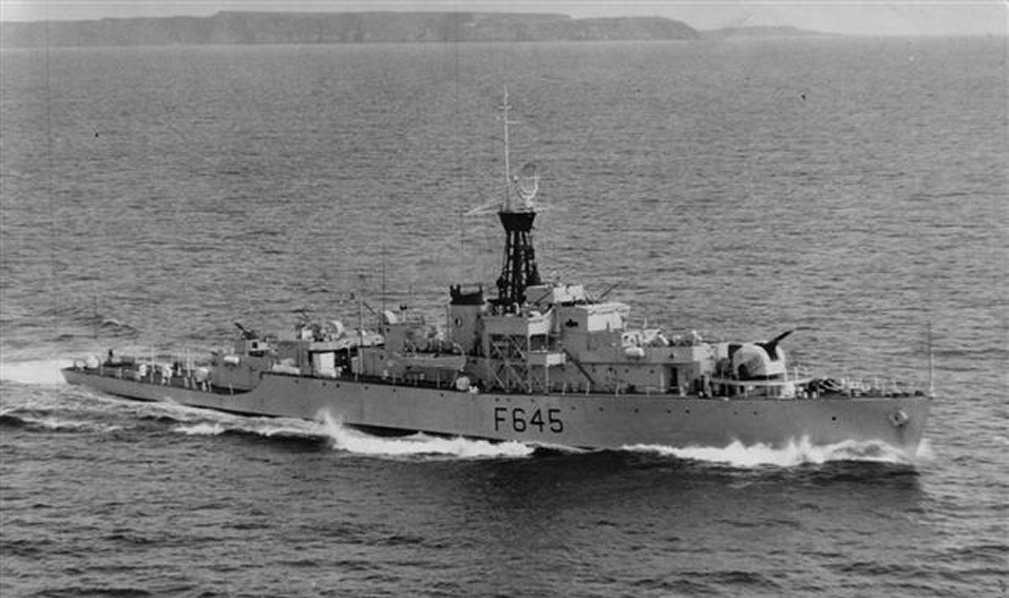
HMS
Ruthven (NP/Bryan
Woodford)
The loss of
the British India Steam
Navigation Company's motor
vessel DARA was a great tragedy
both in of loss of life and in
the failure of an extensive
salvage operation. The DARA, on
passage from Bombay to various
ports in the Persian Gulf, had
called at Hubai
in the south east of the Gulf,
about 100 miles from the Strait
of Hormuz. Because
there were no port facilities
at that time, passengers and
cargo had to be dealt with
from an offshore anchorage.
The weather on 7 April
deteriorated during the forenoon
and owing to the poor anchor
holding ground the Master put to
sea. DARA headed north into
heavy weather with Force 7
winds. It had not been possible
to land visitors and local
officials so there were extra
people on board — a total 819.
By the
morning of 8 April the weather
had eased and course was
reversed to land those who had
been obliged to remain aboard.
At approximately 0445 there was
an explosion in the port
passageway near to the engine
room. The resultant fire and
power failure produced a chaotic
situation aggravated by smoke.
As the main engine stopped the
DARA drifted across the wind.
Power was restored using the
emergency power supply system
but this failed when the
generator room was engulfed by
the fire. Owing to the extent of
smoke and danger from fires,
great difficulty was experienced
in lowering lifeboats, two of
which were lost during launching
operations. The DARA was
completely abandoned by 0500.
It had not
been possible to transmit a
distress signal but fortunately
the plight of DARA had been
observed by the British LST
EMPIRE GUILLEMOT and she
transmitted a request for
assistance. Amongst the ships
which went to help were the
Norwegian tanker THORSHOLM, the
British tanker BRITISH ENERGY
and the Japanese YUYO MARU NO 5.
In all they rescued 584
survivors. HM Ships LOCH FYNE,
LOCH ALVIE and LOCH RUTHVEN were
exercising 230 miles west of the
DARA's
position and were ordered to
proceed at best possible speed
to assist. Medical aid was sent
from Dubai in MV BARPETA and the
US destroyer LAFFEY proceed to
assist.
To ensure
immediate availability, fire
fighting equipment and towing
gear was prepared on the British
frigates during their passage to
the scene and LOCH ALVIE
transferred her Medical Officer
to BRITISH ENERGY. By
nightfall
the glowing hull was visible to
the approaching rescue ships.
Attempts were made by the
frigates to cool the structure
by playing hoses on the still
burning vessel and despite
difficult swell conditions,
teams of fire fighters were
eventually put on board. It was
necessary to frequently relieve
these teams due to the smoke,
and this delayed getting the
fires under control. Eventually
DARA began to like to starboard
due to the accumulation of water
and debris. Effort was,
therefore, deployed to remove
water using portable pumps and
to jettison loose gear. Further
complications arose with fires
in the engine room and after
hold being fed with oil from
ruptured fuel tanks and by
lagging from the refrigerated
cargo space. Another factor
hampering the salvage attempt
was lack of access ladders since
those fitted has been made of
wood and had been destroyed.
DARA continued to drift towards
the shore until LOCH ALVIE was
able to establish a tow with
LOCH RUTHVEN secured alongside.
Further delay was caused when
the securing cable and power
supply feeder from LOCH RUTHVEN
parted. By evening it was quite
clear that the list was again
increasing and fears were raised
that sea water would soon be
able to enter the ship through
open scuttles.
The Master
signed a Lloyds Open Form on 9
April with the Royal Navy and
the RFA salvage vessel SEA
SALVOR which had then arrived on
the scene. By the following
morning (10 April) it had been
decided to beach DARA at first
light to complete fire fighting
and improve stability. The
casualty was taken in tow by SEA
SALVOR towards a suitable
beaching point, but when with
three miles of this position she
suddenly increased her list,
rolled over and sank at about
0920. Her post side davits still
showed above the water. Before
HMS LOCH FYNE left the scene she
marked the position with flags
and buoys to warn shipping of
the presence of the wreck.
60 bodies
were found on board and the
final death toll amounted to
238. Some gold bars and other
valuables were recovered from
the ship before she foundered.
Evidence obtained during the
subsequent investigation showed
that the fire had been caused by
an explosion. Whether this was
due to use of a heating stove
used by one of the passengers or
whether il
was deliberately caused is an
open question.
No salvage
awards were made to any of the
ships involved since DARA had
sunk. However, her owners made a
payment to the Welfare Funds of
the three LOCH class frigates
which took part, in recognition
of the long and exhausting work
that they had undertaken.
HMS
LOCH LOMOND, AUGUST 1962 –
British
ship – MEDINA PRINCESS
The British
flagged tramp ship requested
assistance from HMS LOCH LOMOND
which was paying a visit to
Djibouti in French Somaliland.
Amazingly, MEDINA PRINCESS was
lying alongside the wharf but
the Master signed
a Lloyds Open Form ! Salvage
work was taken in hand
immediately by technical staff
from the British frigate. All
efforts to remove water from the
flooded engine room proved in
vain. It was suspected that as
fast as one sea valve was shut
by the salvage team in an
attempt to prevent ingress of
water, other valves were being
opened by persons unknown to
ensure that the ship would not
be able to sail. The absence of
any ship drawings made all
salvage attempts a lengthy and
hit and miss affair. LOCH LOMOND
had to sail three days later and
salvage work was then abandoned
with no success. MEDINA PRINCESS
had a history of disaster since
sailing from Europe with a cargo
of wheat consigned to China.
There has
been innumerable problems
including a mutiny whilst on
passage through the
Mediterranean. After LOCH LOMOND
left, the MEDINA PRINCESS was
towed to a shoal in the harbour
at Djibouti and beached by the
harbour authorities. The whole
dismal affair culminated in a
legal action in the High Court
in London. Salvage awards were
not paid.
TABLE
OF SALVAGE OPERATIONS
1950-1964
This table
details all the salvage
operations undertaken by LOCH
Class frigates during the period
1950-1964. It is not a complete
listing of all salvage work
undertaken by the Royal Navy
during this period.
|
Date
of Salvage
|
Name
of frigate(s) involved
|
Ship
Assisted
|
Salvage
Money
|
Remarks
|
|
|
|
|
Captain
|
Lowest
|
|
|
|
|
|
|
|
|
|
12/50
|
LOCH
FADA
|
LEITID
|
£7
|
0.56p
|
Fishing
Vessel
|
|
01/52
|
LOCH
VEYATIE
|
MAEVE
|
£7
|
0.50p
|
Fishing
Vessel
|
|
05/55
|
LOCH
KILLISPORT
|
ARGEA
PRIMA
|
£473
|
£16
|
Collision
& fire
|
|
07/55
|
LOCH
LOMOND
|
RFA
WAVE KING
|
£3
|
£2
|
Feed
pump defect
|
|
07/56
|
LOCH
FADA
|
CORABANK
|
£60
|
£3
|
Fuel
shortage in poor
weather
|
|
12/56
|
LOCH
FYNE
|
JULIUS
|
£250
|
£4
|
Engine
failure
|
|
12/56
|
LOCH
INCH
|
HAVKONG
|
£97
|
£5
|
-
|
|
01/57
|
LOCH
KILLISPORT
|
OLYMPIC
GAMES
|
£137
|
£7
|
Ship
aground
|
|
12/56
|
LOCH
KILLISPORT
|
ATHEL
MONARCH
|
£196
|
£10
|
Ship
aground
|
|
01/57
|
LOCH
FYNE
|
GILDA
|
£65
|
£2
|
Ship
aground
|
|
08/57
|
LOCH
LOMOND
|
ARAGONESE
|
£46
|
£2
|
Damaged
Boilers
|
|
10/57
|
LOCH
FADA
|
ADLAI
|
Nil
|
Nil
|
Salvage
failed
|
|
04/58
|
LOCH
FADA
|
SKAUBRYN
|
Nil
|
Nil
|
Salvage
failed
|
|
09/58
|
LOCH
KILLISPORT and LOCH
ALVIE
|
MELIKA
and FERNAND GILABERT
|
£277
and
£186
|
£9
and
£6
|
Ships
in Collision off Omani
coast
|
|
10/60
|
LOCH
RUTHVEN
|
POLYANA
|
£1482
|
£18
|
Explosion
and fire
|
|
04/61
|
LOCH
ALVIE, LOCH RUTHVEN
and LOCH FYNE
|
DARA
|
Nil
|
Nil
|
Explosion
and fire. Salvage
failed.
|
|
08/61
|
LOCH
INCH
|
MENQUINEZA
|
£5
|
£0.15
|
Ship
aground
|
|
08/62
|
LOCH
LOMOND
|
MEDINA
PRINCESS
|
Nil
|
Nil
|
Flooded
Engine Room
|
|
09/64
|
LOCH
KILLISPORT
|
CHOPIN
|
£82
|
£3
|
Ship
aground.
|
Sources:
Lloyds
Casualty Lists, Admiralty
Fleet Orders notifying Awards,
The Electrical Review (DARA),
Mr A Tremlett
and Fleet Photographic
Officer, CinC
Fleet (Photographs)