| |
Main units:
Brigadier J H A Thompson (CB) OBE ADC RM
Deputy Commander, Colonel T
Seccombe RM
Brigade Major (Chief of Staff),
Maj J Chester (OBE) RM
(Deputy Chief of Staff), Maj G V
J O'N Wells-Cole RM
40 Cdo RM, Lt Col M P J Hunt (OBE) RM
42 Cdo RM, Lt Col N F Vaux (DSO) RM
45 Cdo RM, Lt Col A F Whitehead (DSO) RM
29 Cdo Regt RA, Lt Col M J
Holroyd-Smith (OBE) RA
59 Ind Cdo Sqdn RE, Maj R
MacDonald (MID) RE
Cdo Logistics Regt, Lt Col I J
Hellberg (OBE) RCT
|
|
Bde HQ & Signals Sqdn, Maj R
C Dixon RM
Mountain and Arctic Warfare
Cadre, Capt R J Boswell RM
SBS, Maj J J Thomson (OBE) RM
3 Cdo Bde Air Sqdn, Maj C P
Cameron (MC) RM with 9
Gazelles and 9 Scouts (3 from
No.656 AAC)
Main
attached Army Units:
2 Para, Lt Col H Jones (VC) OBE
3 Para, Lt Col H W R Pike (DSO) MBE
22 SAS Regt, Lt Col H M Rose OBE (MID)
|
|
|
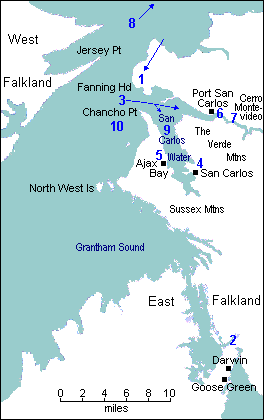
1. FANNING
HEAD RAID - SBS land by helicopter
from Antrim; Argentine positions engaged
by machine guns under Antrim's covering
fire
2. DARWIN
RAID -
D Sqdn SAS landed by
helicopter to hold down Argentine forces
around Darwin and Goose
Green.
Support fire from Ardent out in Grantham
Sound
3. AMPHIBIOUS
SHIPS - 1st ASSAULT WAVE: Fearless -
40 Cdo by Fearless LCU; Norland - 2
Para
by Intrepid LCU; 2nd ASSAULT WAVE:
Intrepid - 3 Para; Stromness - 45
Cdo; RESERVE:
Canberra - 42 Cdo; SUPPLY TRANSPORTS -
Europic Ferry, Fort Austin, Sir Galahad,
Sir Geraint, Sir Lancelot, Sir Percivale,
Sir Tristram
4. SAN
CARLOS (Blue
Beach) - 40 Cdo RM
and 3
Cdo Bde HQ, Arty Bty. Also 2
Para
which moved towards Sussex
Mountains
5. AJAX
BAY
(Red Beach) - 45
Cdo RM.
Also Brigade Maintenance
Area, Cdo
Logistic Regt, Arty Bty
6. PORT
SAN CARLOS (Green Beach) - 3
Para.
Also 42 Cdo RM, Arty Bty
7. British aircraft
lost just east of
Port San Carlos - [b11,b12] Gazelles
AT END OF DAY
8.
BACK TO CVBG - DD Antrim,
Transports Canberra, Europic Ferry,
Norland
9.
AMPHIBIOUS SHIPS IN
SAN CARLOS WATER- Assault ships Fearless,
Intrepid, RFAs Fort Austin, Stromness,
LSLs Sir Galahad, Sir Geraint, Sir
Lancelot, Sir Percivale, Sir Tristram
10. ESCORTS REMAINING - Antrim (UXB
damage),
Ardent (SINKING), Argonaut
(UXB damage), Brilliant (minor
damage),
Broadsword (minor damage), Plymouth,
Yarmouth
As the Amphibious
Group sailed in towards Falkland Sound, diversionary raids were mounted
starting on Thursday night. Of immediate concern was
a half company of infantrymen on the 800 feet high Fanning
Head
overlooking the entrance to San Carlos Water. To deal
with these, "Antrim" went ahead with two
Wessex, some 25 SBS
heavily armed with machine guns, and a naval gunfire
observer. The force landed by helicopter to the east of
the Argentine positions under covering fire from
"Antrim", and the defenders called on to
surrender. This they refused to do and the engagement
continued with a number of them killed or captured.
Others escaped,
but Fanning Head was
finally under British control and the
vulnerable landing craft below saved from attack. Further south, any attempt by the Darwin
garrison to move
towards the beachhead was blocked by the small force of D Sqdn SAS under the command of Major Delves
and supported by
"Ardent" out in Grantham Sound. Landed by No.846 Sea Kings to the north,
the attackers engaged the Argentines with machine guns,
anti-tank missiles and mortars to such an extent they
were reported to be in battalion strength.
While the diversions took place,
the landings went ahead admittedly with
some delay and confusion, and yet with complete success.
With the main body of the Amphibious Group anchored just
outside San Carlos Water, the final plan was for 2 Para and 40 Cdo to land at San Carlos first so the Paras could move south to
prevent the Argentines at Darwin from occupying the Sussex Mountains. Then 45 Cdo would go ashore at Ajax Bay and 3 Para at Port San Carlos to complete the encirclement of the
anchorage. With 42 Cdo
remaining on "Canberra" in reserve, Rapier
missiles and artillery, ammo, fuel, rations and other
stores would then be landed by the few helicopters,
landing craft and Mexeflotes. The landing craft carrying
the first wave were due to beach at San Carlos at 2.30 am
on
Friday 21st May.
Unfortunately delays built
up both in reaching the anchorage and in loading the
troops, but eventually they headed in below Fanning Head before turning south towards San
Carlos led in by Major Southby-Tailyour RM.
The landing craft from
"Fearless" including the smaller LCVP's carried
40 Cdo, with two of the LCU's carrying a
Scorpion and Scimitar each in the bows (four light tanks
in total) ready to provide gunfire support. With them in
"Intrepid's" four LCU's was 2 Para from "Norland".
"Plymouth" accompanied them in as close escort.
Then 3,800 miles from Ascension, the first major British
landing since Suez took place around an hour late, but completely unopposed. As soon
as 2
Para landed, they
moved off the five miles to Sussex Mountains, and 40 Cdo dug in below the
western ridge of The Verde Mountains. As dawn broke, the
landing craft returned to the ships still outside San Carlos Water to pick up the second wave - most
of 45
Cdo from
"Stromness" with Z Coy from "Intrepid", and
all
of 3
Para from
"Intrepid". Now in daylight, the Marines went
ashore near the disused meat packing plant at Ajax Bay on the western side, and the Paras a mile west of Port San
Carlos on the northern
side. Before 3 Para could
secure the settlement, 3 Cdo Bde suffered its only fatal
casualties on D-day.
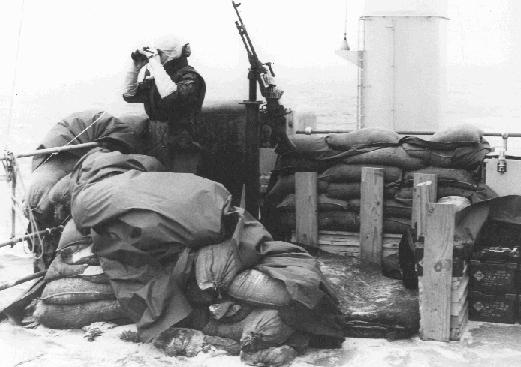
Left - Machine
gun position on board assault ship HMS Fearless
(below right) while on passage. The sand-bags were
filled at Ascension (Courtesy - MOD, Navy)
With the three
beachheads being secured, the twelve amphibious
ships entered San Carlos Water in broad daylight - "Canberra" and some of the
larger ones anchoring in the deeper water to the north, and the smaller LSL's nearer San Carlos. The escorts patrolled nearby in Falkland Sound and took the brunt of the air
attacks that followed. Using especially the No.846 Sea
Kings, the first priority was to get the T Bty Rapiers ashore, although it took a
number of hours to set up the twelve firing posts around
the perimeter ready to join in the air defence. Early
in this operation, shortly before 9 am, one of the Sea Kings flew east of Port San
Carlos and within
gunfire range of the small Argentine garrison as it
withdrew east. It escaped, but the escorting Gazelle of C
Flt 3CBAS was hit and crashed near the shore, the pilot
mortally wounded [b11].
Only minutes later a second C Flt Gazelle shared the same
fate, going down on a nearby hillside, and this time both
crewmen were killed [b12].
Along with the other tanks of The Blues and
Royals, the three
105mm batteries of 29 Cdo Regt RA and the single battery of 4 Field Regt RA also landed. During this time the
air
attacks started, threatening the amphibious
ships and their stores, and so every effort was made to
unload as much as possible, especially ammo so the
merchantmen could leave that night. From "Canberra", reserve 42 Cdo went ashore at Port San Carlos to support 3 Para if any threat there developed, and
one of the two Surgical Support Teams landed at Ajax Bay to set up a Field Dressing Station under
the command of Surgeon Cmdr R T Jolly (awarded OBE) RN,
and in the same vicinity as the
Brigade Maintenance Area. Because of the air raids, Brigadier
Thompson was not flown
ashore until late afternoon but immediately started
visiting his unit commanders.
At the end of this long
and violent day, and with "Canberra" now
carrying "Ardent's" survivors, the merchantmen
although only partly unloaded and still carrying much of
the infantry unit stores, left for the safety of the CVBG. Other amphibious ships and most
of the escorts remained.
Commodore Clapp and Brigadier
Thompson had successfully
secured a beachhead on the Falklands - 3 Cdo Bde was ashore with their Rapiers and
artillery together with some ammo, a start had been made
on bringing a major part of the combat stores ashore, and
the Marines and Paras were digging in and actively patrolling.
The crucial battle over the next four
days would be for air supremacy over the islands.
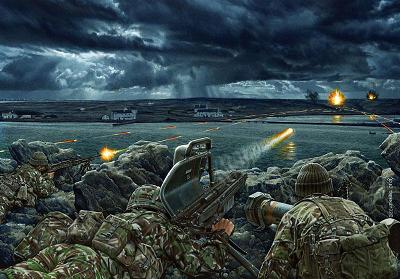
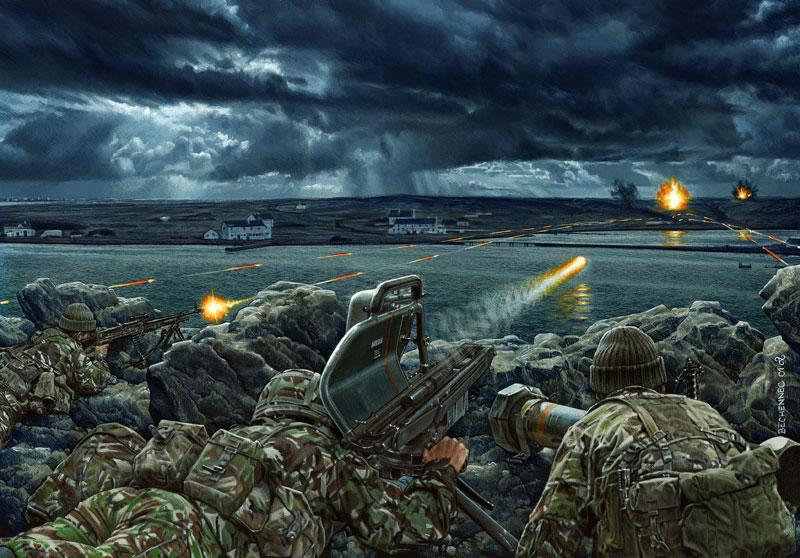
SAS Raid on Darwin Settlement
- from the
Art of Daniel Bechennec |