JULY
1943
Atlantic
Monthly Loss Summary
- 34 U-boats
including 7 by US escort carrier groups south
and west of
the Azores (6 of these by aircraft from "Core",
"Santee" or "Bogue")
Mediterranean
Invasion
of Sicily: Operation 'Husky' -
The final plan was
approved in
mid-May and not much more than a month later the
first US
troop convoys were heading across the Atlantic
for an
operation even greater than the French North
African
landings the previous November. The grand total
of 2,590
US and British warships - major and minor were
mostly
allocated to their own landing sectors, but the
Royal
Navy total included the covering force against
any
interference by the Italian fleet. The main
group under
Vice-Adm Sir A. U. Willis of Force H included
battleships
"Nelson", "Rodney",
"Warspite" and "Valiant" and fleet
carriers "Formidable" and
"Indomitable". German and Italian aircraft sank
and damaged a number of warships and transports
in the
invasion area including a US destroyer on the 10th.
On the 16th carrier "Indomitable"
was
damaged by Italian torpedo
aircraft.
AUGUST
1943
Atlantic
Monthly
Loss
Summary - 20 U-boats including 6 by aircraft of
US
escort carriers "Card" and "Core" off
the Azores and in mid-Atlantic
Indian
& Pacific Oceans
|
Strategic
and Maritime
Situation - In May 1943,
Allied agreement was
reached on an offensive towards the
Marshall and
Caroline Islands in the Central
Pacific to
parallel Gen MacArthur's advance
along the north
coast of New Guinea. At the Quebec
Conference,
the Gilbert Islands were chosen as
the first step
in the island-hopping campaign under
the overall
command of Adm Nimitz, C-in-C,
Pacific Fleet.
|
SEPTEMBER
1943
Mediterranean
3rd
- Italy Surrenders; Salerno Invaded
Salerno
Landings, Operation 'Avalanche'
- In addition
to the
grand total of 586 Allied naval units directly
engaged in
the landings, most of which were in their
respective
British or American sectors, Adm Cunningham as
C-in-C
provided a strong Royal Navy cover force and
carrier
support group. The cover force was again Force H
under
Adm Willis with battleships "Nelson",
"Rodney", Warspite", "Valiant"
and carriers "Formidable" and
"Illustrious". Rear-Adm Vian commanded the
support carriers with light carrier "Unicorn",
escort carriers "Attacker", Battler",
"Hunter" and "Stalker", three
cruisers and destroyers. Most of the troops were
carried
to Salerno via Sicily in the landing ships and
craft,
and, early on the 9th, without any preliminary
air or
naval bombardment, landed in the face of strong
German
resistance. By the end of the day, with the
support of
the covering warships and carrier aircraft, both
the
British and Americans had established
bridgeheads.
OCTOBER
1943
Atlantic
Norway
- Covered by battleships "Anson" and "Duke
of York" and other units of the Home Fleet, US
carrier "Ranger" launched air attacks against
shipping off Bodo, northern Norway on the 4th.
Four ships
were sunk and others damaged.
Monthly
Loss
Summary - 23 U-boats including 6 by US escort
carriers "Card", "Core" and
"Block Island" off the Azores and in
mid-Atlantic.
NOVEMBER
1943
Atlantic
6th
-
Capt Walker's Escort Group with escort carrier
"Tracker" patrolled east of Newfoundland in
support of convoy HX264. "U-226"
was
sighted by "Tracker's"
aircraft and destroyed by sloops "Starling",
"Kite" and "Woodcock". Shortly after,
"Starling" this time with "Wild
Goose", accounted for "U-842".
Monthly
Loss
Summary -16 U-boats
including 1 by aircraft from US escort carrier
"Bogue"
Indian
& Pacific Oceans
Gilbert
Islands,
Central Pacific - US forces now started
the
advance through the Central Pacific with the
invasion of
the Gilbert Islands. Under the overall command
of Adm
Nimitz, C-in-C Pacific Fleet, Adm Spruance's
Fifth Fleet
landed US Marines and Army troops on the atolls
of Tarawa
and Makin respectively on the
20th. Both
were strongly defended but US losses on Tarawa
were
particularly heavy, although as usual few
Japanese
survived. Both atolls were secured by the 23rd.
Next day,
escort carrier "LISCOME BAY"
was
sunk off Makin by a
submarine. The
next step would be to the Japanese Marshall
Islands lying
to the northwest.
1944
JANUARY
1944
Atlantic
Capt
Walker's
2nd Escort Group - Capt
Walker with sloops "Starling",
"Kite", "Magpie", "Wild
Goose" and "Woodpecker" accompanied by
escort carriers "Activity" and
"Nairana" arrived in the waters to the
southwest of Ireland. Over the next three weeks
the five
sloops shared in the sinking of six U-boats
operating
against the convoys passing through the area.
They
started on the 31st when "Starling",
"Magpie" and "Wild Goose" depth
charged
"U-592" to
destruction.
Monthly Loss Summary
- 14 U-boats
including 1 by US escort carrier "Guadalcanal"
off the Azores
Indian
& Pacific Oceans
Indian Ocean
Operations
- Late in the month the British Eastern
Fleet was
considerably strengthened by the arrival of
capital ships
"Queen Elizabeth", "Valiant",
"Renown", carriers "Illustrious" and
"Unicorn", cruisers and destroyers.
FEBRUARY
1944
Atlantic
10th
-
West of Ireland, "U-666"
was sunk
by Swordfish of 842 Squadron
from escort carrier "Fencer" (below -
Navy Photos/Mark Teadham)
in support of
trans-Atlantic convoy ON223.
Europe
5th - Escort
carrier
"Slinger"
was
mined
and damaged in the Thames Estuary off Sheerness.
Indian
& Pacific Oceans
Japanese Marshall
Islands, Central Pacific - After taking
the
south-eastern and undefended atoll of Majuro on
31st
January, Adm Spruance's Fifth Fleet with its
carrier task
forces landed US forces half way up the
Marshall's group
on the huge atoll of Kwajalein
the same day. The Japanese
defenders resisted stubbornly, but with their
wild Banzai
charges were soon wiped out. At the western end
of the
Marshall's, Eniwetok atoll was
also taken, starting on
the 17th.
The
Truk
Raid - With the
Japanese major fleet base of Truk only 700
miles away in the Caroline Islands, ships and
carrier
aircraft of Fifth Fleet attacked, and together
with
patrolling submarines sank three cruisers, four
destroyers and much shipping in mid-month.
MARCH
1944
Atlantic
13th - RAF
Wellingtons flying from the Azores attacked
"U-575" well to the north. She was finally
sent to the bottom by the aircraft and ships of
the US
escort carrier "Bogue" task group and Canadian
frigate "Prince Rupert" from nearby convoy
ON227.
15th - In
mid-Atlantic, Swordfish of 825 Squadron from
escort
carrier "Vindex" working with 2nd EG's
"Starling" and "Wild Goose" sank "U-653" - Capt
Walker's 13th kill.
Russian
Convoys - The
next return convoy
from Russia RA57,
sailed with the escort of the February JW57
including
escort carrier "Chaser" and her rocket-firing
Swordfish of 816 Squadron. On the 4th,
to the
north west of Norway, they damaged "U-472" which
was finished off by
destroyer "Onslaught". In the next two days, in
spite of foul weather, they destroyed "U-366"
and
"U-973".
Monthly Loss Summary
- 17 U-boats
including 4 by the aircraft and ships of US
escort
carrier "Block Island" off the Azores and Cape
Verde Islands
APRIL
1944
Atlantic
Russian
Convoys - Three
days after 2nd EG sank
"U-961" off Iceland, Russia-bound JW58 was
to the northwest of Norway and the attacking
U-boats
lost three of their number. On the 1st
an Avenger
of 846 Squadron from escort carrier "Tracker"
damaged "U-355" with rockets and destroyer
"Beagle" completed the job. Next day - the
2nd - destroyer "Keppel" sank "U-360"
with her ahead-throwing Hedgehog
mortar. On the 3rd it was the turn of
"U-288",
when a Swordfish,
Wildcat and Avenger from
"Tracker's" 846 and "Activity's" 819
Squadrons sent her to the bottom. Apart from one
merchantman that was forced to return, all
JW58's
remaining 48 ships arrived at Kola on the 5th
April.
3rd
- Fleet Air Arm Attack on
"Tirpitz", Operation 'Tungsten' - The
damage inflicted
by
midget submarines on "Tirpitz" in September
1943 was nearly repaired and the Admiralty
decided to
launch a Fleet Air Arm attack. On the 30th
March,
Adm Fraser left Scapa Flow with battleships
"Duke of
York" and "Anson", fleet carriers
"Victorious" and the old "Furious",
escort carriers "Emperor", "Fencer",
"Pursuer" and "Searcher", cruisers
and destroyers, split into two forces, and
headed north,
partly to cover JW58. By the 2nd
the two
forces had joined up 120 miles off Altenfiord
and early
next morning on the 3rd, two waves each
of 20
Barracuda bombers with fighter cover surprised
"Tirpitz" at anchor. A total of 14 hits were
made, but the damage was not serious. However,
the
battleship was out of action for another three
months.
Home Fleet was back in Scapa on the 6th.
A similar
operation was attempted later in the month, but
bad
weather prevented any attacks. Instead a German
convoy
was found in the area and three ships sunk. The
weather
again saved Tirpitz from two sorties in May
1944, but the
fleet and escort carrier aircraft did manage to
sink
several more merchant ships at these and other
times
during the month.
14th - North
of the
Azores
"U-448"
attacked escort carrier "Biter" but was
detected by Canadian frigate "Swansea" of the
9th EG and sunk by her and sloop "Pelican" of
the 7th.
Indian
& Pacific Oceans
19th
-
Carrier Attack on Sabang, Sumatra - Adm Somerville's
Eastern Fleet had
almost enough strength to start offensive
operations
although the loan of US carrier "Saratoga" was
necessary for the first attack on oil
installations at
Sabang, together with shipping and airfields.
Sailing
from Ceylon with "Saratoga" and fleet carrier
"Illustrious" were battleships "Queen
Elizabeth", "Valiant" and the French
"Richelieu", cruisers and destroyers. From a
position to the southwest, bombers and fighters
flew off
from the two carriers for a successful strike on
the 19th
before returning to Ceylon.
MAY
1944
Atlantic
Russian
Convoys
- Return Russian
convoy
RA59 (45 ships) was attacked by U-boats
to
the northwest of Norway. One ship was lost, but
in return
the Swordfish of 842 Squadron from "Fencer"
sank three with depth charges - on the 1st,
"U-277", and next day "U-674" and "U-959". The
convoy arrived at Loch Ewe
with the rest of the 44 ships on 6th May.
5th/6th - The
2nd
and 5th EGs in the North Atlantic detected
U-boats by
HF/DF after the torpedoing of a US destroyer.
"U-473"
was
found by 2nd EG (Capt
Walker) and
sunk on the 5th by "Starling", "Wren"
and "Wild Goose". Next day it was the 5th EG's
turn (Cdr Macintyre). Aircraft of 825 Squadron
from
escort carrier "Vindex" located "U-765" and
frigates "Aylmer",
"Bickerton" and "Bligh" shared in her
destruction.
6th - The US
escort
carrier "Block Island" group was again on
patrol in the Atlantic off the Canaries and
being
directed to U-boats by the work of 'Ultra' and
the
Admiralty Tracking Room. On the 6th her aircraft
and
accompanying destroyer escorts sank "U-66". Then
at the end of the month, the
carrier was sunk.
29th - "BLOCK
ISLAND"
was torpedoed
and
sunk by "U-549" in the Canaries area, but her
task group
soon avenged the loss of their leader.
Indian
Ocean
17th
-
Carrier Attack on Surabaya, Java - Eastern
Fleet carried out another raid,
this time on the oil facilities at Surabaya and
with the
same ships as the Sabang strike. Afterwards
"Saratoga" returned to the US.
JUNE
1944
Atlantic
4th - Off
West
Africa, "U-505"
was captured
by the USS Guadalcanal and
her task group. Later in the month, tanker
"U-490"
was
sunk in mid-Atlantic
by the ships
and aircraft of the "Croatan" group and "U-360"
in the South Atlantic by aircraft
from "Solomons".
Europe
6th
- Normandy Invasion: Operation
'Overlord' - The
Naval
Task Forces totalled 672 warships for assault
convoy escort, minesweeping, shore bombardment,
local
defence, etc, and 4,126 major and minor landing
ships and
craft for initial assault and ferry purposes: a
grand
total of 4,798. To this could be added a number
of other
specialist forces including Western
Channel
Approaches A/S Escort Groups and
reserves
consisting of three British escort carriers
and 55
destroyers
and escort vessels. These together with
aircraft of RAF
Coastal Command
were ready for any attempt by U-boats to reach
the
Normandy ships. Only schnorkel-equipped boats
dared try,
and the few that did had little success. In June
they
lost 12 of their number.
Indian
& Pacific Oceans
Saipan, Japanese
Mariana Islands - With the Solomons
campaign
virtually over, Adm Halsey transferred from the
South to
the Central Pacific theatre to share in the
command of
the vast and ever-growing Pacific Fleet. He and
Adm
Spruance took turns planning and executing the
assaults
to come, and the Fleet was renumbered
accordingly:
- Third Fleet for
Adm Halsey
- Fifth Fleet for Adm Spruance.
Fifth Fleet carried
out
the Marianas landings. From here, US airpower
could
strike at the Philippines and Formosa, but most
importantly initiate the strategic bombing
campaign of
Japan using the new B-29 Superfortresses. Over
the next
year these would devastate Japanese cities and
in
conjunction with the highly successful submarine
offensive against Japan's merchant marine,
nearly cripple
the country's war production. The island of Saipan
was
the first
target, and after heavy air
and sea bombardments, US Marines landed on the
15th.
Effective resistance was over by early July, by
which
time one of the most crucial naval battles of
the Pacific
war had been fought. At the finish, Japanese
naval
airpower received a beating from which it would
never
recover. Battle
of the Philippine Sea - The Japanese
had prepared for the
Marianas landings and from the direction of the
Philippines despatched a strong naval force that
included
nine carriers and five battleships, two of which
were the
18.1in-gunned "Musashi" and "Yamato".
The carrier aircraft were knocked out of the sky
by their
better-equipped and trained US counterparts in
the 'Great
Marianas Turkey Shoot'. On the 19th, US
submarines sank
carriers "SHOKAKU" and "TAIHO", and next day
carrier aircraft destroyed
the
"HIYO". The
loss in pilots was a major defeat for the
Japanese, and
the Americans were left free to complete the
capture of
the Marianas. The Philippine's inner shield
would then be
broken.
JULY
1944
Atlantic
17th
- FAA Attack on "Tirpitz"
- Barracuda
torpedo
bombers from Home Fleet carriers
"Formidable", "Indefatigable" and
"Furious" attempted to hit "Tirpitz"
in Altenfiord on the 17th, but failed,
partly
because of defensive smokescreens. U-boats were
sent to
attack the carrier force, but over a period of
four days,
RAF Coastal Command sank three in the Northern
Transit
Area.
Monthly Loss
Summary - 7 U-boats including
one each by task groups of US escort carriers
"Wake
Island", "Croatan" and "Card"
off the Canaries, Madeira and Nova Scotia
respectively
Indian
& Pacific Oceans
25th
- FAA Attack on Sabang, Sumatra - Aircraft
from "Illustrious"
and "Victorious" attacked Sabang, after which
three battleships, cruisers and destroyers
bombarded the
area. This was the last Eastern Fleet operation
under the
command of Adm Somerville. He moved on to
Washington DC
as Adm Fraser took over as C-in-C in August.
More carrier
raids were carried out on Sumatra in August and
September.
Guam (U.S) and
Tinian,
Japanese Mariana Islands - With Saipan
secure and the
Japanese fleet in disarray, the Americans went
ahead with
landings on the US colony of Guam on
the 21st and Japanese island of Tinian three
days later. Against the usual
suicidal resistance, both islands were won by
early
August, although the last Japanese soldier hid
out on
Guam until 1972. The Marianas were now in US
hands
AUGUST
1944
Atlantic
Attacks
on "Tirpitz" and
Russian Convoy JW59 - Russian
convoy JW59 (33 ships) left
Loch Ewe on the 15th with a heavy escort
including
escort carriers "Striker" and
"Vindex" and the 20th and 22nd Escort Groups.
Home Fleet, under the command of Adm Moore,
sailed in two
groups, partly to cover the convoy but mainly to
launch
further FAA attacks on "Tirpitz" in Altenfiord.
One group included "Formidable",
"Indefatigable" and "Furious" and
battleship "Duke of York"; the second, escort
carriers "Trumpeter" and the Canadian-manned
"Nabob" together with the
5th EG. Between the 22nd and
29th, three strikes were made, but in two of
them the
German ship was obscured by smoke; and although
a hit was
obtained on the 24th, the bomb failed to
explode. In the
course of these manoeuvres the escort carrier
group
suffered two casualties: 22nd
-
"U-354" encountered them to the northwest of
North Cape and attacked. Frigate "BICKERTON" of
the 5th EG was torpedoed, badly
damaged, and finished off by destroyer
"Vigilant". Escort carrier "NABOB"
was too
badly damaged by her torpedo hit
to be repaired. The U-boat was shortly sunk. The
convoy,
JW59 was also subjected to U-boat attack and
losses were
sustained by both sides including: 25th
- "U-354" now prepared for the arrival of
return convoy RA59A in the Bear Island area and
was
destroyed by a rocket-firing Swordfish of 825
Squadron
from "Vindex".
Monthly Loss Summary
- 3 U-boats
including 1 by aircraft of escort carrier
"Bogue" off Newfoundland
Mediterranean
15th
- South of France Landings:
Operation 'Dragoon' - Originally
code-named 'Anvil', the South of
France invasion was planned to coincide with the
Normandy
landings. Operation 'Dragoon' used forces
withdrawn from
US Fifth Army in Italy. No major British units
were
involved and for the first time in the
Mediterranean the
Royal Navy was in the minority in both ships and
commanders. The warships were allocated across
four
attack forces and, in addition, over 1,300
mainly assault
landing craft took part in the landings. Air
cover and
support was provided by Rear-Adm Troubridge with
seven
British and two US escort carriers.
Indian
& Pacific Oceans
12th - An
escort
carrier task group was formed to hunt for German
and
Japanese submarines operating in the Indian
Ocean off the
coast of Africa. "U-198" was located on the 10th
and two days later, sunk
off the Seychelles by frigate "Findhorn" and
Indian sloop "Godavari".
SEPTEMBER
1944
Atlantic
Russian
Convoys - Return
Russian convoy RA59A (nine
ships) was now off northwest Norway when "U-394"
was damaged
by No 825 Squadron Swordfish
from escort carrier "Vindex" and sunk on the 2nd
by destroyers "Keppel" and
"Whitehall" and sloops "Mermaid" and
"Peacock". The convoy arrived safely at Loch
Ewe on the 6th. The next convoy returning from
Russia, RA60
left Kola on the 28th with 30 ships, but by the
time it
arrived at Loch Ewe in early October had lost
two
merchantmen to U-boat attack. While still to the
northwest of Norway on the 30th,
Swordfish of 813
Squadron from escort carrier "Campania" sank
"U-921".
Mediterranean
End of the
Mediterranean U-boats - The last U-boat
in the
Mediterranean was lost to sea attack. On the 19th
schnorkel-equipped "U-407"
was sunk
north of Crete by destroyers
"Terpischore", "Troubridge" and the
Polish "Garland" of Adm Troubridge's escort
carrier and cruiser force.
OCTOBER
1944
Europe
27th - During
Home
Fleet operations against German shipping off
Norway,
aircraft of 1771 Squadron from fleet carrier
"Implacable" drove "U-1060" ashore near Namsos.
She was
finished off two days later by aircraft of Nos
311
(Czech) and 502 Squadrons RAF.
Indian
& Pacific Oceans
Nicobar Islands
-
Between the 17th and 19th ships and carrier
aircraft of
the British Eastern Fleet attacked the
Japanese-held
islands to divert attention from the US landings
on Leyte
in the Philippines.
Leyte, Central
Philippines - Because of
faster-than-planned
progress, the Americans decided to by-pass the
southern
Philippines island of Mindanao and go straight
for Leyte. On the 20th Gen
MacArthur returned
to the Philippines with four Army divisions.
Less than
two and a half years earlier, he had made his
famous
"I would return!" statement. In preparation for
the landings, Task Force 38 (Adm Mitscher) of
Adm
Halsey's Third Fleet (1)
with a total of 17 fleet and light carriers
had roamed the Philippine Sea, hitting the
Ryukyu
Islands, Formosa and the Philippines themselves.
Now with
six modern battleships, it was off Leyte
covering the
landings, throughout which Adm Halsey reported
direct to
Adm Nimitz in Pearl Harbor rather than Gen
MacArthur, a
separation of command which contained the seeds
of
potential disaster in the coming Battles of
Leyte Gulf.
Directly under Gen MacArthur, Vice-Adm Kinkaid's
Seventh
Fleet (2)
carried out the invasion and provided close
support.
Including ships loaned from Third Fleet; he had
18 escort
carriers and six old battleships. The US fleets
totalled
well over 800 ships.
Battles
of Leyte Gulf - The
Japanese had prepared their
response to the Leyte landings. A Northern
Decoy Force
[1] with
four carriers and two
converted battleship/carriers sailed south from
Japan to
lure away Adm Halsey's Third Fleet fast carriers
(1). From west of
the Philippines, a
Centre Strike Force [2]
of five battleships and 12
cruisers
approached Leyte Gulf from the northwest through
the San Bernadino Strait. From the southwest via
the Surigao
Strait, a smaller Southern Strike Force
[3]
in two parts with a total of two
battleships and four cruisers also headed for
Leyte Gulf.
The resulting pincer movement should have been
powerful
enough to destroy Gen MacArthur's transports and
savage
the Seventh Fleet (2)
now
that Third Fleet's support (1)
had been lured away. In fact the Japanese were
about to lose three battleships, four carriers
(admittedly with few aircraft on board), 10
cruisers and
nine destroyers in the battles and actions known
collectively as the Battle of Leyte Gulf. The
American
transports were saved, but warship losses
amounted to one
light and two escort carriers, three destroyer
types and
one submarine with other vessels damaged. The
Americans
could have lost far more:

Battle
of Sibuyan Sea - On the 24th
the same Centre Force [2]
was heavily attacked by Third Fleet
(1) carrier
aircraft as it neared
the San Bernadino Strait. The giant battleship
"MUSASHI"
was
sunk and
the surviving ships appeared to
turn back. As this happened, US carrier
"PRINCETON" off Luzon in the Philippine Sea
was
lost to land-based aircraft attack. Now the
Northern
Decoy Force [1]
did
its job and Third Fleet (1)
hurried north, leaving the San Bernadino
Strait unguarded. Adm Kinkaid's Seventh Fleet
(2) was left with only escort
carriers
and old battleships to protect the Leyte Gulf
beachhead.
Battle
of Surigao Strait - As the Southern
Strike Force [3]
tried to pass through from the
southwest on the night of the 24th/25th,
it
was ambushed by Seventh Fleet's (2)
Adm Oldendorf with the six old
battleships, cruisers and destroyers,
including the
Australian "Shropshire" and destroyer
"Arunta". In the last battleship action
ever fought, the Japanese battleships "FUSO"
and "YAMASHIRO" and a heavy cruiser were sunk.
Battle
of Samar -
Back to the north, early on the 25th,
the
threat was still great as the main Centre
Strike
Force [2]
with four surviving battleships and eight
cruisers
sailed through the San Bernadino Strait to
attack the
escort carriers and accompanying destroyers of
Seventh Fleet (2).
The escort ships and carrier aircraft fought
back
bravely, but the heavy ships sank escort
carrier "GAMBIER
BAY" and
three destroyers. Kamikaze aircraft also sank
escort
carrier "ST LO" and damaged others. In return,
three of
the Japanese cruisers were lost to escort
carrier
aircraft attack. Then just when Centre Force [2]
could have got in among the
transports, it retreated back the way it came.
Battle
of Cape Engano -
While the US escort carriers were struggling
to
survive, Adm Halsey's Third Fleet (1)
aircraft sank all four
carriers of the Northern Decoy Force [1]
on the
25th - "CHITOSE",
"CHIYODA", "ZUIHO"
and
"ZUIKAKU" - although
by this time their
sacrifice had served no purpose as Centre
Force [2]
failed to press home its attack
on Leyte Gulf. As Centre Force retreated, the
returning Third Fleet (1)
was too late to stop it escaping
through the
San Bernadino Strait.
By any measure the
US
Navy and its carrier aircraft had struck the
Japanese
Navy a blow from which it could never recover.
NOVEMBER
1944
Indian
& Pacific Oceans
Leyte, Central
Philippines - Although the Japanese
managed to
reinforce Leyte, and fought back with a
fierceness that
came as no surprise, they were too late to stop
US forces
from pushing forward throughout the island. A
second
landing at Ormoc Bay on the
west coast took place in
early December, and by the end of that month
organised
resistance was over. All this time the US Navy
suffered
increasing damage in Philippine waters from
kamikaze
attack.
US Submarine
Operations
- By the end of the war, Japan's merchant marine
almost
ceased to exist, a significant factor in
eventual defeat.
US submarines accounted for 60 percent of
sinkings as
well as a third of warships. In November alone
they sank
battleship "KONGO" off Formosa, giant carrier
"SHINANO" (built on a 'Yamato' hull) off
Tokyo only days after her completion, and small
carrier "SHINYO" off Shanghai.
DECEMBER
1944
Atlantic
Russian
Convoys - Return
Russian convoy RA62 (28
ships) prepared to leave Kola Inlet on the 10th
with the
escort of JW62. As the convoy passed Jan Mayen
Island on
the 13th, "U-365"
was sent
to the bottom by Swordfish of
813 Squadron flying from escort carrier
"Campania" (later better known for her
association with the 1951 Festival of Britain).
All
merchantmen reached Loch Ewe on the 19th.
Indian
& Pacific Oceans
British
Pacific Fleet - The Royal Navy prepared
to return
in force to the Pacific, but even then as a
junior
partner to the vast US fleets. At the end of
November the
Eastern Fleet was dissolved and Vice-Adm
Sir
Arthur Power appointed C-in-C of the newly
formed East
lndies Fleet. He took over some of the
ships of the
old Eastern Fleet from Adm Fraser
including
capital ships "Queen Elizabeth" and
"Renown", four escort carriers and nine
cruisers. Now as the last U-boats headed back
for Europe,
Adm Power had sufficient convoy escort strength
for
Indian Ocean operations.
Adm Fraser became
C-in-C,
British Pacific Fleet (BPF) and early in the
month flew
to Sydney, his planned main base, and then on to
Pearl
Harbor to discuss with Adm Nimitz how the Fleet
would be
employed. By the end of the year, fleet carriers
"Illustrious", "Indefatigable",
"Indomitable" and "Victorious",
battleships "Howe" and "King George
V", and seven cruisers including the New Zealand
"Achilles" and "Gambia" had been
allocated to BPF. Adm Fraser's greatest
challenges were
to equip and train his aircrews to US Navy
standards of
operation and assemble a balanced fleet train.
This would
enable him to supply and support the fleet so it
could
operate alongside but independent of the
Americans in the
vast stretches of the Pacific. Even at the end
he would
lack many of the ships needed, especially fast
tankers.
Rear-Adm Sir Philip Vian took command of the BPF
carriers
and led "Indomitable" and
"Illustrious" on an attack against Belawan
Deli, northern Sumatra in mid-month. More raids
took
place on Sumatra in January 1945.
1945
JANUARY
1945
Europe
British
Isles
Inshore Campaign - As
the campaign continued, there were losses
on both sides. These include: 15th/16th
- Off the
Clyde, Scotland on the 15th, "U-482"
torpedoed a merchantman and badly
damaged escort carrier "THANE" (not repaired and
laid up)
ferrying aircraft from Northern Ireland. After a
long
hunt the U-boat was sunk next day by frigate
"Loch
Craggie" and sloops "Amethyst",
"Hart", "Peacock" and
"Starling" of the 22nd EG.
Indian
& Pacific Oceans
Landings
at
Akyab & Ramree Island - Early
on the 3rd,
British and
Indian forces landed at Akyab, Burma from
destroyers and
smaller vessels of the Royal, Australian and
Indian
Navies to find the Japanese had gone. On the
21st
more British and Indians were landed on Ramree
Island
with support and cover partly provided by
battleship
"Queen Elizabeth" and escort carrier
"Ameer". The few Japanese resisted in their
usual manner into February.
Fleet
Air
Arm Attack on Palembang - As the
British Pacific Fleet transferred
from Ceylon to Fremantle en route to Sydney,
Australia,
successful strikes were made by aircraft from
carriers
"Indomitable", "Illustrious",
"Indefatigable" and "Victorious" on
oil installations around Palembang, southern
Sumatra on
the 24th and 29th. Adm Vian was
in command.
Luzon, Northern
Philippines - Three years after the
Japanese landed
at Lingayen
Gulf on the northwest coast of
Luzon, Gen
MacArthur's Sixth Army went ashore early on the
9th,
supported as usual by Seventh Fleet. Kamikaze
attacks
continued to inflict heavy losses throughout the
region,
mainly in ships damaged, but on the 4th
escort
carrier "OMMANEY BAY" on passage to Lingayen was
sunk off
Mindoro.
FEBRUARY
1945
Indian
& Pacific Oceans
British Pacific
Fleet
- Early in the month, the BPF arrived in Sydney
for
replenishment. Adm Fraser stayed ashore as
C-in-C and his
number two, Vice-Adm Sir Bernard Rawlings in
battleship
"King George V", commanded the Fleet. Rear-Adm
Vian was Flag Officer, First Aircraft Carrier
Squadron.
By this time nearly 60 ships of a diversity of
types and
flags were ready for the Fleet Train under
Rear-Adm D. B.
Fisher. BPF had been allocated Manus in the
Admiralty
Islands as its intermediate base, which Adm
Rawlings
reached by mid-March.
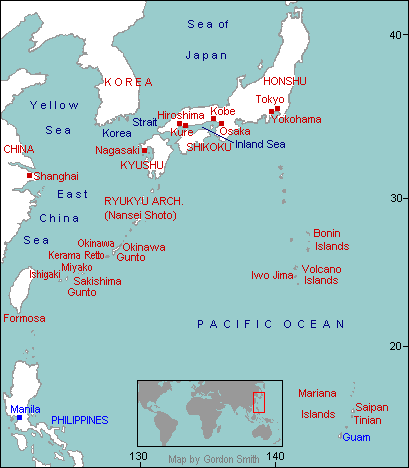
Iwo
Jima,
Volcano Islands -
With Adm Spruance now back in command of
Fifth Fleet, the next assault was on the tiny
island of
Iwo Jima, south of Japan, needed as an air base
to
support the USAAF strategic bombing campaign.
Landings
took place on the 19th, but before this eight
square mile
volcanic island was secured in mid-March, 6,000
US
Marines and most of the 21,000 defenders were
dead. On
the 21st, escort carrier "BISMARCK SEA"
was
sunk by
kamikaze attack offshore.
MARCH
1945
Indian
& Pacific Oceans
British Pacific
Fleet
- On the 15th, Adm Rawlings signalled
from Manus
to Adm Nimitz that the British Pacific Fleet was
ready to
join Adm Spruance's Fifth Fleet. Now known as
Task Force
57, battleships "King George V" and
"Howe", carriers "Illustrious",
"Indefatigable", "Indomitable" and
"Victorious", five cruisers including the New
Zealand "Gambia" and 11 destroyers, two
Australian sailed for Ulithi to refuel. On the 26th
they were on station off the Sakishima
Islands in the Ryukyu group. Their
mission
was to prevent the islands being used as staging
posts
for Japanese reinforcements flying from Formosa
to
Okinawa. BPF's main weapon was of course not the
battleships, but the Seafires and American-made
Avengers,
Hellcats and Corsairs of the carriers' strike
squadrons.
They started their attacks that day.
APRIL
1945
Atlantic
Russia/UK
Convoy RA66, the Last Convoy
Battle of the War - Kola
Inlet bound convoy JW66 (22 ships)
arrived safely on the 25th with escort
carriers
"Premier" and "Vindex", cruiser
"Diadem", Home Fleet destroyers and the 8th and
19th EGs all under the command of Rear-Adm A. E.
Cunninghame-Graham.
Indian
& Pacific Oceans
Okinawa,
Ryukyu
Islands
- Okinawa was the main island in the Ryukyu
group and
half way between Formosa and Kyushu. It was
needed as a
major base for the coming, bloodiest invasion of
all -
mainland Japan. The Japanese were committed to
defending
Okinawa for as long as possible and with maximum
use of
kamikaze attack. Under Adm Spruance and Fifth
Fleet, the
greatest amphibious operation of the Pacific war
started
on the 1st with US Tenth Army including both
Marines and
Army forces landing on the west side of the
island. There
was little opposition to start, but by the time
they had
taken the northern five-sixths of the island on
the 13th,
bitter fighting was raging in the south,
continuing
through April, May and into June. Air and sea
kamikaze
missions led to heavy losses on both sides. The
British
Pacific Fleet did not escape: 1st -
Operating off
the Sakishimas, "Indefatigable" was hit by a
suicide aircraft but saved
from serious damage by the armoured flight deck.
6th
- Japanese launched the first of 10 'kikusui'
(floating
chrysanthemum) mass kamikaze attacks which
carried on
until June. US losses in men and ships sunk and
damaged
were severe. On the 6th, British carrier
"Illustrious"
was
hit. Damage
was slight and she
continued in service, but this much-battered
ship was
shortly relieved by "Formidable". BPF continued
attacking the Sakishima Islands as well as
airfields in
northern Formosa, with short breaks for
refuelling. The
Fleet sailed for Leyte on the 20th to replenish.
Battle
of
the East China Sea - Giant
battleship "Yamato", a cruiser
and destroyers sailed on a one-way mission for
Okinawa.
Overwhelmed by carrier aircraft of Fifth Fleet
on the
7th,
"YAMATO",
the cruiser and four destroyers were sent to the
bottom
southwest of Nagasaki.
MAY
1945
Europe
4th
-
A Royal Navy task force consisting of escort
carriers
"Queen", "Searcher" and
"Trumpeter" with cruisers and destroyers and
under the command of Vice-Adm R. R. McGrigor
returning
from Murmansk, launched strikes against shipping
off
Norway, and "U-711" was sunk near Narvik.
Indian
& Pacific Oceans
2nd
- Landings Near Rangoon, Operation
'Dracula' - Under
the
naval command of Rear-Adm B. C. S. Martin, an
Indian
division was carried from Ramree island in
landing ships
and craft and put ashore at Rangoon, covered by
escort
carriers, cruisers and destroyers (Cdre G. N.
Oliver). At
the same time, diversionary attacks were made on
the
Andaman and Nicobar Islands by Vice-Adm H. T. C.
Walker
with battleships "Queen Elizabeth" and the
French "Richelieu" and aircraft from two escort
carriers. Rangoon was entered on the 3rd by the
Indian
landing force to find the Japanese gone. On the
6th they
met up with 14th Army units just a few miles to
the
north. The rest of the war was spent mopping up
the
Japanese unable to escape to Thailand.
Okinawa,
Ryukyu
Islands - As
the struggle for Okinawa continued, US Fifth
Fleet was
hit by four 'kikusui' attacks in May. By the
4th, BPF was
back off the Sakishimas and also under fire: 4th
-
"Formidable"
and
"Indomitable"
were
hit by one
aircraft each. 9th
- "Victorious"
was
damaged
and "Formidable"
hit again by a suicide aircraft. In all
cases the carriers' armoured deck allowed them
to resume
flight operations in a remarkably fast time. On
the 25th
the RN ships headed first for Manus to prepare
for the
next stage of the attack on Japan. In two months
the
aircraft of BPF had flown over 5,000 sorties.
JUNE
1945
Pacific
Ocean
British Pacific
Fleet -
The main body of the Fleet prepared to leave
Sydney to
join the US fleet, now the Third under Adm
Halsey. As
they did, newly arrived fleet carrier
"Implacable" with an escort carrier and
cruisers in support, launched raids on the
by-passed
island of Truk in the Carolines on the 14th and
15th.
Okinawa,
Ryukyu
Islands
- The fighting finally came to an end on the
22nd after
one of the bitterest of campaigns. More than
7,000 men of
the US Army and Marine Corps had been killed -
and nearly
5,000 men of the US Navy, mainly from kamikaze
attacks.
The Japanese lost well over 100,000 killed. USN
losses in
ships included five carriers badly damaged and
32
destroyer types, many on radar picket duty, sunk
or never
repaired. Over 7,000 Japanese aircraft were lost
from all
causes.
JULY
1945
Pacific
Ocean
British Pacific
Fleet
- Adm Rawlings, now with "King George V",
Formidable", "Implacable",
"Victorious" and six cruisers including the
Canadian "Uganda" and New Zealand
"Achilles" and "Gambia" joined Third
Fleet in mid-month to bombard Japan by sea and
air
through into August.
Japan - During
the
attacks on Japan the US Navy reserved the right
to finish
off the Imperial Japanese Navy and in massed
carrier
aircraft strikes on Kure destroyed battleship
"HARUNA", battleship/carriers "ISE"
and
"HYUGA",
carrier
"AMAGI" and
several carriers under
construction.
AUGUST
1945
Pacific
Ocean
Japan - As US
Third
Fleet and the British Pacific Fleet continued to
bombard
Japan, the Royal and Dominion Navies won their
last
Victoria Cross of World War 2. Lt Robert Gray
RCNVR,
Corsair fighter-bomber pilot with
"Formidable's" 1841 Squadron pressed home an
attack on shipping in Onagawa harbour,
north-eastern
Honshu on the 9th. Under heavy fire, he sank his
target
before crashing in flames and was posthumously
awarded
the Victoria
Cross.
27th - Ships
of
Third Fleet under Adm Halsey started to arrive
in Tokyo
Bay and anchored within sight of Mount Fuji.
Representative ships of the British Pacific
Fleet and
Dominion Navies included "Duke of York" (flying
the flag of Adm Fraser), "King George V",
carrier "Indefatigable", cruisers
"Newfoundland" and New Zealand
"Gambia" and two Australian destroyers.
SEPTEMBER
1945
Indian
& Pacific Oceans
Royal Navy -
As
ships of the Royal and Dominion Navies
repatriated Allied
prisoners of war and transported food and
supplies
throughout South East Asia, other surrenders
followed
during the next few days. 6th - On
board light
carrier "Glory" off the by-passed
Japanese stronghold of
Rabaul, Australian Gen Sturdee took the
surrender of the Bismarck
Archipelago, New Guinea and the Solomon
Islands. Local surrenders
in the
area took place on Australian warships.